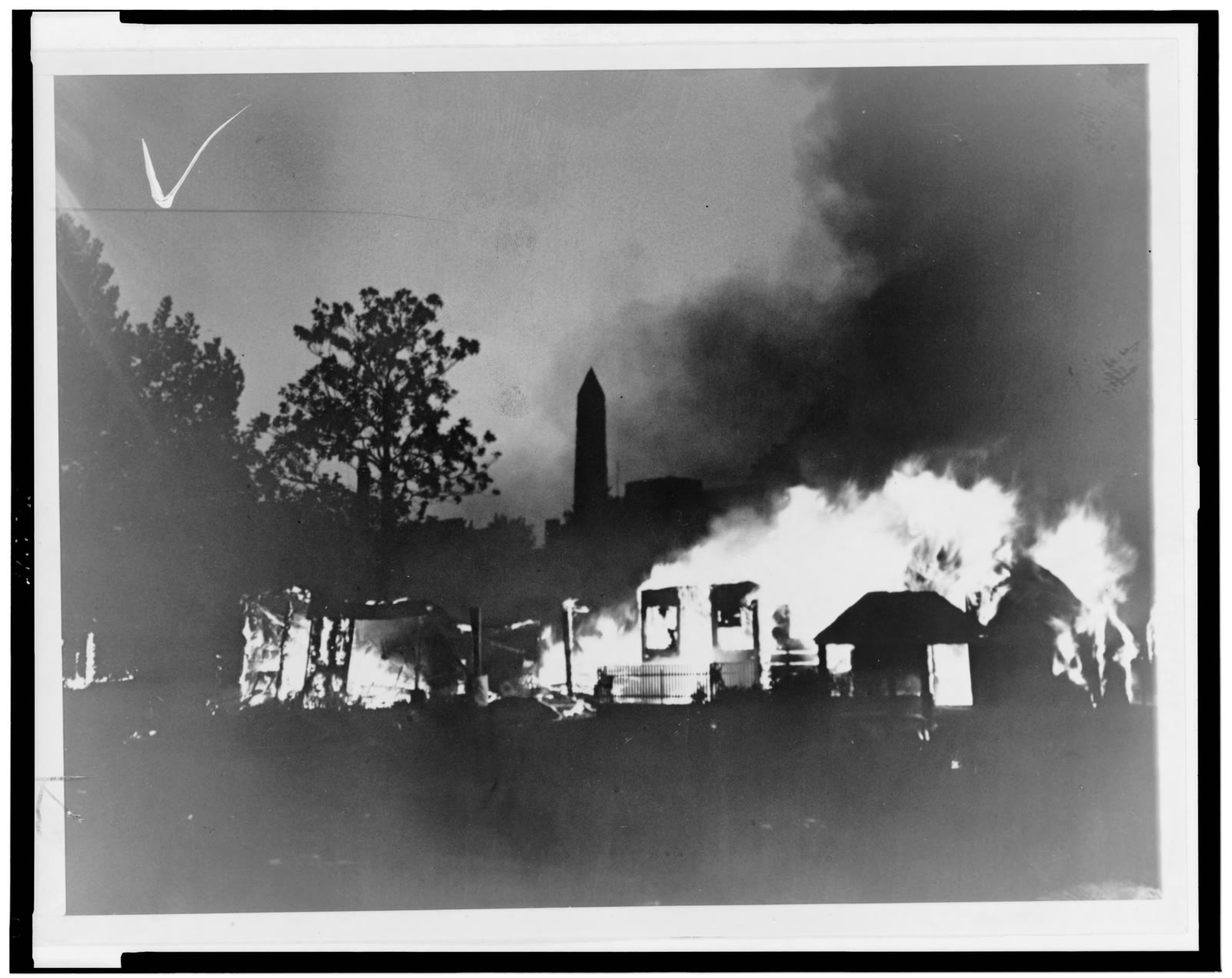
The Bonus Army is often remembered through one brutal image from the summer of 1932: smoke rising over Washington as troops clear out World War I veterans who had come to demand early payment of their service certificates.[2][5] That image is accurate, but it is still the end of the story. The sharper historical question is how a veterans' petition to Congress hardened into a semipermanent encampment, then into a police clash, and finally into a military spectacle that helped wreck Herbert Hoover's standing in an election year.[1][2][3][4]
The answer sits in sequence. The veterans were not driven from Washington the day they arrived.[1][3][4] Hoover at first tolerated the march and even allowed federal support in the form of rations, tents, cots, and medical supplies while the demonstrators stayed peaceful.[4] The real break came after the Senate's June 17, 1932 defeat of immediate payment, when the march stopped looking like a short pressure campaign and began to look, from the administration's perspective, like a residency problem in abandoned buildings and shanty towns.[1][4] Once Congress adjourned on July 16, and once city officials issued eviction orders, the government shifted from legislative delay to physical clearance.[1] Then, on July 28, police gunfire killed two veterans, Hoover called in the Army, and Douglas MacArthur expanded an eviction order into a nationally photographed rout.[1][2][5]
The cover image catches the point of no return.[5] Flames consume the Bonus Expeditionary Forces camp while the Washington Monument rises in the background. That matters because the Bonus Army backfired politically when it stopped being a budget dispute and became a public picture of the American state using troops, tanks, bayonets, and fire against its own veterans.[1][2][5]
Timeline anchors
- May 17, 1932: about 400 veterans gather in Portland, Oregon, under Walter W. Waters and begin the trip east.[2]
- June 1, 1932: roughly 1,500 veterans and family members are already in Washington, where they begin occupying multiple camp sites, including the large Anacostia Flats encampment later known as Camp Bartlett.[2]
- June 17, 1932: after a ten-hour debate, the Senate rejects immediate payment of the bonus by 62 to 18.[1]
- July 16-20, 1932: Congress adjourns; four days later, city officials issue eviction notice to Bonus Expeditionary Force leaders.[1]
- July 28, 1932: police attempting to clear downtown buildings open fire after violence breaks out, killing two veterans; Hoover calls in the Army; MacArthur's troops clear downtown and burn the main camp across the Anacostia.[1][2][5]
- 1936: Congress finally authorizes immediate payment of the certificates, overriding presidential resistance and closing the issue in the veterans' favor.[3]
1. The march reached Washington as a petition, not yet a crisis
The Bonus Army began in material desperation rather than in abstract ideology. The government had promised adjusted service certificates in 1924, but the certificates would not mature until 1945.[2][3] During the Depression, that delay became intolerable to many veterans who were unemployed, indebted, or unsure they would even live long enough to collect what they called the "tombstone bonus."[2][3] By May 17, 1932, Waters had gathered several hundred veterans in Portland, and their west-to-east train journey gave the movement a disciplined public face from the outset.[2]
When the first large groups reached Washington, they did not form one chaotic mob. They built camps.[1][2] The National Park Service account places the main sites at 12th Street and B Street NW, 3rd Street and Pennsylvania Avenue NW, and the broad encampment on the Anacostia Flats, a roughly 30-acre site that became the movement's symbolic center.[2] The Senate Historical Office adds a detail that matters for the political reading: by the height of the summer, more than 11,600 veterans lived in these encampments, and the camps were not male-only barracks but communities that included wives and children.[1] That meant the federal city was now hosting a visible, racially integrated veterans' town in the middle of the Depression.[1]
The administration's initial posture was more complicated than the later firestorm makes it seem. The Hoover Library notes that Hoover believed most of the marchers were honest veterans as long as they remained peaceful, and he quietly allowed assistance in the form of Army rations, tents, cots, and medical supplies.[4] At the local level, Pelham D. Glassford, Washington's police superintendent, treated the veterans more sympathetically than many other officials did and even asked Congress for $75,000 to feed them, though Congress refused.[2] In other words, the Bonus Army was not instantly framed as an insurrection. For several weeks it remained a tolerated petitioning presence in the capital, awkward and embarrassing for Hoover, but still within a recognizable democratic script.[2][4]
2. The Senate's June 17 vote changed the meaning of staying
The decisive political turn came when the veterans' pressure campaign failed in the Senate. The House had already passed immediate-payment legislation, which kept hopes alive and drew more men into Washington.[1][2] On June 17, veterans packed the Senate galleries while thousands more waited outside on the East Front Plaza.[1] The Senate Historical Office's reconstruction makes clear that the debate was not casual. It lasted ten hours and exposed a hard divide between fiscal restraint and moral obligation.[1]
The vote itself, 62 to 18, mattered for more than its lopsided margin.[1] It removed the short-term legislative target while leaving the veterans physically in place. Many did not disperse. Congress tried a narrower answer by permitting loans against the certificates to finance food and transportation home, yet few accepted it.[1] The veterans returned to the Capitol the next day, continued lobbying, and kept the camps alive.[1]
That changed the government problem from representation to duration. So long as Congress was in session, the Bonus Expeditionary Force could be treated as an intense, uncomfortable petitioning public. Once legislative relief failed and the camp persisted, Washington authorities had to decide whether the demonstrators were still constituents in temporary protest or occupants who now had to be removed from valuable urban space.[1][2][4] Vice President Charles Curtis was alarmed enough to call in Marines to the Capitol Crypt before revoking the order.[1] That aborted scene is revealing. It shows the state wavering between toleration and force well before the final confrontation.
3. After adjournment, an encampment became an eviction file
The next hinge came with congressional adjournment. The Senate Historical Office dates the break clearly: Congress adjourned on July 16, and four days later city officials issued eviction notice to Bonus Army leaders.[1] The administration's reasoning was administrative and political at once. With Congress gone, the Hoover team could say the veterans no longer had a legislative reason to remain in Washington.[1] At the same time, a building contractor with salvage rights to half-demolished structures on Pennsylvania Avenue threatened legal action over the government's failure to clear the occupied buildings.[1]
This is the middle layer that makes the July 28 violence easier to understand. The Bonus Army was no longer only a symbolic challenge to fiscal orthodoxy. It had become a land-use and public-order problem in the federal core.[1][2] Hundreds of women and children remained in the camps; more than eleven thousand veterans were still scattered through buildings and shanty settlements.[1] The administration now had to clear people, not merely defeat a bill.
Hoover's own public language hardened as the clearance question approached. The National Park Service article quotes his July 28 statement describing the remaining demonstrators as "so-called bonus marchers" and asserting that a considerable part of them were not veterans but Communists or people with criminal records.[2] That rhetorical shift matters. Once the White House leaned on the idea that the crowd had been contaminated by illegitimate elements, the moral distance required for force became easier to perform.
4. July 28 turned a clearance order into a military spectacle
The eviction itself did not begin as a cavalry charge. It began with an attempt to remove a smaller number of veterans from downtown buildings scheduled for demolition.[4] The Hoover Library recounts that Treasury officials moved against about forty occupants on the morning of July 28; when the veterans refused to leave, police were called in, the crowd swelled, and panic and violence followed.[4] The Senate Historical Office states the sequence starkly: the process began peacefully, bricks were thrown, police opened fire, and two veterans were killed.[1]
At that point Hoover made the fatal decision to call out the Army.[1][5] From the president's perspective, this was meant to prevent a riot and restore control in the capital.[1][4] The problem is that the event did not stop at the level of limited restoration. MacArthur arrived with infantry, cavalry, and tanks; the Park Service article puts 800 troops in the main force with an additional 2,700 held nearby in reserve.[2] The Senate story adds the most damaging symbolic fact: soldiers with fixed bayonets rounded up veterans and bystanders, emptied the Pennsylvania Avenue buildings, then crossed the Anacostia and burned the largest camp.[1]
That expansion mattered more than any single tactical decision. A government can sometimes clear squatters without lasting political trauma. It has a much harder time surviving front-page images of the Army routing World War I veterans from a shantytown under the Washington Monument's line of sight.[1][5] Once MacArthur's soldiers crossed the river and set the camp on fire, the administration lost control over the meaning of the action. Whatever legal distinction officials had in mind between federal buildings and private ground, or between veterans and alleged agitators, was swallowed by the spectacle.[2][5]
5. The backfire was political because the photographs settled the argument
The Bonus Army did not destroy Hoover because it proved immediate payment was fiscally easy. The sources do not support that. What the event destroyed was Hoover's ability to appear both orderly and humane in a depression presidency already associated with delay.[1][3][4] The Senate Historical Office says the next day's newspapers carried photographs of the Army routing its own veterans, and it ties the expulsion directly to electoral consequences in November 1932.[1] Hoover lost in a landslide, and 14 Senate incumbents were also defeated.[1]
The Library of Congress "Today in History" page is useful for the long arc because it shows how incomplete the July victory really was.[3] A second veterans' march came to Washington under Franklin D. Roosevelt in 1933; Congress eventually passed early-payment legislation in 1936; and the broader lesson fed into the later, far more constructive settlement of the GI Bill.[3] In that sense, July 28 solved nothing durable. It merely converted a social demand into an image of state failure.
That is the value of reconstructing the event step by step. The Bonus Army became a national humiliation when three clocks converged: the clock of deferred compensation promised for 1945, the clock of Depression desperation in 1932, and the clock of government impatience after Congress went home.[1][2][3][4] The police shooting supplied the immediate crisis. MacArthur's escalation gave the crisis its unforgettable form. The fire in the camp then fixed the meaning for the public. By the time the smoke cleared, the administration had won possession of the capital's ground and lost the argument about what kind of country it was governing.
Sources
- U.S. Senate Historical Office, "The Senate and the Bonus Expeditionary Force of 1932" - on the June 17 debate and 62-18 vote, the size and family character of the camps, the July 16 adjournment, the July 28 police clash, the burning of the camp, and the electoral consequences.
- U.S. National Park Service, "The 1932 Bonus Army" - on the Portland origin under Walter Waters, the June 1 arrival and camp geography, Glassford's relief request, Hoover's July 28 statement, and MacArthur's troop deployment.
- Library of Congress, "Today in History - July 28" - on the 1945 maturity of the certificates, the scale estimates for the Bonus Army, the July 28 confrontation, and the eventual 1936 early-payment legislation.
- Herbert Hoover Presidential Library and Museum blog, "Bonus Army" - on Hoover's initial tolerance of the marchers, the quiet provision of rations and supplies, the July 28 eviction attempt downtown, and the administration's view of the crowd.
- Library of Congress, "(Fire, set by U.S. Army, consuming camp of Bonus Expeditionary Forces; Washington Monument in background)" - source page for the archival photograph used as this article's cover image.