Near the end of Sarah Winnemucca Hopkins's 1883 autobiography, the reader receives an assignment. Copy the petition. Collect signatures. Send the lists to a house on Bowdoin Street in Boston. Mary Peabody Mann, the book's editor, supplies the address and a practical explanation: “the weight of a petition is generally measured by its length.”[1]
A life story has become a means of recruiting people to act. Winnemucca's Life Among the Piutes: Their Wrongs and Claims carries its audience through childhood, dispossession, war and government offices, then places a demand before Congress. The request concerns homes, land and the reunion of families. Reading sympathetically is only the beginning of what the book asks.[1]
For Winnemucca, finding listeners had become inseparable from a harder problem: getting promises carried out. Her work as an interpreter had taken her into rooms where officials could offer reassurance. Her campaign as an author would expose the distance between those assurances and what happened afterward.
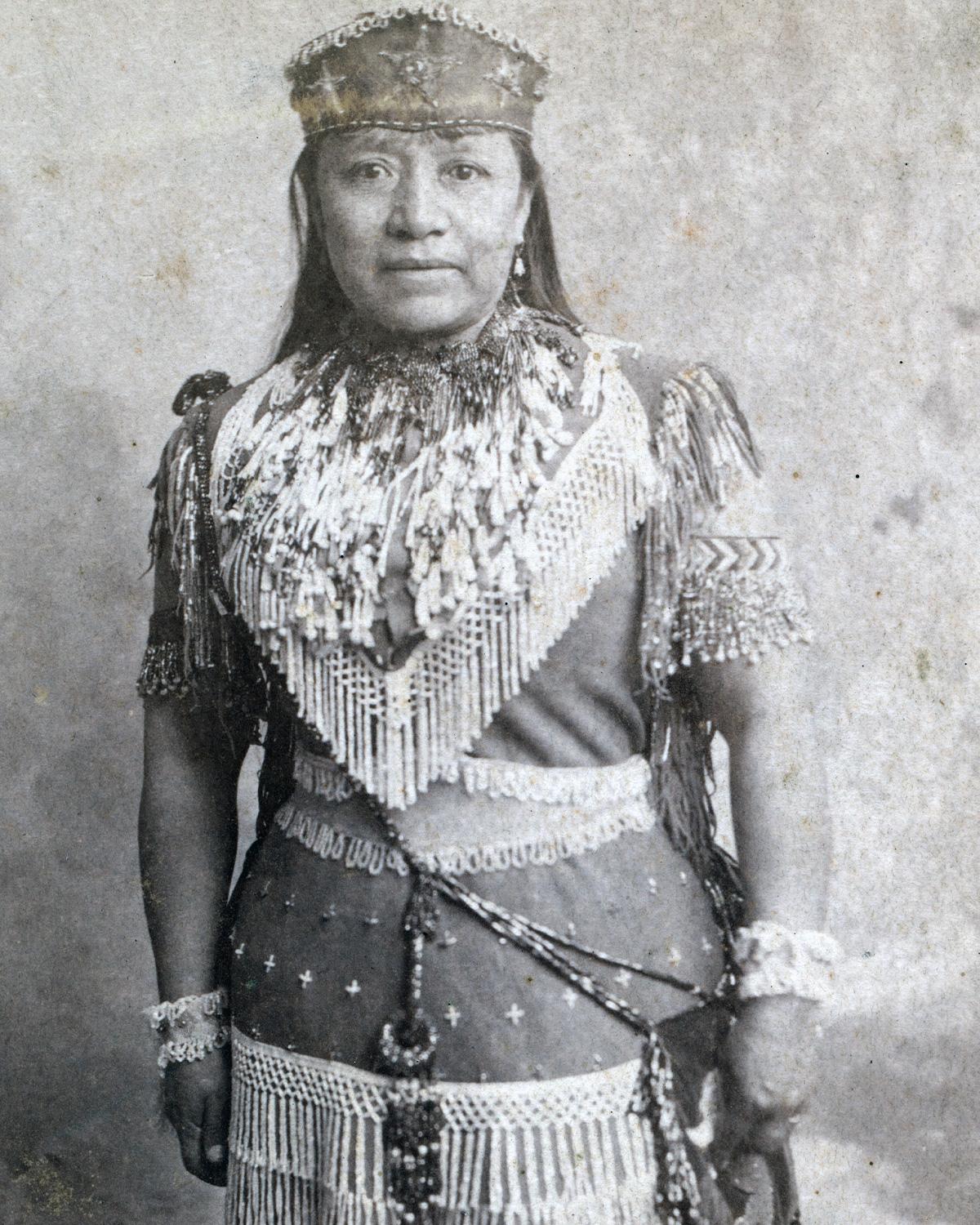
The interpreter carried the promise home
Born around 1844 in what became Nevada, Winnemucca learned English and Spanish while young. Her grandfather, Truckee, had sought friendly relations with incoming settlers. By 1866, members of her community were asking her to use her English to appeal to the U.S. Army against violence by settlers. Translation became a political responsibility: she could convey grievances to people with the power to respond.[2]
That position offered access without control. In the 1870s she worked with the Indian Office and military commanders, seeking supplies and protection for reservation residents. During the 1878 Bannock War, she served the Army as a guide and interpreter. A letter from General Oliver Otis Howard, reproduced in her book's appendix, praised her assistance and her care for women and children taken prisoner.[1][3]
Army service did not secure her people's position. After the war, Paiutes were removed from the Malheur Reservation in southeastern Oregon to the Yakama Reservation in Washington Territory; the removal included people who had remained peaceful. Families were separated. Winnemucca's relationships with officers existed within a government campaign that could still displace the people she sought to protect.[3]
In 1880, she travelled with a delegation to Washington. Her autobiography reproduces an order from Interior Secretary Carl Schurz allowing displaced Paiutes to rejoin relatives and outlining individual allotments at Malheur. Its qualifications mattered. The government would not pay transportation costs; legal authority still had to permit the promised land patents. Permission on paper left practical and legal obstacles in place.[1]
Winnemucca describes returning with expectations of assistance, then waiting for supplies while people went hungry. When she relayed instructions to travel to Malheur, she met disbelief. The shame in her account falls upon the messenger: she had carried government words home as something her community could trust. This is her retrospective testimony, written for a campaign, but its account of damaged credibility gives the failed promise a consequence beyond the administrative file.[1]
Making a record that could travel
By 1883, Winnemucca was addressing eastern audiences. Elizabeth Peabody and her sister Mary Mann helped support the lecture tour and the publication of her book. Winnemucca's husband, Lewis Hopkins, gathered material at the Library of Congress. The public campaign depended on her testimony and on people who could help that testimony circulate.[2]
Mann's preface explains why print mattered. A speaker could cover only a few points in one appearance; a book could hold more of what Winnemucca wanted to say. Mann described her editorial work as correcting spelling and punctuation, with occasional revisions by the author. That account identifies an editorial collaboration while preserving Winnemucca's responsibility for the argument.[1]
The volume does more than recount remembered encounters. It reproduces letters, official orders and endorsements. A reader can move from an assurance to evidence of its failure without depending entirely on the emotion of a lecture. The appendix, often the part of a book easiest to skip, becomes central to how this one makes its case.
Among its documents is July 1882 correspondence from the Interior Department. Officials argued that supplies existed for the Paiutes at Yakama and that funds were unavailable elsewhere. The printed instructions told the Warm Springs agent to send arriving Paiutes back and withhold food if they refused. Read beside the earlier permission to rejoin relatives, this instruction shows how control over provisions could restrict movement.[1]
Those documents also help explain Winnemucca's preference for particular military allies over reservation agents. Her book presents officers as witnesses who could support her accusations. It does not make the Army an institution outside the history of dispossession. Her strategy relied on finding assistance among people whose offices and loyalties did not necessarily serve the same ends as her own.[1][3]
An address for the reader's sympathy
The petition printed on page 247 named Malheur as a place where Paiutes could support themselves. It requested land held individually while maintaining tribal relationships, and specifically sought the return of people separated from their families. These were connected demands: a home required a means of living and the possibility of living together.[1][4]
Its language needs to be read as an appeal. The petition's expectation that citizenship and landholding would protect Paiutes from settler encroachment described the security Winnemucca sought. It did not establish that either protection had been delivered. Similarly, the promise of return in 1880 appeared in the petition as an obligation still unfulfilled.[1][4]
Mann's invitation then gave supporters a task small enough to undertake at home. A reader needed neither to travel west nor to become an expert witness. Copying the text and collecting names could extend the campaign beyond the people who heard Winnemucca speak. Sending the sheets to one Boston address gathered those dispersed acts into something that could be presented to Congress.
The surviving petition is dated 4 January 1884. Representative Ambrose Ranney of Massachusetts introduced it in the House on 24 January, and it went to the Committee on Indian Affairs.[4][5]
A hearing still left the land unsettled
Winnemucca appeared before a congressional subcommittee in April 1884. By then, her request had shifted toward land at Fort McDermitt on the Nevada–Oregon border, where she had worked as an interpreter. The House's historical account reconstructs this change from reporting on her testimony and supporting correspondence. It suggests she had become pessimistic about recovering Malheur; that motive remains an interpretation of the change, rather than a certainty supplied by the petition itself.[5]
On 12 May, Representative Robert S. Stevens introduced H.R. 6973 for Paiute relief. The bill died in committee. Signatures, allies and testimony had brought the claim into the legislative process without securing the requested outcome.[5]
After returning west, Winnemucca established a school for Paiute children, teaching in their language as well as English. It allowed children to remain with their families, but insufficient support eventually forced it to close. Her educational work continued the concern that runs through the petition: gaining useful resources while preserving relationships that removal and institutional control had threatened.[3]
The Bowdoin Street address captures both the ingenuity and the limits of her campaign. Winnemucca made an account of her life portable, gave readers evidence to examine, and asked them to attach their names to a demand. She could organize that passage from listening to participation. The next passage—from a petition received to a home restored—remained in other hands.
Sources
- Sarah Winnemucca Hopkins, Life Among the Piutes: Their Wrongs and Claims (1883), edited by Mary Peabody Mann — preface; pp. 223–226, 246–249 and 256–258; Newberry Library copy, digitized by Internet Archive.
- Wendi Maloney, “Native American Heritage Month: Celebrating Sarah Winnemucca,” Library of Congress, 2 November 2017 — early language learning, intermediary work, publication and assistance from Lewis Hopkins and the Peabody sisters.
- Nicole Martin, “Sarah Winnemucca,” National Park Service — interpreter work, removal, military relationships, public advocacy and the bilingual school; also reproduces and credits the 1883 portrait.
- U.S. House of Representatives, History, Art & Archives, “Sarah Winnemucca Hopkins Petition” — document dated 4 January 1884, Committee on Indian Affairs records, 48th Congress; National Archives holding.
- U.S. House of Representatives, History, Art & Archives, “Land of Misfortune: Sarah Winnemucca Petitions Congress,” 26 March 2018 — January introduction, April testimony, the Fort McDermitt proposal and the fate of H.R. 6973.
- U.S. Capitol Visitor Center, “Sarah Winnemucca Image Source List” — identifies Norval H. Busey's Baltimore portrait of 1883 and its National Portrait Gallery provenance.