A strange ship appears at sea. Those watching it approach fear capture, sale and a lifetime of enslavement. That imagined emergency opens the Germantown petition of 18 April 1688, which asks its Quaker readers to picture themselves in the position of the people they buy. Before the document offers an abstract principle, it makes freedom personal.[1]
The petition's sharpest turn comes a little later: “Here is liberty of conscience,” its authors write; there should also be “liberty of ye body.” Religious freedom in Pennsylvania becomes the premise of a demand that reaches beyond the settlers who enjoy it. The question is what happens when a community's cherished protection is applied to people that community holds in bondage.[1]
The surviving manuscript preserves an answer of sorts. Below its four signatures, other hands record decisions to send the matter onward. The argument travels. A decision to end the practice does not.[1][3]
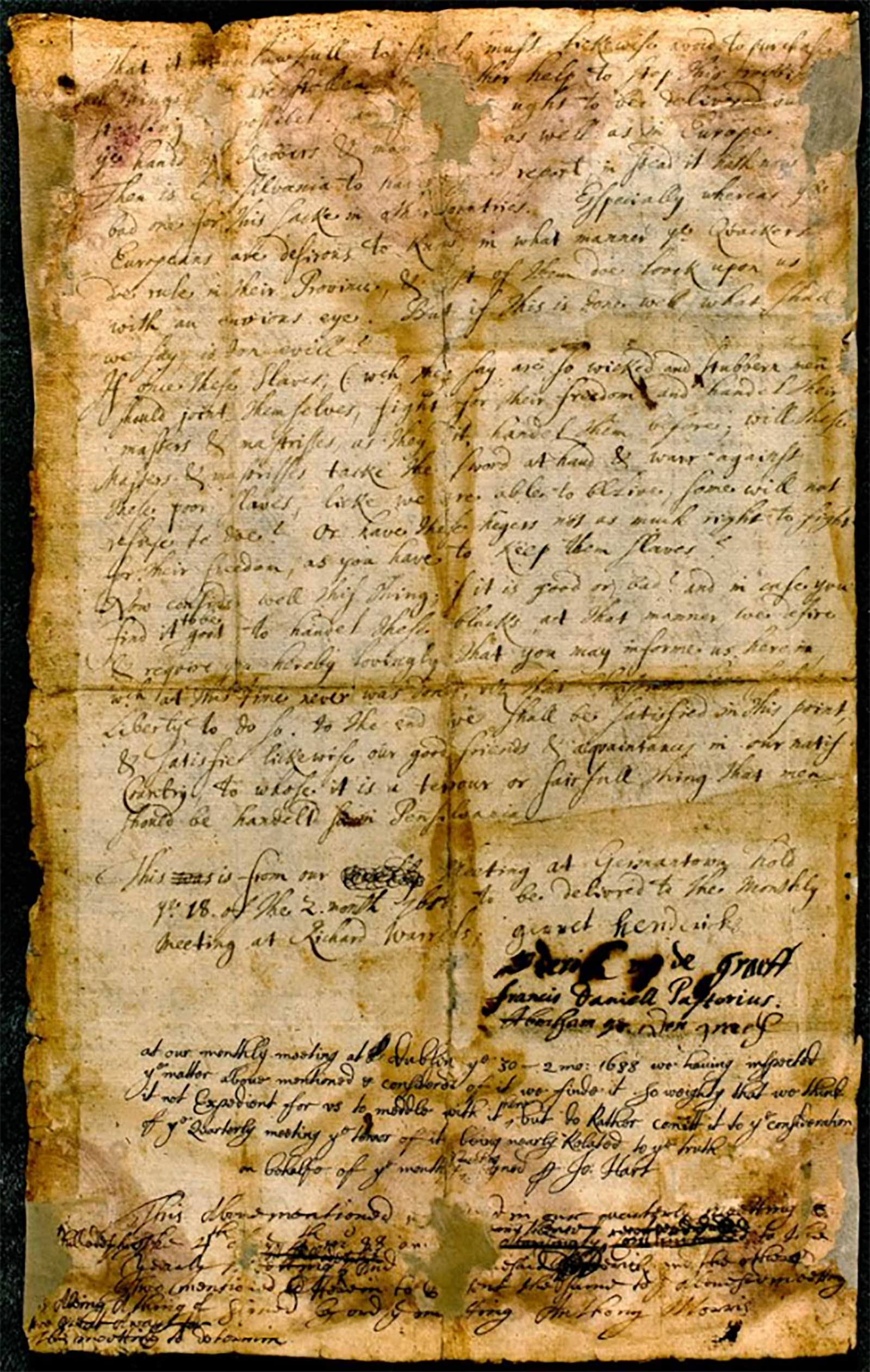
A familiar fear, turned around
Germantown's German and Dutch settlers had begun arriving in Pennsylvania in 1683. The four signers—Gerret Hendericks, Derick op de Graeff, Francis Daniel Pastorius and Abraham op den Graef—addressed their protest to a monthly meeting within the Quaker community. Their position was awkward: they belonged to its institutional world while bringing different linguistic and religious backgrounds to it. Historian Katharine Gerbner argues that these differences help explain the protest's unusual form and perspective.[1][2]
The opening invokes European fears of capture by people the text calls Turks. This is a rhetorical comparison, not a report of an encounter the signers had witnessed. Its force depends on an audience that already knows how to dread enslavement. The petition then asks why the same treatment should become permissible when the captives are Black and the purchasers Christian.[1]
Reciprocity does the argumentative work. The obligation to treat others as one would wish to be treated cannot, the petition insists, stop at differences of ancestry or colour. Readers are asked to carry their own expectation of safety across a boundary that their purchasing practices maintain.[1]
The document also refuses to let buyers stand at a comfortable distance from kidnapping. It places those who steal people beside those who purchase them and asks whether they share responsibility. A transaction at the end of a journey cannot, in this argument, make the coercion at its beginning disappear. The petitioners want their readers to stop buying and help secure the captives' release.[1]
Conscience has a body
The transition from conscience to body draws together two kinds of persecution. The authors point to Europeans oppressed for their religion and Black people oppressed in Pennsylvania. They ask a community familiar with religious vulnerability to recognize an obligation beyond its own membership.[1]
Their claim has a stated boundary. The sentence about bodily liberty makes an exception for wrongdoers. It does not propose the abolition of every form of confinement. Its immediate target is the seizure, transport and sale of people against their will. Keeping that qualification visible makes the petition's claim more precise without diminishing its challenge to racial enslavement.[1]
Family separation gives the argument another point of entry. The text describes spouses divided and children sold away. It then turns Christian teaching about marriage against the people arranging those separations. The authors treat enslaved families as relationships that impose obligations on others; an owner's power to sell cannot settle the moral question.[1]
This is why the repeated appeals to imagine the same treatment happening to the reader matter. They make a refusal of identification difficult to reconcile with the rule the reader professes. The petition does not need to invent a new commandment. It asks who has been excluded from an existing one.
The sword behind the sale
Near its end, the petition imagines enslaved people joining together and fighting for freedom. Would their owners take up weapons against them? And what makes the owners' claim to hold them stronger than their claim to escape?[1]
For Quaker readers, the prospect exposes a further contradiction: maintaining slavery might require the violence their religious commitments opposed. Gerbner places this passage within contemporary concerns about revolt and security. Moral reasoning and practical fear sit together here; treating the appeal as entirely detached from the settlers' interests would flatten it.[2]
The petition is equally explicit about reputation. Reports of Quaker slaveholding, it says, discourage people in Europe from migrating to Pennsylvania. The signers want an answer they can give friends and acquaintances overseas. That is their claim about the colony's reputation, not a count of migrants who stayed away. The text joins concern for enslaved people to concern about what Pennsylvania is becoming.[1]
Its courteous closing consequently has an edge. If the meetings consider this treatment acceptable, the signers ask them to explain why. The request places the burden of justification on those continuing the practice.
A question passed upward
On 30 April 1688, the monthly meeting at Dublin judged the subject too weighty to decide locally and referred it to the quarterly meeting. At Philadelphia on 4 June, that meeting likewise sent the question to the yearly meeting. Both responses survive beneath the petition's signatures.[1]
The yearly meeting at Burlington on 5 September declined to deliver a positive judgment because the issue concerned other places as well. These responses acknowledge a matter of considerable consequence while leaving its central demand unanswered. They record deferral, rather than a reasoned rebuttal of the petitioners' case.[3]
It would be tempting to make this journey the opening scene of an inevitable institutional conversion. The evidence does not support that tidy sequence. Gerbner emphasizes that the petition remained unpublished and largely forgotten until its recovery in 1844; its later prominence should not be mistaken for an immediate change in Quaker policy.[2]
There were continuities, however. In a later study, Gerbner identifies Abraham op den Graeff's involvement in the 1693 antislavery Exhortation, connecting a signer of this manuscript to another protest that reached print. Institutional inaction did not mean that the petitioners' work simply ended.[5]
Philadelphia Yearly Meeting eventually made slaveholding a disownable offense in 1776, according to Haverford's account of its manumission records. That meant a member could lose recognition as belonging to the meeting. The decision belongs to a much longer history of opposition, resistance and institutional change. The dates alone cannot make the 1688 document its cause.[4]
Read at its own scale, the petition remains demanding. It identifies a contradiction, makes ordinary transactions part of it, and asks the people benefiting from those transactions for an answer. The ink beneath the signatures preserves how an institution received that challenge: it recognized the weight of the question and passed it on.
Sources
- National Park Service, “Germantown Friends’ First Protest Against Slavery, 1688” — manuscript reproduction and transcription, including the monthly and quarterly meeting responses; Haverford College Quaker & Special Collections, HC.MC-975-11-055.
- Katharine Gerbner, “‘We Are against the Traffik of Men-Body’: The Germantown Quaker Protest of 1688 and the Origins of American Abolitionism,” Pennsylvania History 74, no. 2 (2007), pp. 149–172, especially pp. 150–152 and 156–159 — historical context, rhetoric, practical interests and later reception; author's hosted copy.
- Arch Street Meeting House, “1688 Germantown Quaker Petition Against Slavery” — transcription of the yearly meeting's response at Burlington on 5 September 1688 and the document's subsequent archival history.
- Haverford College Libraries, “About: Manumitted—The People Enslaved by Quakers” — background on Quaker slaveholding, institutional inaction in 1688, and Philadelphia Yearly Meeting's 1776 decision.
- Katharine Gerbner, “Antislavery in Print: The Germantown Protest, the ‘Exhortation,’ and the Seventeenth-Century Quaker Debate on Slavery,” Early American Studies 9, no. 3 (2011), pp. 552–575 — authorial connections between the 1688 protest and the 1693 Exhortation; author's hosted copy.