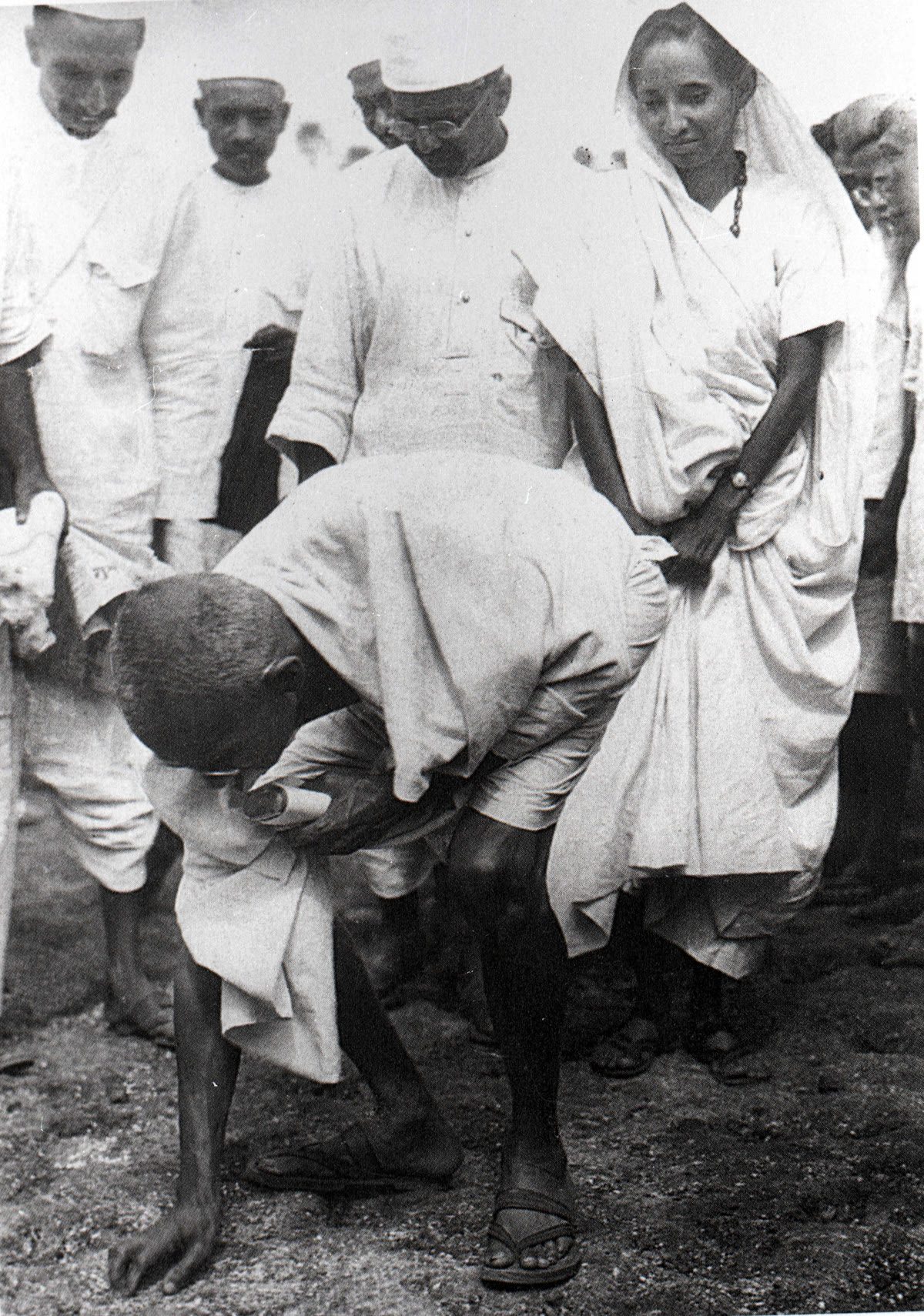
The Salt March is easy to reduce to a single iconic scene: Mahatma Gandhi stooping on the shore at Dandi in early April 1930, lifting salt in defiance of British law.[2][4][6] The scene deserves its fame, but by itself it can make the event look too sudden, almost like a miracle performed on a beach. The harder historical question is how a march aimed at something as ordinary as salt turned into one of the decisive escalations of the Indian independence movement. Reconstructing the event step by step makes the mechanism clearer. The campaign did not rely on one dramatic confrontation. It worked because Gandhi built a sequence that moved from constitutional disappointment to public ultimatum, from Sabarmati Ashram to a long village route, from a symbolic breach at Dandi to a form of civil disobedience that millions could imagine repeating for themselves.[1][2][3][4][5]
That sequence gave the march its political force. Salt was not chosen because it was trivial. It was chosen because it was basic, taxed, monopolized, and used by nearly everyone.[1][4] A campaign built around salt could make empire look intrusive at the scale of daily life. Once the protest moved on foot through village after village, the issue stopped being a debate among elites and became a public rehearsal in which the body of the marcher, the route, the speeches, and the final illegal act all reinforced one another.[2][5]
Timeline anchors
- 30 January 1930: Gandhi publishes his eleven demands, framing grievances against British rule before the civil-disobedience campaign is launched.[1]
- 2 March 1930: Gandhi writes to Lord Irwin, explaining why he intends to break the salt law and effectively issuing an ultimatum.[1]
- 12 March 1930: Gandhi leaves Sabarmati Ashram at 6:30 a.m. with seventy-eight satyagrahis, beginning the march to Dandi.[2][5]
- 12 March to 5 April 1930: the march proceeds through Gujarat in stages, with halts, speeches, river crossings, and rest days that widen its audience.[2][5]
- 5 April 1930: the marchers arrive at Dandi.[2][5][6]
- 6 April 1930: Gandhi breaks the salt law at Dandi, beginning the broader Salt Satyagraha.[2][4][5]
- 5 May 1930: Gandhi is arrested as the campaign continues beyond the original march route.[3]
These dates matter because the Salt March was not a march only. It was a carefully paced transfer from argument to action. Each step prepared the next one.[1][2][3]
1. The march began as an answer to a failed constitutional sequence
The event makes most sense when placed against the political frustration of the late 1920s. The Gandhi Heritage Portal chronology shows the buildup through the failed constitutional negotiations around the Nehru Report, the Lahore Congress declaration of complete independence, Gandhi's eleven demands, and finally the 2 March 1930 letter to the viceroy.[1] That letter mattered because Gandhi did not begin with a surprise assault on state authority. He first named grievances and explained why salt would be the chosen line of breach. The point was to make the coming illegality look argued, not impulsive.[1]
This is the first part of the reconstruction that often gets lost. By the time Gandhi began walking on 12 March, the campaign already had a political script. The empire had been given an opportunity to respond. It declined to yield. That refusal made the march appear less like agitation for agitation's sake and more like a public transfer from petition to disciplined noncooperation.[1] In that sense, the Salt March drew strength from failure. The British state had not simply imposed a tax; it had also shown that constitutional negotiation would not satisfy the Congress demand for real self-government on meaningful terms.[1][4]
Salt was the ideal hinge between these two stages. The Britannica summary emphasizes the monopoly and heavy tax burden on a substance used across the population.[4] Gandhi's choice therefore fused moral clarity with tactical reach. A protest over a legislature or a technical tariff could remain abstract. A protest over salt traveled at once into kitchens, markets, and village talk. The object of protest was humble, but that humility was the point. It let the campaign say that colonial power was not distant. It sat in the grain of ordinary life.[1][4]
2. From Sabarmati to Dandi, the route turned protest into a moving public theater
The march itself was not a dash to the coast. The route page on the Gandhi Heritage Portal lays out the stages day by day: Aslali on 12 March, then Bareja, Navagam, Matar, Nadiad, Anand, Borsad, Jambusar, Broach, Surat, Navsari, Matwad, and finally Dandi on 5 April.[2] Rest days broke the pace in places such as Anand, Samni, and Delad.[2] The effect was cumulative. The campaign took time on purpose.
That pace mattered politically. A fast clandestine breach of the salt law might have produced a headline, but it would not have built the same constituency. By walking through Gujarat over more than three weeks, Gandhi and the seventy-eight marchers converted the route into a stage of repetition.[2][5] Each arrival created another crowd, another speech, another chance to connect salt with broader themes of swaraj, discipline, village reform, and nonviolence.[5] The march was therefore both protest and pedagogy. It taught people how to watch, how to gather, and eventually how to imitate.
The mkgandhi.org account preserves this sense of enlargement. It notes that the journey took twenty-five days, involved speeches across dozens of villages and towns, and stirred enthusiasm well beyond the core band of marchers.[5] This widening audience is essential to the event reconstruction. The Salt March became powerful because it stayed visible long enough for spectatorship to turn into expectation. The marchers were not sneaking toward Dandi. They were announcing the breach in advance and letting anticipation accumulate from stop to stop.[2][5]
There is a second layer here as well. The march displayed discipline as a political argument. Its regular departures, evening halts, river crossings, prayers, and public addresses suggested that nonviolent resistance could operate with order rather than chaos.[2][5] That was crucial in a colonial setting where the state could present dissent as disorder. The route made a counterclaim: disciplined lawbreaking could be more morally coherent than the law it was breaking.
3. Dandi mattered because the breach was small, legible, and repeatable
When the marchers reached Dandi on 5 April 1930, the event did not climax in a battle.[2][5][6] The decisive act came the next morning, 6 April, when Gandhi picked up natural salt and thereby broke the law.[2][4][5] In one sense the act was almost absurdly modest. No fortress was stormed. No office was seized. That modesty is exactly what gave the event its unusual reach.
The Salt March worked by making illegality technically simple. The Britannica account stresses that Gandhi and his followers broke the law by picking up handfuls of salt along the shore, thus "producing" salt outside the monopoly.[4] The mkgandhi.org narrative goes further, showing Gandhi immediately urging people elsewhere to make salt freely and continue the struggle until the law became unenforceable in practice.[5] Here the campaign crossed a critical threshold. Up to Dandi, the march had been a visible procession centered on Gandhi. At Dandi, it became an instruction.
This is why the lead photograph matters.[6] It captures a moment whose force lies in its scale. Gandhi's gesture was not designed to impress because it was grand. It was designed to persuade because it was copyable. A subject population could look at that scene and understand that empire had placed one of its claims on something elemental and that disobedience could begin with a movement of the hand.[4][5][6]
In event-reconstruction terms, Dandi was the hinge between representation and diffusion. Before 6 April, the march represented a challenge. After 6 April, it authorized replication. That is how an action at the seashore became a national political form.[2][5]
4. The march's real endpoint was not the beach but the widening cycle that followed
Treating Dandi as the ending misreads the campaign. The post-march chronology on the Gandhi Heritage Portal makes clear that the story continued through expanding civil disobedience and Gandhi's 5 May 1930 arrest.[3] The original march had done its work by then: it had created a moral script, a public audience, and a reproducible tactic. Once that infrastructure existed, the government faced a broader problem than one illegal act on one beach.
That helps explain why the Salt March became such a durable symbol in the independence struggle. Its power did not rest on immediate institutional transfer. British rule did not collapse in April 1930. What changed was the scale and intelligibility of defiance. The march taught people to see the salt monopoly not as a technical administrative arrangement but as an everyday sign of alien rule.[1][4][5] It also taught them that civil disobedience could move from elite declaration to bodily practice without losing strategic coherence.
The aftermath sharpened the stakes. Once Gandhi was arrested on 5 May, the state re-entered the story in a more openly coercive form.[3] But arrest did not cancel the march's political logic. It confirmed that the campaign had moved beyond a petitionary performance. The sequence from ultimatum to march to breach had already succeeded in placing the Raj in an awkward position: tolerate widening illegality or suppress a movement whose discipline and visibility had attracted broad sympathy.[1][3][4]
This is the event's deeper historical shape. The Salt March did not win because salt was the largest grievance under empire, and it did not matter because Dandi was the only place where people broke the law. It mattered because Gandhi built an escalation that could be understood at every level: by the viceroy reading a letter, by villagers lining a road in Gujarat, by newspaper readers encountering the image from Dandi, and by Indians elsewhere deciding that the breach could be reenacted in their own locality.[1][2][4][5][6]
Seen this way, the Salt March was a choreography of political transfer. It moved opposition from document to road, from road to shore, and from shore into mass practice. That is why the event remains so large in historical memory. It made colonial rule answer not an abstract doctrine, but a household substance carried to the center of national politics.
Sources
- Gandhi Heritage Portal, "Background to the Salt Satyagraha" - chronology of the failed constitutional sequence, Gandhi's eleven demands, the 2 March 1930 letter to Lord Irwin, and the decision to launch civil disobedience through the salt law.
- Gandhi Heritage Portal, "The March" - day-by-day route of the Salt March from Sabarmati to Dandi, including departure time, halts, rest days, river crossings, arrival on 5 April, and the 6 April salt-law breach.
- Gandhi Heritage Portal, "Events Post March" - chronology of the campaign after Dandi, including the continuing Salt Satyagraha and Gandhi's arrest on 5 May 1930.
- Encyclopaedia Britannica, "Salt March" - overview of the British salt monopoly, the 240-mile march from Sabarmati to Dandi, and the 6 April 1930 breach that widened into a broader civil-disobedience campaign.
- mkgandhi.org, "Dandi March" - detailed narrative of the march's start, its village speeches and twenty-five-day progress, the arrival at Dandi, and Gandhi's call for wider salt-law defiance after the ceremonial breach.
- Wikimedia Commons, "File:Gandhi at Dandi 5 April 1930.jpg" - archival image source page identifying Gandhi at Dandi with Manilal Gandhi and Mithuben Petit at the end of the march.
Editor’s Pick Review
This pick wins the standard slot because it turns a familiar icon into an unusually clear mechanism. The article does not lean on Gandhi-at-Dandi as inherited symbolism; it reconstructs the transfer chain from ultimatum to route discipline, from village theater to a small act of lawbreaking that could be copied across India. The evidence base is tight, the timeline anchors are doing real explanatory work, and the prose keeps the household scale of salt connected to the political scale of empire without flattening either one.
It also clears the updated image gate cleanly. The archival Dandi photograph is immersive, topic-grounded, and documentary rather than analytical; it shows the precise gesture the essay explains. The Chinese version is publication-grade, with natural historical narration, stable terminology around satyagraha/civil disobedience, and a rhythm that preserves the article’s staged escalation rather than reading like a literal transfer.