Hoover Dam is easy to remember as a finished object: a smooth concrete curve, a mastered river, a machine-age monument in the desert. That memory hides the harder historical question. In the early 1930s, the real problem was not whether Americans could imagine a giant dam. It was whether a giant dam on the lower Colorado could be made administratively fundable, physically accessible, and materially stable all at once.[1][3][4][5]
That is why the strongest way to read Hoover Dam is as a workflow rather than a wall. The project worked because planners and builders turned four different bottlenecks into one coordinated sequence. First, the Boulder Canyon Project had to justify itself as a multi-purpose federal project whose repayment would lean heavily on commercial power sales.[1][4][5] Second, the Colorado River had to be pushed out of the work zone through four diversion tunnels so crews could reach a dry foundation.[1][3] Third, the site had to be converted into a nonstop logistics system of rail spurs, batch plants, cableways, and labor discipline that could move concrete faster than desert heat could ruin it.[1][2][3] Fourth, engineers had to solve the internal heat of mass concrete by abandoning the fantasy of one enormous pour and cooling the structure block by block with embedded pipes.[1][2]
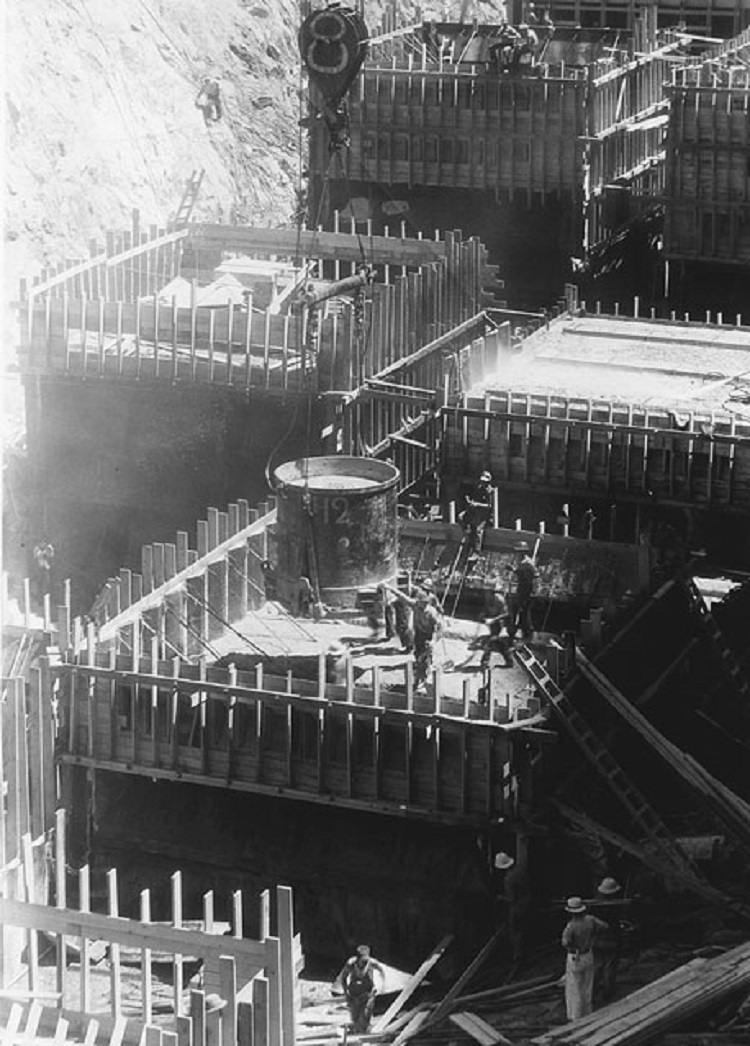
Image context: the cover uses a Bureau of Reclamation construction photograph reproduced by the National Park Service's Hoover Dam teaching page.[3][6] It is the right image for this article because it shows the dam at the level where the explanation lives: not as a completed symbol, but as a repeated operation of forms, workers, scaffolding, and fresh concrete moving through an engineered sequence.
Timeline anchors
- December 21, 1928: President Calvin Coolidge signs the Boulder Canyon Project Act, authorizing a lower Colorado dam, the All-American Canal, and a project structure built around flood control, water storage and delivery, navigation, and electric generation.[1][3][5]
- March 11, 1931: Six Companies wins the construction contract with a bid of nearly $49 million, then the largest construction contract the federal government had yet awarded.[3][5]
- June 1931 to November 1933: tunnel excavation proceeds through Black Canyon as crews drive four diversion tunnels through the canyon walls.[3]
- November 14, 1932: two finished tunnels begin carrying the Colorado around the site, allowing the riverbed to be isolated by cofferdams.[3]
- June 6, 1933: the first bucket of concrete is placed in the dam itself.[1][2]
- February 1, 1935: a bulkhead closes one diversion tunnel and water begins backing up into what becomes Lake Mead before the final concrete is poured.[1][3]
- May 29, 1935: the last bucket of concrete is poured, with the project finished ahead of schedule.[2][3]
1. The project first had to become financially legible as a federal power-and-water machine
The Hoover Dam story usually begins at the canyon rim, but the deeper mechanism starts in Washington and across the Colorado River Basin.[1][5] Reclamation's long project history makes clear that lower Colorado development had been politically stalled for years by interstate conflict, eastern skepticism, and hostility to the federal government entering the power business.[1] The 1922 Colorado River Compact and the 1928 Boulder Canyon Project Act did not merely authorize a big dam in the abstract. They assembled the political frame in which a big dam could look repayable, multipurpose, and regionally defensible.[1][5]
That financing logic matters because it shaped the entire project. The National Park Service's hydropower history notes that Hoover marked a new era in which cost recovery pivoted on maximizing commercial electricity sales, to the point that the statute required a powerplant suitable for the "fullest economic development of electrical energy."[4] In practical terms, this meant the dam was not justified as scenic grandeur or even flood control alone. It was built as a combined water-storage and power machine whose electrical output would help make federal capital appear rational.[4][5]
That is a more precise explanation for why Hoover became such a landmark in federal infrastructure history. The project solved a balance-sheet problem before it solved a concrete problem. Water storage, flood control, irrigation delivery, municipal growth, and electric generation were bundled together so that one project could do enough jobs to survive politics.[1][4][5] Once that bundle held, design and construction could move from argument to execution.
2. The river had to be moved before the dam could exist
No amount of engineering bravado could change the most basic physical fact: crews could not build a masonry mass in the middle of a live Colorado River channel.[1][3] So the first real construction victory was not the dam body. It was site clearance at continental scale.
The National Park Service's Hoover Dam teaching resource lays out the sequence plainly. Four tunnels were driven through the canyon walls, two on each side, to reroute the river around the future dam site.[3] Excavation ran for more than two years, from June 1931 to November 1933, in extreme heat and dust.[3] Reclamation's history page adds the dimensions that make the feat legible: four diversion tunnels, each 56 feet in diameter, with a combined length of nearly three miles, later lined with 36 inches of concrete.[1] Only after two of those tunnels were ready could workers dump excavated rock and gravel into the river to form the temporary cofferdam that began diverting flow on November 14, 1932.[3]
This is the first place where Hoover stops looking like a single-object history. The project did not advance in a straight line from survey to pouring. It advanced by manufacturing a temporary river system. The tunnels were not peripheral preliminaries. They were the condition of possibility for everything downstream: the dry riverbed, the shaped abutments, the foundation excavation, and later the reuse of tunnel infrastructure for spillways, outlet works, and controlled releases.[1][3]
The labor system inside that river-moving phase was equally important. High scalers stripped loose rock from the canyon walls; jumbos accelerated drilling; workers tolerated summer tunnel temperatures that the NPS page describes as reaching 140 degrees in places.[3] What looks in hindsight like heroic imagery was, in operational terms, a way of stabilizing the work envelope. The canyon had to stop shedding rock, the tunnels had to stop being raw excavation and become finished conduits, and the foundation had to become trustworthy enough to carry more than 41 billion tons of future load.[1][3]
3. Once the riverbed was dry, time became the enemy inside the concrete itself
Hoover Dam's most famous technical fact is the one that sounds almost mythical: if the structure had been poured as one continuous mass, Bureau of Reclamation engineers calculated that it would have taken about 125 years for the concrete to cool to ambient temperature.[2] The importance of that number is not its size alone. It explains why the builders had to reject the naive image of a giant monolithic pour.
The dam rose instead as a field of interlocking blocks.[1][2] Reclamation's detailed history says the blocks were placed in 5-foot lifts, with strict limits on how quickly any one block could rise relative to its neighbors.[1] The concrete essay explains why. Each form contained thin-walled steel cooling coils. River water circulated through the pipes for initial cooling, then refrigerated water finished the job before joints were pressure-grouted and the blocks were knit into a single structural whole.[2] The dam became monolithic only after spending much of its birth as a disciplined archipelago of cooling units.[1][2]
That design choice immediately created a logistics problem. Concrete had to reach the forms before it began to set. Reclamation describes two onsite plants, including a fully automated high-mix plant on the canyon rim that could turn out 24 cubic yards every three and a half minutes.[2] Fresh concrete moved by rail, then by cableway, then by bottom-dump bucket into place.[1][2] Crews of puddlers spread it through forms while vibrators chased out voids.[2] In other words, the cooling solution only worked because the transport solution worked. Hoover could not have been saved by clever thermal theory alone. The cure for cracking depended on keeping an enormous quantity of material moving through the canyon at industrial tempo.[1][2]
This is the central mechanism of the whole project. Diversion made pouring possible. Power-finance made the project politically durable. But block cooling linked design to construction in a way that turned an impossible mass into repeatable work. Hoover Dam succeeded because its builders made the properties of concrete govern the organization chart, the rail schedule, the cableway network, and the pace of crews on the forms.[1][2][3]
4. The dam finished early because the pieces reinforced one another
Many accounts celebrate Hoover for being completed ahead of schedule, with the last concrete poured on May 29, 1935.[2][3] The more interesting historical question is why the schedule held at all during the Depression, in a brutal desert environment, at unprecedented scale.
Part of the answer sits in organization. Reclamation's history notes that the job was too large for a single contractor and helped normalize the joint-venture form through Six Companies.[1] Part sits in federal provisioning. Boulder City, rail access, hospitals, dormitories, and mess arrangements were not social footnotes. They were throughput infrastructure for labor.[3] Part sits in the technical reuse of prior work. Once diversion tunnels existed, they did not vanish from the story; they were folded into spillway and outlet systems, meaning the temporary works became part of the permanent machine.[1][3]
Most of all, the project advanced because each solution reduced pressure on the next stage instead of creating a new contradiction. Hydropower finance justified scale.[4][5] Diversion tunnels created dry access.[1][3] Dry access allowed proper excavation and foundation work.[1][3] Foundation work enabled block-by-block pouring.[1][2] Block pouring only succeeded because rail, cableways, and batch plants kept fresh concrete arriving on time.[1][2] Cooling pipes then let those blocks harden without self-destruction.[2] Hoover Dam did not emerge from one masterstroke. It emerged from a chain in which political design, temporary river control, labor organization, transport, and thermal management kept handing off to one another without breaking.
The sharper conclusion
Hoover Dam deserves its reputation as an engineering wonder, but "wonder" is an incomplete historical category.[1][3] It makes the project sound as if size alone did the work. A more exact reading is that Hoover became buildable when its backers and builders stopped treating it as one giant problem and began treating it as four linked operating problems: repayment, diversion, delivery, and cooling.[1][2][4][5]
That is why the dam still matters as history rather than merely as scenery. It shows how twentieth-century public works succeeded when states could bundle political legitimacy, finance, temporary works, and material science into one continuous construction regime. The finished wall at Black Canyon is the visible result. The real historical achievement was the sequence that made pouring the wall possible at all.
Sources
- Bureau of Reclamation, "Hoover Dam" - project history covering the Boulder Canyon Project Act, diversion tunnels, block sequencing, cooling experiments, and long-term significance.
- Bureau of Reclamation, "Concrete" from The Story of Hoover Dam - on batch plants, cableways, block pours, the 125-year cooling problem, and embedded cooling coils.
- National Park Service, "The Greatest Dam in the World: Building Hoover Dam" - timeline and construction narrative covering Six Companies, tunnel excavation, cofferdams, labor conditions, and the last concrete pour.
- National Park Service, "Hydroelectric Power and the Bureau of Reclamation" - on Hoover Dam as a new era in multi-purpose federal hydropower and repayment through commercial electricity sales.
- National Park Service, "Nevada and Arizona: Hoover Dam" - overview of the project's statutory goals, contract, arch-gravity design, and role in southwestern growth.
- Bureau of Reclamation, "Historic Views" photo gallery - source page for the Bureau of Reclamation construction photograph used as this article's image.