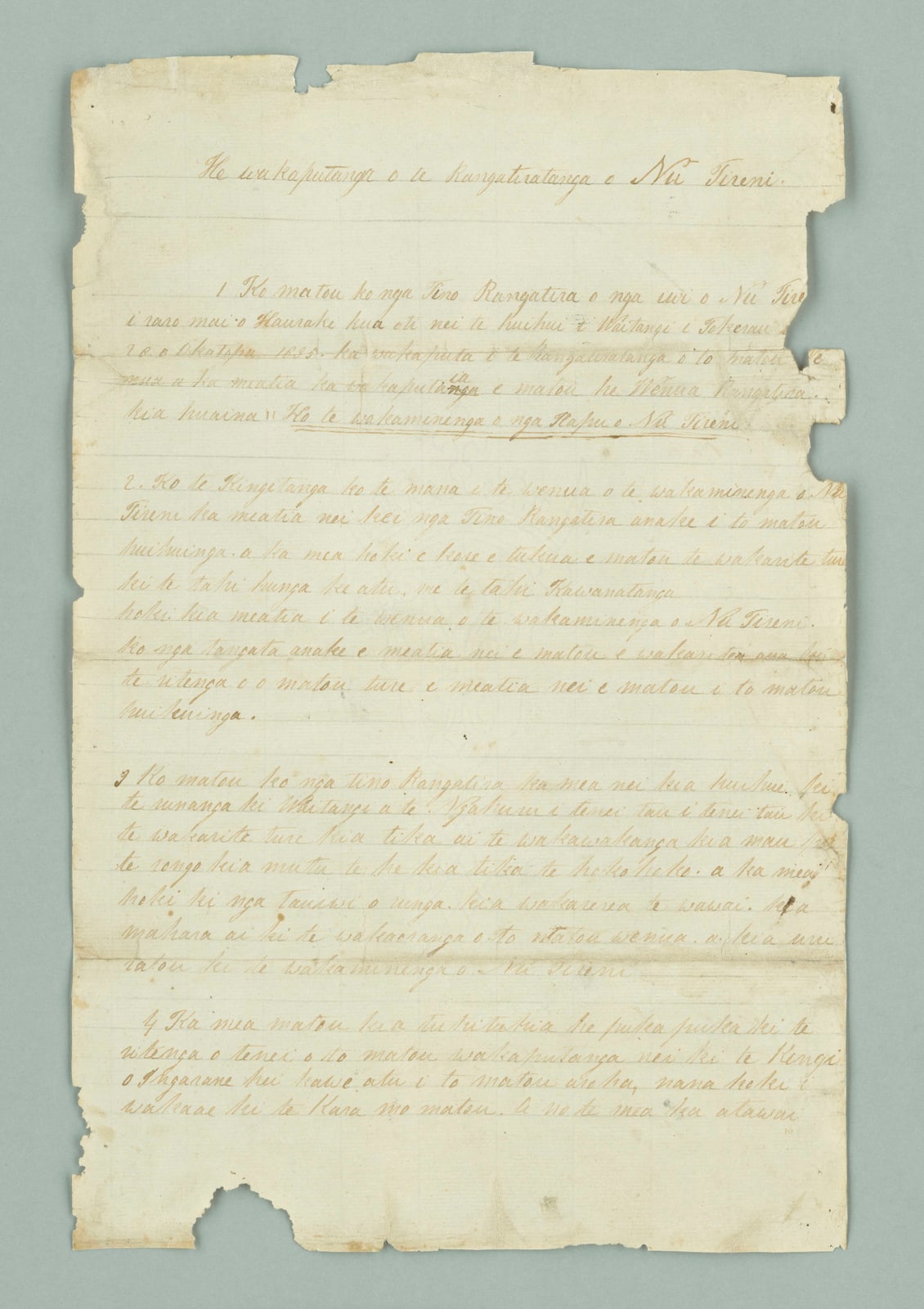
The puzzle sits on one sheet—the worn first manuscript page reproduced above.[1][5] In article 2 of He Whakaputanga o te Rangatiratanga o Nu Tireni, rangatira reserve kīngitanga and mana i te whenua to themselves and refuse unauthorized lawmaking or government in their territories. In article 4, they ask the British king to act as matua and protect their rangatiratanga. Read only through the English words “parent” and “infant State,” that final request can look like a retreat from independence. Read in sequence, in the Māori text that rangatira debated and signed, it does something more exact: it distinguishes the source of authority at home from the ally asked to shield it abroad.[1][2][3]
That distinction is the document’s constitutional hinge. He Whakaputanga did not ask Britain to manufacture Māori authority. Its first two articles declared where authority already lay; its third proposed a way for autonomous rangatira to act together; only then did its fourth define a reciprocal relationship with Britain. The king’s requested function was protective, and the stated object of that protection was rangatiratanga itself.[1][3]
This is not evidence that a centralized, European-style nation-state suddenly began operating across all of Aotearoa on 28 October 1835. The initial signatories were northern rangatira, the declared territorial scope lay north of Hauraki, and the Māori wording did not simply transfer hapū authority upward into a supreme confederate government.[3][4] The document is more interesting than that. It records rangatira using a written international instrument to make collective action serve authority rooted in hapū and whenua.
Before the declaration: relationship without submission
He Whakaputanga belongs to a longer diplomatic sequence. In 1831, thirteen northern rangatira wrote to King William IV amid concern about foreign intervention and the conduct of British subjects. They sought a relationship with a powerful monarch who might help restrain outsiders; they did not describe him as the ruler from whom their own standing flowed. Britain appointed James Busby as Resident, and he arrived in 1833 with little coercive power over either Māori or unruly Europeans.[3][4]
Shipping then turned recognition into a practical problem. A New Zealand-built vessel had been impounded in Sydney because it sailed without recognized national colours. On 20 March 1834, northern rangatira chose a flag at Waitangi. The flag allowed locally owned ships to enter foreign ports under an acknowledged identity, but it also demonstrated a political technique that would recur in the declaration: rangatira could coordinate for an external purpose without dissolving the authority of their hapū.[3][4]
The immediate pressure in 1835 was Charles de Thierry’s advertised plan to establish himself as a sovereign in the Hokianga. Busby helped prepare a written answer. He drafted an English text; missionary Henry Williams rendered it into Māori; Eruera Pare Hongi wrote the final Māori manuscript. Thirty-four rangatira signed at Waitangi on 28 October, and eighteen more added their assent by July 1839.[1][2] Those mediations matter, but they do not make the English draft the signed instrument. The rangatira discussed and marked the Māori text. Where the two versions pull in different directions, the historian must not silently let Busby’s vocabulary speak over the document on the page.[2][3]
Article 1: the declaration begins with “we”
Article 1 opens with Ko matou—“we.” The rangatira declare the rangatiratanga of their land, name it a whenua rangatira, and give their association a title: Te Wakaminenga o ngā Hapū o Nu Tireni. The English version calls this the United Tribes of New Zealand and describes an “Independent State.”[1][2]
The difference in voice is easy to miss. Every Māori article continues with the first-person mātou, while Busby’s English moves after article 1 into the third person: “the hereditary chiefs” and “they.”[2][4] That grammatical shift does not by itself settle a constitutional argument. It does, however, identify the document’s speakers. In the signed text, rangatira do not appear as the objects of a status awarded by a resident or king. They remain the acting “we” who declare, reserve, agree, invite, protect, and request.
Nor does whenua rangatira need to be squeezed into one imported category before it can carry political force. Archives New Zealand’s presentation of Mānuka Hēnare’s translation renders the phrase as a chiefly country and treats He Whakaputanga as an emergence or declaration of authority.[1] The wording binds political status to land and leadership rather than beginning with a detached theory of the state. Busby’s “Independent State” is useful evidence of what the English drafter wanted foreign officials to understand. It is not a complete translation of what Māori readers could hear.
Article 2: joint action does not erase hapū
Article 2 climbs through a dense sequence of political terms: kīngitanga, mana i te whenua, tino rangatira, wakarite ture, and kāwanatanga. In Hēnare’s translation, the sovereignty or kingship and the mana from the land belong solely to the rangatira in their gathering. No other group may frame laws, and no governorship may be established, except through people appointed to carry out laws enacted in that assembly.[1]
Busby’s English compresses this into a claim that sovereign power resides in the chiefs “in their collective capacity.”[2][3] The compression is consequential. It can make the new association sound like a single authority placed above its members. The Māori phrase is closer to the rangatira alone in our gathering. The Waitangi Tribunal’s 2014 Stage 1 report concludes that the document affirmed the mana and rangatiratanga of the participating hapū while showing that their rangatira could deliberate and act together. It did not subordinate each hapū to a new supreme state.[3]
That is not a weakness disguised as nuance. It is the political design. Article 2 blocks two different substitutions at once. An outsider cannot simply claim a lawmaking or governing function; nor does a gathering become legitimate by abstract existence alone. Authority remains attached to rangatira and to rules they make. Collective machinery is authorized from below.
The language also sets a boundary on translation. The Tribunal warns that mana and British sovereignty are not interchangeable concepts. Mana i te whenua expresses the highest authority within the rangatira’s territories, but it carries assumptions about land, relationships, and the source of authority that the English legal term does not.[3] A close reading can therefore say that article 2 confronts a foreign sovereign claim without pretending that it adopts a complete British theory of sovereignty.
Article 3: a constitution in the future tense
Article 3 converts the declaration from assertion into program. The rangatira agree to meet at Waitangi each autumn to frame laws for justice, peace, the ending of wrongdoing, and fair trade. They invite southern hapū and iwi to set aside conflict and join the association.[1][2]
The verbs describe a commitment, not proof of a regularly operating parliament. There is no written record of the precise annual congress imagined in Busby’s English taking shape exactly as drafted. Rangatira did continue to gather and act across hapū, and the chosen autumn season was consistent with established inter-hapū councils held around harvest and major feasts.[3] The safest reconstruction is therefore neither “nothing happened” nor “a Westminster state was born.” He Whakaputanga put an existing capacity for joint deliberation into a prospective written form.
The later signatures reinforce that open architecture. A codicil allowed rangatira who had missed the first gathering because of flooding or other reasons to join. The total rose from 34 in October 1835 to 52 by July 1839.[1][2] The declaration was not merely a photograph of one meeting. It offered an accession process—limited and uneven, but designed to grow.
Article 4: protection has an object
Article 4 is reciprocal before it is deferential. Rangatira say they show friendship and care toward Pākehā residents and traders in their territories. In return, they ask the king to act as matua during their tamarikitanga. The purpose clause controls the request: kei wakakahoretia tō mātou Rangatiratanga—so that their rangatiratanga is not denied or negated. Busby’s English asks the king to protect the state from attempts upon its independence.[1][2][3]
The word matua carries a genuine interpretive difficulty. “Parent” can imply hierarchy; it can also name a protective senior relationship. The surrounding clauses do not make the king a rangatira, appoint him to govern, or relocate mana i te whenua. The Tribunal heard debate over the word but found that, in this context, the requested role addressed external recognition and danger. Rangatira would protect British people locally; the king would help prevent a foreign adventurer or power from usurping Māori authority.[3]
Articles 2 and 4 must therefore be read together. The source and the shield are different. Rangatira claim the authority to authorize law and government. Britain is asked to recognize and defend that arrangement in a world where a flag, a document, and a relationship with a major power could deter foreign claims. If article 4 had made Britain the source of authority, it would have undone the document’s explicit allocation in article 2. Nothing in its wording performs that reversal.
1836: acknowledgement with a British condition
Britain’s answer was cautious. New South Wales governor Richard Bourke commended Busby’s response to de Thierry in February 1836, yet criticized the exclusive legislative claim as premature. On 25 May 1836, Colonial Secretary Lord Glenelg acknowledged the declaration and offered goodwill, support, and protection only so far as these were compatible with the rights of others and British interests. The message reached Busby in January 1837 and was not formally delivered to the rangatira in a new gathering.[3]
This response has produced a real disagreement. One interpretation stresses that Britain never formally assented to or gazetted the declaration as a newly constituted state. Another holds that, whatever officials thought of Busby’s proposed confederate legislature, they accepted the wider assertion of Māori sovereignty. The Tribunal places the strongest common ground between them: the dispatches were consistent with earlier British acknowledgement of Māori independence, but they did not enlarge it, and their promise of protection was conditional.[3]
That distinction prevents two opposite myths. Britain did not hand independence to Māori in 1836; nor did it unreservedly guarantee every institutional plan in the declaration. British officials acknowledged an authority they had not created while reserving room to privilege imperial interests later.
By February 1840, when te Tiriti o Waitangi was first signed, He Whakaputanga was part of the political record that both sides carried into a new negotiation.[3][4] Its existence cannot settle every later constitutional dispute by itself. It can settle a narrower historical question. Five years earlier, northern rangatira had not described protection as the gift of authority. They had written authority first, joint action second, and protection last.
That order is the argument. He Whakaputanga made an external alliance answer to an internal claim. Britain was invited to help keep rangatiratanga from being negated—not to stand at its origin.
Sources
- Archives New Zealand, “He Whakaputanga o te Rangatiratanga o Nu Tireni: The Declaration of the Independence of New Zealand” — signed-text provenance, Mānuka Hēnare translation, signatory sequence, and document history.
- Manatū Taonga—Ministry for Culture and Heritage, NZHistory, “He Whakaputanga—Declaration of Independence, 1835” — Māori transcript, Busby’s English version, drafting history, and archival reference.
- Waitangi Tribunal, He Whakaputanga me te Tiriti: The Declaration and the Treaty, Report on Stage 1 of the Te Paparahi o Te Raki Inquiry (2014), especially chapter 4 — textual interpretations, hapū authority, article 4, and the British response.
- Basil Keane, “He Whakaputanga—Declaration of Independence,” Te Ara: The Encyclopedia of New Zealand — 1831–1835 context, language, contents, and aftermath.
- Archives New Zealand via Wikimedia Commons, “He Whakaputanga … pg1” — source page for the archival manuscript image, Archives reference AAAC 6248.