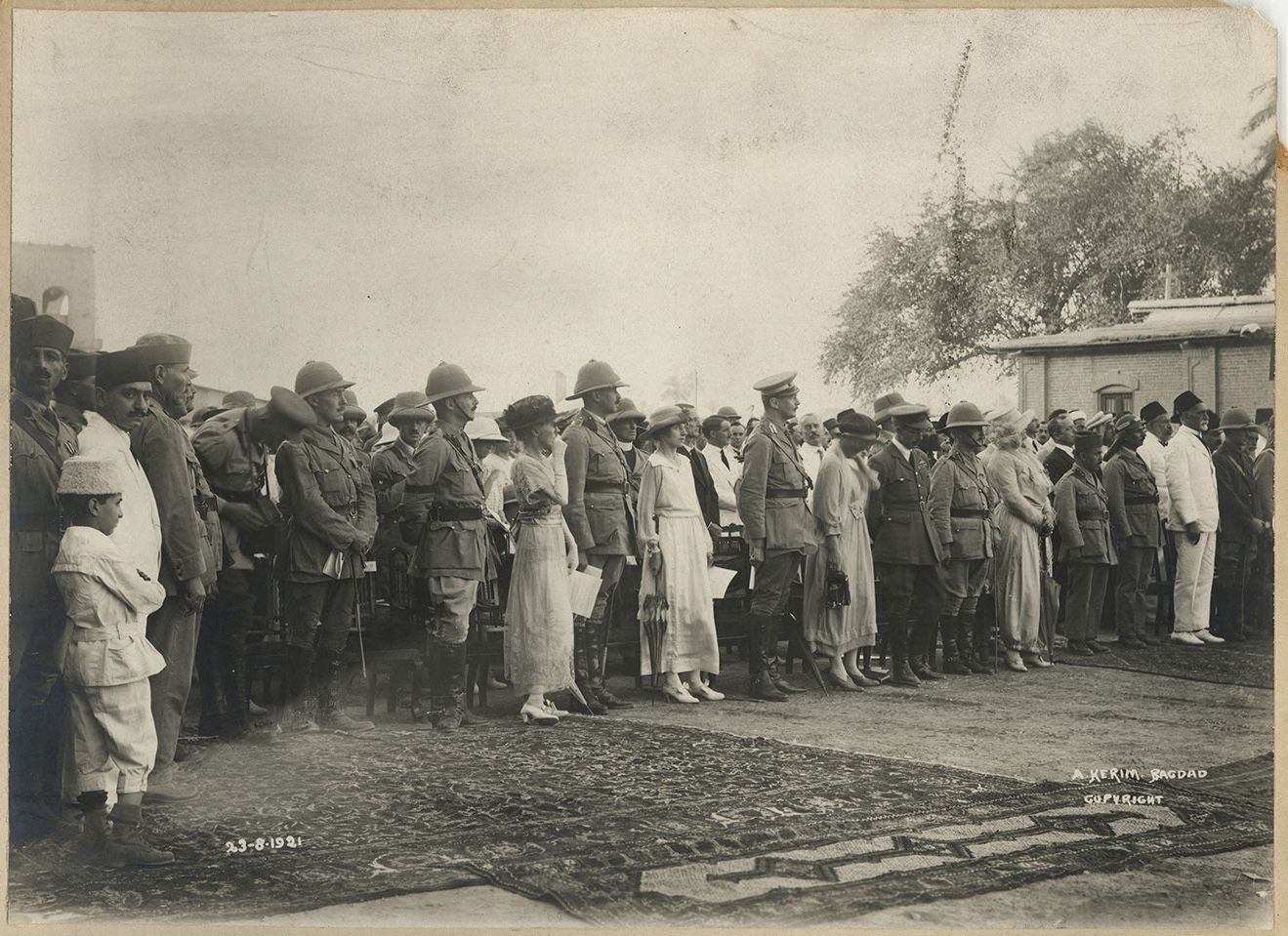
Gertrude Bell is too often reduced to the cinematic phrase "queen of the desert," as if the crucial historical action were a single woman crossing empty space and drawing lines with romantic confidence. The better place to see her power, and its limits, is less grand: Baghdad in the burning weeks of June and July 1921, when Faisal bin Hussein's future kingship had to be made plausible to ministers, tribal leaders, religious figures, British officials, local newspapers, and Faisal himself.[2][3][4]
This microhistory follows Bell through that narrow window. It does not make her the sole maker of Iraq. That would repeat the imperial simplification the story needs to resist. By March 12-30, 1921, the Cairo Conference had already gathered Winston Churchill, T.E. Lawrence, Percy Cox, Bell, and others to settle British policy in the former Ottoman Arab provinces; Newcastle's Special Collections account identifies Bell as Oriental Secretary to the High Commissioner of Iraq and stresses the conference's role in shaping the region's political future.[1] Scholarly summaries make the same point with sharper boundaries: Bell argued for indirect administration and an Arab government under British control, a form of "self-determination" still held inside a mandatory imperial frame.[5]
What her letters show is the daily workmanship behind that frame. Bell's influence did not operate mainly as a border pencil. It operated through calls, teas, speeches, rumors, draft formulas, newspaper pressure, reassurance, and the management of who could claim to speak for "the people" before the people had a durable state apparatus of their own.[2][3][4]
The candidate needed a lead
On June 12, 1921, Bell wrote from Baghdad to her father that "things are at last beginning to move."[2] Faisal, son of Sharif Hussein of Mecca and briefly king in Damascus before French force ended that Syrian episode in 1920, was expected to leave for Iraq. Bell's letter is valuable because it catches policy before it hardened into ceremony. She describes telegrams, British statements, Percy Cox's plan to speak with the Naqib, and a stream of visitors trying to learn what Britain wanted.[2]
The most revealing line is not triumphal. Bell admits that it was a "comic position" to tell people they must have an Arab rather than British government whether they liked it or not.[2] That sentence compresses the contradiction of the mandate. Bell believed direct British rule could not continue indefinitely; she also worked inside a system determined to keep British advice, military power, and diplomatic sponsorship at the center of Iraq's new order.[2][5]
Her role, then, was not merely to favor Faisal. It was to make support for Faisal look locally legible before it looked too nakedly imported. The June letter shows tribal leaders and political intermediaries visiting Bell to discover whether Faisal had British backing. Bell says she gave reassurances according to Cox's direction.[2] That is biography at the level of mechanism: her social access mattered because it turned imperial preference into a hundred private confirmations.
A kingdom needed paperwork before pageantry
By July 16, 1921, the operation had moved from candidacy to procedure. Bell reported that the Council had unanimously declared Faisal king and that Cox still wanted a referendum so the British administration could claim the "voice of the people."[3] The phrase should be read carefully. The referendum was not an open modern election in a settled constitutional state. It was a legitimating device built after the preferred outcome had already been organized through elite negotiation, ministry channels, and British approval.[3][5]
That does not make the episode fake in a simple sense. It makes it political in a more interesting and uncomfortable sense. Bell's letter describes arguments over an unofficial formula of allegiance that spoke of a fully free and independent Iraq; she worried that it might create difficulty in the provinces and was relieved when an official declaration could be circulated through the Ministry of the Interior by local administrators.[3] In other words, the founding argument was not only who should rule. It was which words would count as consent, and through whose offices those words would travel.
Bell also records Faisal managing his own supporters. At one meeting, she says, he rejected a premature acclamation because he had not come to impose himself and wanted people to have the opportunity to say whether they wanted him.[3] This matters because Faisal was not simply a passive British instrument in Bell's letters. He was learning how to make dependence look like legitimacy and how to keep over-eager factions from making his throne appear too narrow.
The result was a triangular performance. British officials needed Faisal to seem wanted. Faisal needed British sponsorship without being swallowed by it. Local elites needed to know where power would actually sit before committing themselves. Bell moved through the triangle as messenger, interpreter, hostess, tactician, and witness.[2][3][4]
The room was never one public
The most vivid evidence comes in Bell's July 20, 1921 letter, where she describes a reception for Faisal at the Grand Rabbi's house in Baghdad.[4] The scene is not a footnote. It shows how kingship had to be performed across communities in a city where Jews, Christians, Sunni notables, Shi'ah clerics, Arab ministers, British officers, and schoolchildren could occupy the same courtyard while fearing different futures.[4]
Bell records speeches, schoolchildren, women watching from upper windows, the Rolls of the Law, and Faisal making a direct address that pleased the Jewish community by stressing kinship and British support.[4] Her account also reveals the anxiety underneath. Some Muslim critics, she reports, objected that Faisal treated Jews and Christians too much as equals with Muslims, while anti-British extremists disliked references to British help.[4] The state being staged in that courtyard was not a settled nation revealing itself. It was a coalition being coaxed into public.
This is also where Bell's limits are clearest. Her letters are extraordinary sources, but they are not neutral instruments. She writes with fluency, detail, wit, and prejudice. Her descriptions of Shi'ah leaders are often suspicious and hostile; the article cannot responsibly borrow her judgments as fact without marking them as her perspective.[4] The useful historical point is that Bell's access was uneven. She could sit beside Faisal and advise British officials, but the political world she described was partly filtered through class, empire, gendered access, and sectarian assumptions.[4][5]
The July 20 letter also shows how hard the new order worked to control memory of the 1920 revolt. Bell says she warned a newspaper editor against publishing biographies of revolt leaders, and she understood that her official power could close the paper.[4] That moment cuts through any soft portrait of Bell as only a cultural mediator. She was also an imperial officer helping decide which stories were safe to circulate while a new monarchy was being assembled.
The photograph came after the labor
The cover image belongs at the end of this sequence rather than the beginning. Newcastle's Gertrude Bell Archive identifies the photograph as the August 23, 1921 coronation of King Faisal in Sarai Courtyard, with Bell left of center holding eyeglasses, Lady Cox, the Garbetts, Mrs. Slater, officers, and dignitaries present.[8] It is tempting to read the image as the event itself: carpet, uniforms, white dresses, hats, a formal line, a state coming into being.
But the letters teach the opposite. The photograph is a surface made possible by weeks of prior labor: the June preparation of the way, the July council declaration, the referendum logic, the official formula of allegiance, the management of rival candidates, the careful staging of community receptions, and the steady question visitors brought to Bell's office: did Faisal have British support?[2][3][4]
That is why Bell is visible but not central in the photograph. Historically, that placement is almost too perfect. She was not the monarch, not the High Commissioner, not the Iraqi ministry, not the electorate, and not the archive's later narrator of every Iraqi experience. Yet she was close enough to the hinge that her letters expose the machinery around it. They show how a mandate government tried to translate domination into advice, advice into consent, and consent into ceremony.[2][3][4][5]
The afterlife moved into antiquities
Bell's later Iraqi work makes the same ambiguity durable. From the end of the First World War until her death in 1926, she turned again toward archaeology, served as honorary director of antiquities, and helped draft Iraq's 1924 antiquities legislation.[5][7] The Iraq Museum's own institutional history says the Baghdad Archaeological Museum was established with Bell's help in 1926.[6] Hella Mewis's chronicle of the Iraq Museum describes Bell's law as lenient toward foreign archaeologists and controversial because the Director General could choose objects to be given to foreign excavators, even as the arrangement helped stock the museum quickly.[7]
That afterlife should change how the kingship story is read. Bell's achievement was never pure liberation or pure manipulation. It was a form of imperial statecraft that could preserve, organize, translate, and connect while also constraining sovereignty and privileging British leverage. In June and July 1921, she helped make Faisal's rule possible by operating in the small rooms where legitimacy was negotiated before it was photographed. In the museum years, she helped build institutions that claimed Iraq's ancient past while still reflecting the unequal archaeology of the mandate.[5][6][7]
The biography therefore works best at close range. Bell's historical significance lies not in a myth of one person inventing a country. It lies in the daily practices by which empire tried to make a sponsored monarchy appear natural: visitors waiting under awnings, letters written after suffocating days, tribal leaders asking for signals, newspapers being warned off, formulas being rewritten, community receptions testing the tone, and finally a line of dignitaries standing in Baghdad on August 23, 1921 as if the photograph could make all that negotiation look settled.[2][3][4][8]
Sources
- Newcastle University Special Collections, "Gertrude Bell and the 1921 Cairo Conference" - account of the March 1921 conference, Bell's role, attendees, and archive context.
- Gertrude Bell Archive, "Letter from Gertrude Bell to her father, Sir Hugh Bell," June 12, 1921 - primary letter on preparing the way for Faisal and British-backed Arab government.
- Gertrude Bell Archive, "Letter from Gertrude Bell to her father, Sir Hugh Bell," July 16, 1921 - primary letter on the council declaration, referendum logic, allegiance formulas, and Faisal's early positioning.
- Gertrude Bell Archive, "Letter from Gertrude Bell to her father, Sir Hugh Bell," July 20, 1921 - primary letter on Faisal's reception at the Grand Rabbi's house, official allegiance formula, press control, and factional tensions.
- Miranda Spieler, "Bell, Gertrude," 1914-1918 Online: International Encyclopedia of the First World War, 2022 - scholarly overview of Bell's wartime and mandate roles, indirect administration, Faisal, and antiquities work.
- The Iraq Museum, "About the Museum" - institutional page noting Bell's help in establishing the Baghdad Archaeological Museum in 1926 and describing the museum's collections and later history.
- Hella Mewis, "Gertrude Bell and the Chronicles of the Iraq Museum (1920-2015)," Our Iraq, 2024 - account of Bell's antiquities role, the 1924 law, the early Iraq Museum rooms, and the law's controversial division of finds.
- Gertrude Bell Archive, "Photograph of attendees at the coronation of King Faisal, Baghdad, 1921" - archival photograph source for the article image, reference GB/PERS/B/017.