The most durable popular version of Rosa Parks turns one of the central figures of the civil-rights movement into a single mood: a tired seamstress, worn down after work, who happened to remain seated on a Montgomery bus on December 1, 1955. The story survives because it is clean, teachable, and morally legible in one sentence. It is also too small for the historical record.[1][3]
The sharper question is not whether Parks was physically tired after a day of work. Most working people are. The real question is what the refusal meant inside the political life she had already built and inside the organizational world that surrounded her in Montgomery. Once the evidence is put back in, the episode looks less like a sudden spark from nowhere and more like a refusal made by a seasoned activist at exactly the moment when a city was prepared to convert it into sustained collective action.[1][3][5]
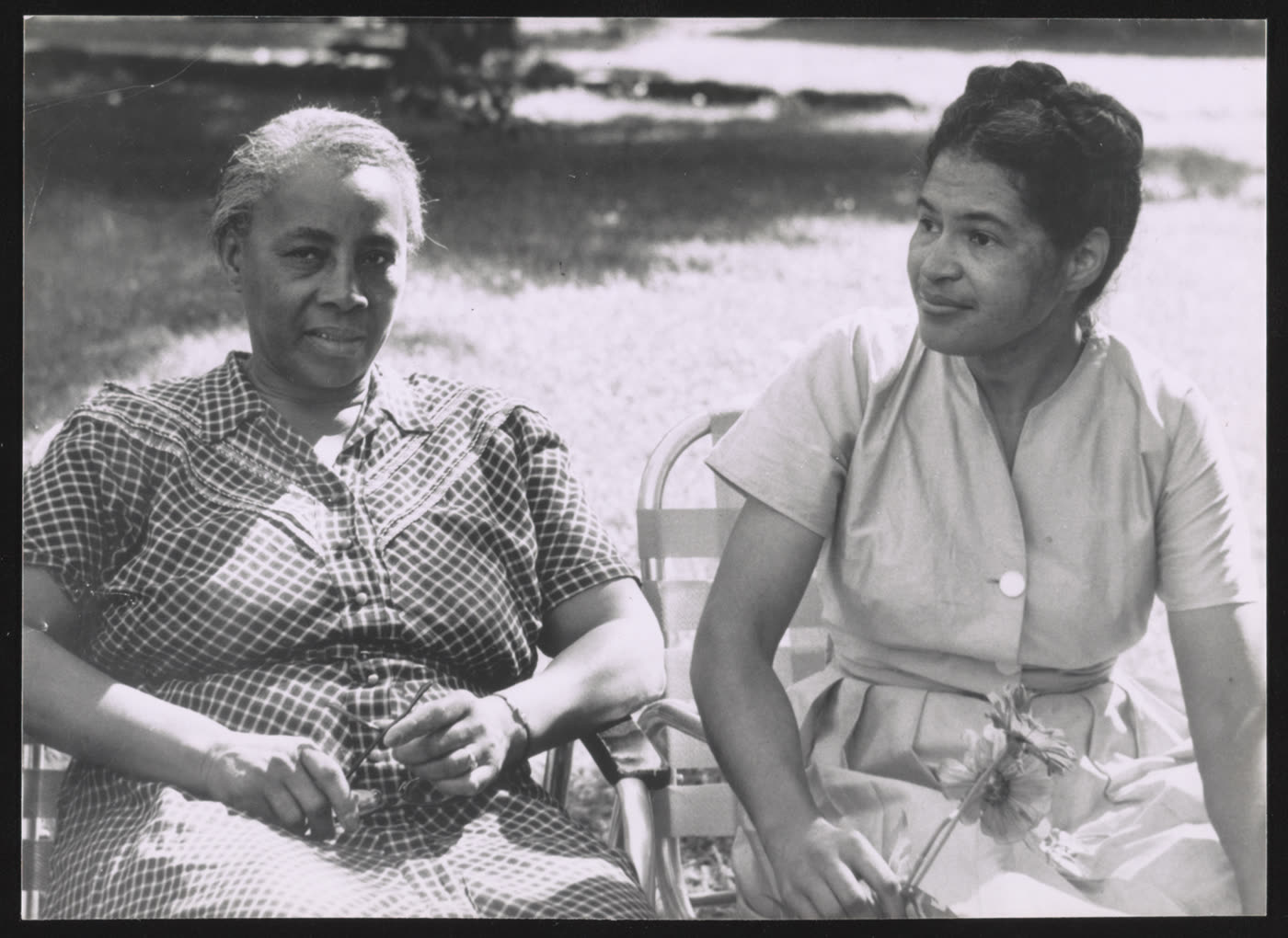
The 1955 Highlander Folk School photograph used for this post matters for that reason. Taken only months before the arrest, it places Parks beside Septima Clark in an interracial training setting devoted to desegregation and movement learning.[2] It is a better visual key than the simplified classroom legend because it keeps Parks inside networks, study, and preparation.
Time anchors: where the evidence changes the story
- 1943: Parks joined the Montgomery NAACP and became branch secretary.[3]
- 1944: she investigated the gang rape of Recy Taylor and helped build the Committee for Equal Justice for Mrs. Recy Taylor.[4]
- March 1954: the Women's Political Council pressed Montgomery officials for bus reforms, well before Parks's arrest.[5]
- August 1955: Parks attended Highlander Folk School's desegregation workshop in Tennessee.[2][3]
- December 1, 1955: Parks was arrested after refusing to surrender her seat.[3][5]
- December 5, 1955: the one-day bus protest succeeded on a mass scale and the Montgomery Improvement Association was formed.[5]
- February 1, 1956 to December 17, 1956: Browder v. Gayle moved through federal court, ending the legal basis for bus segregation.[7]
What the myth gets wrong about Parks herself
The strongest correction is the simplest one: Parks was not politically unformed before the bus incident. The Library of Congress exhibition on her papers states the point directly by warning readers against the familiar misconception and by describing her as a "seasoned activist" rather than a passive bystander who drifted into history.[1] Stanford's King Institute fills in the practical record behind that description. Parks had been NAACP secretary since 1943, registered to vote after repeated denial, advised the local NAACP Youth Council, and spent years working inside Montgomery's Black civic infrastructure.[3]
That background matters because the "just tired" formula quietly strips away agency. It implies that history changed because fatigue accidentally crossed a private threshold. Parks's own later explanation points elsewhere. She wrote that she was not worn out in any unusual bodily sense; she was "tired of giving in."[3] The sentence is short, but it changes the shape of the event. It presents refusal as a moral and political limit, not as a collapse of stamina.
The evidence from 1944 makes that even clearer. When Recy Taylor was abducted and raped by white men in Alabama, Parks traveled to investigate the case and helped organize the campaign for justice around it.[4] The National Park Service account shows Parks already doing the work that later memory often forgets: collecting testimony, building committees, linking gendered violence to civil-rights organizing, and helping turn one local atrocity into a wider political cause.[4] That history does not make the bus refusal less brave. It makes it more intelligible.
Highlander belongs in the same correction. The August 1955 workshop did not create Parks from scratch, but it did place her in a live training environment with Septima Clark and other organizers thinking through desegregation in practical terms.[2][3] The image and the record around it matter because they show continuity. Parks did not move from private obscurity to public action in one magical evening. She was already in motion.
Why earlier refusals did not trigger the same chain
Another simplification follows from the first one: if Parks was "just tired," then the whole boycott can look like a spontaneous eruption caused by one emotionally resonant arrest. The movement record is more exact than that. Montgomery had pressure under the surface before December 1955. The Women's Political Council had already confronted city officials in March 1954 about the humiliations and inefficiencies of the bus system, asking for procedural reforms and warning that a citywide boycott was imaginable.[5]
That chronology is important because it shows that organizational imagination came first. The boycott was not invented after Parks's arrest. A framework for protest already existed. So did evidence that bus resistance could happen before Parks. Stanford notes that Claudette Colvin had been arrested in March 1955 and Mary Louise Smith in October 1955 for similar refusals.[3][5] Their cases matter because they disprove the fairy-tale version in which no one had challenged bus segregation until Parks. The issue is not priority. The issue is why one case became the hinge.
The answer lies in movement readiness, reputation, and timing. King later wrote that Parks was ideal for the role history handed her because her character was widely respected in Montgomery's Black community.[5] E. D. Nixon could mobilize leaders around her case. Jo Ann Robinson and the Women's Political Council could turn outrage into leaflets and logistics almost immediately.[5] The result was visible by December 5: a one-day protest with extraordinary participation, followed by the creation of the Montgomery Improvement Association and a longer campaign sustained through committees, fundraising, and a large carpool system.[5]
That does not reduce Parks to a mere symbol selected by others. It places her act where it belongs: at the meeting point between individual resolve and collective capacity. A refusal without organization can remain a local wound. In Montgomery, the organizations were ready.
The boycott began as organized pressure, not as a neat ending
The myth also flattens the political intelligence of the boycott itself. In schoolbook form, Parks sits, the city rises, and segregation morally collapses. But one of the most revealing documents from December 10, 1955 shows something more strategic. In the "Statement of Negro Citizens on Bus Situation," King and the Montgomery Improvement Association argued that Alabama law merely authorized segregated seating practices; it did not require the bus company to administer seats in the most degrading way possible.[6] Their point was not yet a full demand for instant integration. It was a pressure move built inside the legal openings available at that moment.[6]
That document matters because it restores negotiation, procedural reading, and tactical sequencing to the story. The boycott was a mass protest, but it was also an argument about statutes, municipal code, and what bus operators were actually compelled to do.[6] Parks's arrest became powerful partly because the movement could connect moral outrage to a workable chain of demands.
The legal endgame sharpened that chain. Browder v. Gayle, filed on February 1, 1956, challenged the constitutionality of bus segregation directly in federal court.[7] Stanford's summary adds an important detail often lost in public memory: Parks was not made a plaintiff because Fred Gray wanted the case focused on the constitutionality of the law rather than entangled with her prosecution.[7] By June 5, 1956, the district court had ruled against segregation, and by December 1956 the Supreme Court had allowed that ruling to stand, ending the legal regime that sustained the system.[7]
So even at the level of law, the historical sequence is richer than the legend. Parks did not single-handedly "win the case" by staying seated. Her refusal helped trigger a movement that fought on multiple tracks at once: mass boycott, public fundraising, carpool administration, legal challenge, and national attention.[5][7]
What the evidence supports now
If the myth says Rosa Parks was a tired individual who accidentally changed history, the evidence supports a harder and more useful conclusion.
Parks was an experienced activist before December 1955, shaped by NAACP work, voting struggles, youth organizing, anti-rape activism, and movement education.[1][2][3][4] Montgomery's Black political organizations had already identified the buses as a pressure point and had already imagined boycott as a tactic.[5] Earlier bus resisters proved the issue was alive before Parks, while Parks's standing and the city's readiness made her case the one that could hold a wider coalition together.[3][5] The boycott that followed was not a single burst of feeling but a disciplined campaign that moved from protest to legal demolition of the system.[5][6][7]
That is the version worth keeping. It does more justice to Parks herself, and it also teaches a more accurate lesson about how historical change happens. Movements rarely emerge from innocence. They emerge when long-prepared people meet an opening and know how to use it.[1][3][5]
Sources
- Library of Congress, "Rosa Parks: In Her Own Words" exhibition overview - on misconceptions about Parks and her longer activist life.
- Library of Congress, "Highlander Folk School" - exhibition page for the 1955 photograph of Rosa Parks with Septima Clark and the workshop context.
- Stanford Martin Luther King, Jr. Research and Education Institute, "Parks, Rosa" - biographical entry on her NAACP work, Highlander training, earlier bus resisters, and Parks's own account of her refusal.
- U.S. National Park Service, "Mrs. Recy Taylor (1919-2017)" - on Parks's investigation and organizing role in the Taylor justice campaign.
- Stanford Martin Luther King, Jr. Research and Education Institute, "Montgomery Bus Boycott" - on the Women's Political Council, boycott organization, carpool system, and the movement sequence.
- Stanford Martin Luther King, Jr. Research and Education Institute, ""Statement of Negro Citizens on Bus Situation"" - December 10, 1955 document showing the boycott's early legal and tactical framing.
- Stanford Martin Luther King, Jr. Research and Education Institute, "Browder v. Gayle, 352 U.S. 903" - federal case timeline and why Parks was not a plaintiff.