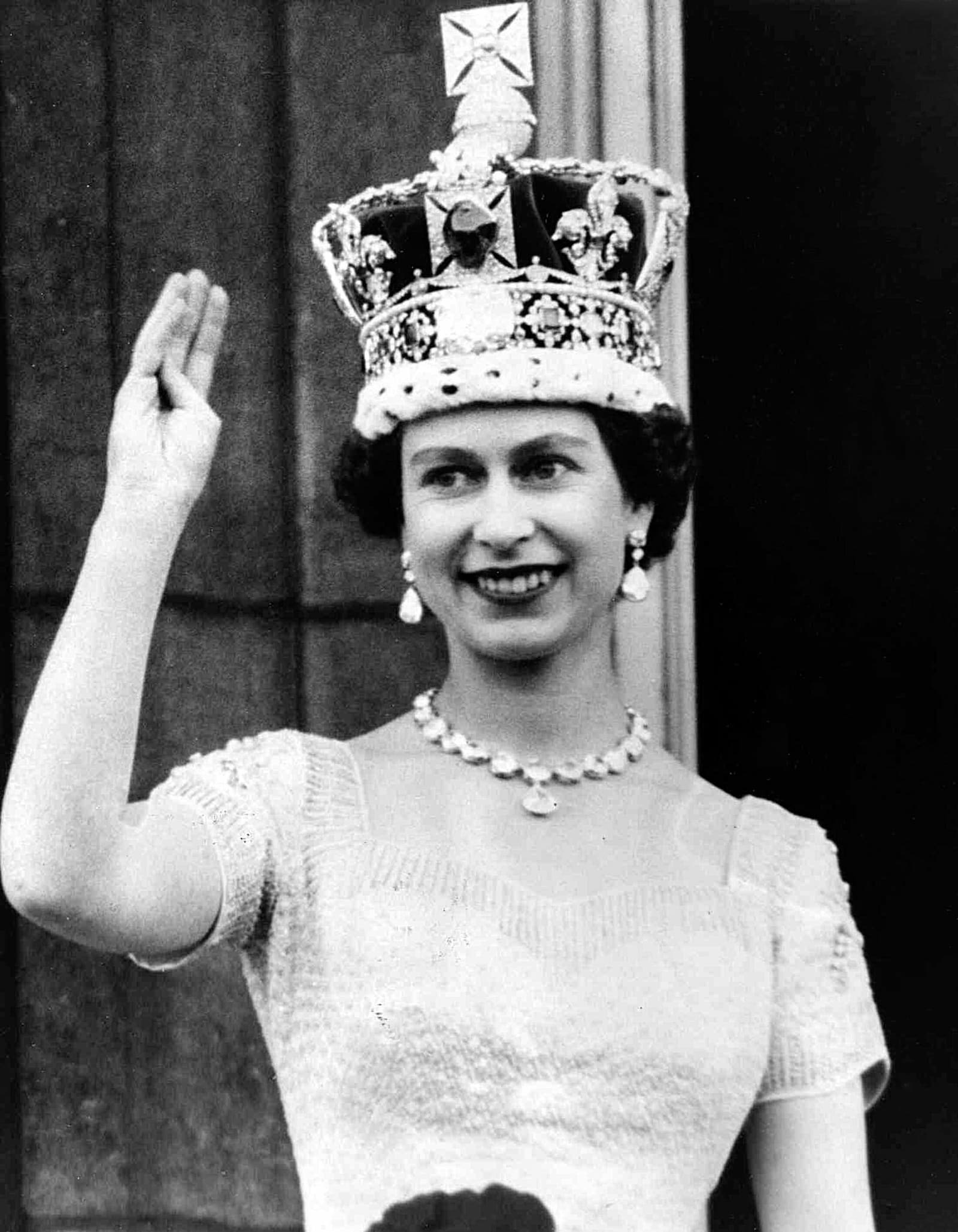

Elizabeth II's coronation on 2 June 1953 is often remembered as a pageant of crowns, coaches, and postwar optimism.[2][3] That memory is not wrong, but it is incomplete. What made the event historically different was not only that Westminster Abbey staged an old rite with unusual splendor. It was that the rite was reorganized for cameras and therefore for households. By the time the Queen was crowned, Westminster Abbey's own history notes, millions around the world were able to witness the ceremony on television.[3] The coronation did not cease to be sacred. It became newly shareable.
That shift matters because coronations had long depended on controlled distance. The service was ancient, hierarchical, and spatially selective. In 1953 the Abbey still had to be physically rebuilt for the occasion, with a 200-strong labor force creating tiered seating for 8,251 guests, a royal gallery, staircases, and an exterior annexe to manage the processions.[2] Yet even while the space was being intensified for those inside it, the event was also being flattened into something legible for those outside it. Reporters and cameramen took up their positions in the church from 6:00 a.m., half a million people lined the route by the previous evening, and the service entered homes as both state ritual and timed domestic experience.[2][3]
The archival clip below is valuable because it preserves that double life. British Pathé's Part 1 coronation film is not the BBC's complete live broadcast, but it keeps the camera logic that made the day work as mass spectacle.[1] It begins not at the altar but in London's damp morning: blankets, sandwiches, tea, road sweepers, packed stands, then the state coach and finally the Abbey interior.[1] The sequence is revealing. The coronation is presented not as a remote sacrament glimpsed only at its climax, but as a long public day whose sacred center had to be approached through waiting, routine, and crowd discipline.
Image context: the cover uses a real 2 June 1953 balcony photograph from the Daily Herald Archive at the National Media Museum, preserved via Wikimedia Commons.[5] That choice fits the article because the argument here is about translation. The Abbey rite remained the core of the day, but the coronation also had to become a picture ordinary people could hold onto once the liturgy ended.
Historical context: a medieval service rebuilt for postwar screens
The coronation followed a moment of constitutional shock. Elizabeth heard of George VI's death in Kenya on 6 February 1952 and returned home as queen.[2] Planning then moved quickly toward 2 June 1953, with the Earl Marshal and Coronation Committee overseeing the vast practical transformation of Westminster Abbey.[2] The Abbey page on Elizabeth II makes the scale unmistakable: wooden floors laid over monuments, a railway line temporarily installed through nave and transepts to move materials, thousands of chairs and stools covered in blue velvet, and daily rehearsals attended by the Queen and royal family once construction neared completion.[2]
That labor is easy to lose when the coronation is remembered only as seamless grandeur. It is central to the meaning of the footage. A ritual that advertises permanence was in fact a highly engineered temporary machine. The same service order still rested on the Liber Regalis tradition and the older structure of recognition, oath, anointing, investiture, crowning, and recess.[3] But in 1953 that inherited order had to coexist with cables, lenses, crowd routes, timing pressures, and the need to make the ceremony visible beyond the Abbey walls.[2][3]
This is where the event's media significance begins. Westminster Abbey's coronation history states the large fact: by 1953, millions around the world could witness the service on television.[3] A parliamentary exchange only weeks later reveals how far that circulation reached. In the House of Lords on 23 June 1953, the Postmaster General said there were just over 2,400 broadcasting stations in the United States and described the coronation as a source of emotional union between Britain and America, even amid complaints about tasteless advertising uses abroad.[4] That debate shows the coronation had already overflowed the Abbey, the route, and even the nation. Once televised, it became a transnational media object that could no longer be governed only by ceremonial etiquette.
Video provenance
The embedded film comes from British Pathé's official YouTube channel: "The Coronation Of Her Majesty Queen Elizabeth - Part 1 (1953)."[1] The upload description identifies it as historical film of the Queen's journey to Westminster Abbey and the opening movements of the ceremony, with British Pathé's film identifier 82.15.[1] That provenance matters for an archival spotlight. The clip is not a modern explainer about the coronation. It is period footage shaped by the visual priorities of the time itself: crowds first, procession second, liturgy third, all arranged so that ceremony could become public sequence.
Close reading: the cameras domesticate the rite without fully secularizing it
The first minute matters more than it seems to. British Pathé opens on dawn, camping crowds, a child eating, a woman powdering her nose, another drinking tea, and a road sweeper clearing the route.[1] None of this is incidental. The film teaches viewers how to approach the coronation: not as an isolated mystical instant, but as a whole civic day in which ordinary bodies wait, shiver, snack, clean, and look toward the same timetable. The monarchy enters modern media here by being synchronized with everyday rhythms.
That is the point at which the coronation starts to feel less like a sealed court ceremony and more like a household event. The film does not abolish hierarchy; the Gold State Coach, the escort, the packed stands, and Churchill's appearance all reinforce it.[1] But the camera also insists on accessibility through sequence. It gives the viewer a route into the event: palace, streets, spectators, coach, Abbey, chair, Bible, canopy, crown. The effect is pedagogical. You are being shown not merely that the Queen is crowned, but how such a day unfolds.
The Abbey interior sharpens the tension between revelation and withholding. The 1953 order of service still treated the anointing, not the crowning, as the most sacred part of the ceremony, shielded from the congregation under a canopy.[3] The film respects that boundary while still making the choreography around it highly visible.[1][3] We see the Queen approach the Chair of Estate, answer the recognition, receive the Bible, move toward St Edward's Chair, and sit beneath the cloth-of-gold canopy.[1] The sacred center is protected, but everything around it is made legible. Television-era monarchy did not simply expose all mystery. It taught audiences exactly where mystery was located.
That is why the clip remains historically useful. It shows monarchy adapting to mass spectatorship through selective visibility. The cameras do not flatten every distinction between inside and outside, holy and ordinary, ruler and subject. They redraw those distinctions into a form that can survive mediation. The crowd scenes at the beginning and the liturgical precision in the middle belong to one system. A postwar viewer could feel close to the event without being allowed to penetrate every layer of it.
The balcony image that followed the service completed that translation.[5] After the oath, anointing, investiture, crowning, homage, and recess, the queen changed into the Imperial State Crown and returned outward into a public image that newspapers and households could keep.[2][3][5] That outward-facing sequence helps explain why the coronation lived so powerfully in memory. The event moved from sacrament to procession to photograph without losing coherence. It was at once deeply traditional and expertly reproducible.
Why this archival moment still matters
The strongest reading of 2 June 1953 is not that television trivialized monarchy or that the cameras merely documented what would have happened anyway. The stronger claim is narrower and more convincing: television changed the scale on which coronation could be felt. Westminster Abbey still staged a rite rooted in medieval precedent.[3] Yet the event's political and emotional force in 1953 came from its ability to pass through cameras into ordinary domestic time. People did not need to stand in the Abbey or even on the route to inhabit the sequence.
That is why the Pathé footage still deserves attention in 2026. It preserves a monarchy learning how to remain distant and intimate at once. The crown had to stay sacred enough to matter. The image had to become familiar enough to live in kitchens, parlors, cinema newsreels, and foreign broadcasts.[1][4] Elizabeth II's coronation entered legend because it first entered the screen.
Sources
- British Pathé, "The Coronation Of Her Majesty Queen Elizabeth - Part 1 (1953)," YouTube video.
- Westminster Abbey, "Elizabeth II" - official account of the 1953 coronation preparations, route crowds, reporters, cameramen, timings, and ceremonial details.
- Westminster Abbey, "A history of coronations" - official history noting that by 1953 millions around the world could witness Elizabeth II's coronation on television, with the core order of service outlined.
- UK Parliament, "THE CORONATION: AMERICAN TELEVISION PROGRAMME" (House of Lords debate, 23 June 1953) - on U.S. broadcasting reach and the coronation's immediate transatlantic afterlife as television content.
- Wikimedia Commons, "File:Elizabeth II waves from the palace balcony after the Coronation, 1953 (cropped).jpg" - file page for the archival photograph used as this article's image.