Dwight D. Eisenhower's Order of the Day for June 6, 1944 is usually remembered through one phrase: the invasion of Normandy is described as a "Great Crusade."[1] The phrase is memorable, but it can also narrow the document too quickly. Read as a whole, the order is not mainly a burst of martial uplift. It is a tightly engineered public text that has to do three jobs at once. It has to name a multinational force, justify a dangerous assault whose outcome is still unknown, and connect a beach landing in northern France to a much larger political horizon.[1][3]
That broader function becomes clearer when the order is placed beside another Eisenhower text from almost the same moment: the handwritten "In Case of Failure" note drafted in case the landings collapsed.[2] The two documents form a revealing pair. The public order distributes duty across soldiers, sailors, airmen, resistance movements, and home fronts.[1] The private note does the reverse and concentrates blame in one line: if the attempt fails, the fault is "mine alone."[2] Together they show what supreme command required on the eve of Overlord: public inevitability in one hand, private responsibility in the other.
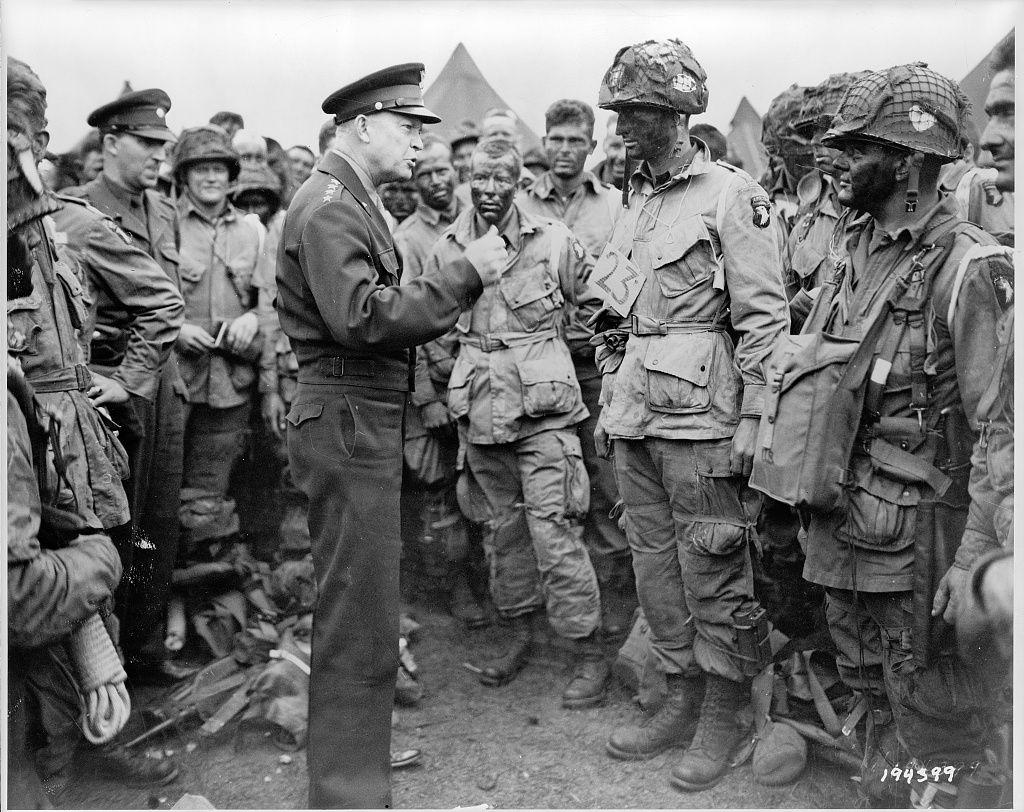
The Greenham Common photograph used here shows Eisenhower speaking with paratroopers from the 101st Airborne Division on June 5, 1944, the day before the assault began.[3][5] It is the right image for this article because the order only makes full sense when it is pulled back toward bodies, weather, and uncertainty. By the time Eisenhower met those men, the launch had already been delayed by bad weather, the decision conference had become a test of nerve, and the printed order was no longer theory.[3][4][5]
The opening line writes a coalition into existence
The order begins with a form of address that is easy to skate past: "Soldiers, Sailors, and Airmen of the Allied Expeditionary Force."[1] That sentence matters because it refuses to speak in the singular. Eisenhower is not addressing an army, still less an American army. He is writing a command voice for a coalition machine whose parts differ in nationality, service branch, and operational role.[1][3] The invasion depends on landing craft, naval gunfire, airborne drops, tactical air cover, logistics, and deception. The opening line compresses that complexity into one audience without pretending the force is homogeneous.
That compression is politically important. Overlord in 1944 was never only a battlefield operation. It was also the most visible test of whether the western Allies could turn years of planning, bargaining, and shared material buildup into coordinated action.[3][4] Eisenhower's title already tells the reader what kind of command problem he is solving. The document must sound singular enough to move people at the point of action while remaining accurate to the fact that the action is multinational. The phrase "Allied Expeditionary Force" does that work. It gives unity a formal name without erasing difference.
The rest of the first paragraph extends the same logic. Eisenhower tells the force that "the eyes of the world are upon you," then immediately links the landing force to "the hopes and prayers of liberty-loving people everywhere" and to "our brothers-in-arms on other Fronts."[1] This is not ornament. It enlarges the battlefield's audience and gives the invasion a networked meaning. Normandy is being framed not as an isolated military gamble, but as one front in a system of fronts, and the troops are being told that their action is legible far beyond the Channel coast.[1][3]
The middle of the order does not promise ease; it turns risk into sequence
Many remembered wartime proclamations lean on certainty. Eisenhower's order is more disciplined than that. It admits difficulty while still constructing confidence. The enemy, he says, will fight savagely.[1] The force is told that the landing follows "many months" of air offensives and that the home fronts have given "an overwhelming superiority in weapons and munitions of war."[1] This is the document's central move. Confidence is not offered as temperament. It is offered as accumulation.
That matters because the launch itself had only just survived a weather crisis. National Archives teaching material on D-Day and William Hitchcock's reconstruction of the June 5 decision conference both emphasize how contingent the timing was.[3][4] Eisenhower delayed, listened to meteorological forecasts, weighed the risk of waiting against the risk of going, and finally accepted the narrow weather window that made June 6 possible.[3][4] In that context, the order's rhetoric looks less like blind confidence than like command management under uncertainty. The text cannot confess operational doubt to the men boarding ships and aircraft, but it does not fake omniscience either. Instead, it points backward to preparation, matériel, and prior pressure on Germany as the grounds for proceeding.[1][3]
This is where the order becomes more interesting than the single phrase "Great Crusade" suggests.[1] Crusade language can sound like pure exaltation, and some later memory has treated it that way. Yet the document's structure is practical. First, it names the mission. Then it places the mission inside a longer campaign of bombing, attrition, training, and production. Only after that does it drive toward "full Victory."[1] The sequence matters. Eisenhower is not presenting Normandy as a magical break with the past. He is presenting it as the next necessary step in a cumulative Allied effort that reaches back through 1943 and earlier.[3][4]
"Free world" is the political horizon of the text
The most revealing line in the order may be the one least often quoted today. Eisenhower tells the force that its task will bring "the elimination of Nazi tyranny over the oppressed peoples of Europe" and "security for ourselves in a free world."[1] That final phrase is worth lingering over because it shows the order operating at a register larger than invasion tactics.
First, the line ties liberation to self-interest without embarrassment.[1] The landing is not described as charity for Europe or as national revenge alone. The argument is that Allied security and European liberation belong to the same strategic sentence. Second, the phrase "free world" gives the document a political vocabulary that would become even more familiar after 1945.[1] On June 6, 1944, the war is not over and the postwar order is not settled. Yet the order already speaks as if the meaning of victory will be measured not just in terrain gained, but in the kind of world secured after the fighting.
That helps explain why the document has endured in public memory. It is short enough to circulate as battlefield rhetoric, but it also carries a draft of the postwar argument inside it.[1] Normandy appears here as a hinge between campaigns and futures. The force is not merely being told to seize beaches and roads. It is being told that a crossing from Britain to France belongs to the struggle over what political life in Europe will look like afterward.[1][3]
The failure note reveals the reverse architecture of command
The best way to see the order clearly is to read it against the failure note.[2] The contrast is stark. In the public order, agency is distributed outward. Troops are praised. Other fronts are acknowledged. Resistance movements and home production are folded into the field of action.[1] In the private note, the chain contracts. The landings have "failed to gain a satisfactory foothold"; the troops, air forces, and navy "did all that bravery and devotion to duty could do"; any blame belongs to Eisenhower alone.[2]
That reversal tells us something important about command language in wartime. Supreme command is not only the power to issue orders. It is also the burden of arranging where success and failure will be narrated. The public text collectivizes effort so that a multinational operation can sound morally and operationally coherent.[1] The private text individualizes blame so that the same operation, if broken, will not be explained as a failure of courage among subordinates.[2] Eisenhower's reputation for calm often makes this look like straightforward decency, and it was that. It was also institutional intelligence.
Seen from this angle, the famous Greenham Common image acquires extra force.[5] The photograph records a smiling conversation, almost casual at first glance. The paired documents tell a harsher story. By June 5, airborne troops were hours away from being dropped into darkness over hedgerows, flooded fields, and fortified routes inland.[3][5] The order of the day gave them a usable public script. The failure note prepared a private accounting if the script collapsed. Both belonged to the same command moment.
Why the document still matters
Eisenhower's D-Day order survives because it is more than a pep talk and more than a relic.[1] It is a compact model of how democratic coalition warfare had to speak at a decisive moment. The text makes unity audible without pretending sameness. It converts uncertainty into a sequence of reasons for action. It joins battlefield risk to a political future. And, when read beside the failure note, it shows that the confidence of public command rested on an intimate awareness of what disaster would have meant.[1][2][3][4]
That is why the document rewards close reading. The most famous words are only the entry point. The deeper historical interest lies in how carefully the order balances coalition, peril, and purpose on the day those paratroopers boarded their aircraft and the invasion moved from paper into history.[1][3][5]
Sources
- National Archives, "General Dwight D. Eisenhower's Order of the Day" - milestone document page with transcript and historical framing.
- Dwight D. Eisenhower Presidential Library, "In Case of Failure" transcript PDF - Eisenhower's draft note accepting responsibility if the Normandy landings failed.
- National Archives, "D-Day" - teaching resource covering planning, weather, troop concentrations, and Eisenhower's June 5 visit to airborne troops.
- William I. Hitchcock, ""OK, We'll Go"" in Prologue (National Archives) - on the June 5, 1944 weather decision and the uncertainty around Eisenhower's spoken launch order.
- Library of Congress, "General Dwight D. Eisenhower gives the order of the day..." - photograph record for the June 5, 1944 Greenham Common scene used as this article's image.