Article 5 is one of the most famous sentences in modern diplomatic history, and it is also one of the most routinely flattened. In public memory, the North Atlantic Treaty is often reduced to a simple formula: attack one ally and everyone else automatically goes to war.[1][2] That memory captures the treaty's deterrent purpose, but it misses how the document was actually written on April 4, 1949. A close reading points to a narrower and more interesting claim: the treaty promised solidarity in advance while leaving the form of response inside each state's constitutional control.[1][3][4]
That distinction was not a hidden technicality. It was the problem the negotiators were trying to solve. Western European governments wanted a security guarantee that would be credible against Soviet pressure, while the Truman administration had to draft language that the United States could ratify without pretending that Congress had surrendered its constitutional role over war powers.[2][3][4] Article 5 is the compromise they arrived at. It is strong by design, but it is not mechanically automatic.
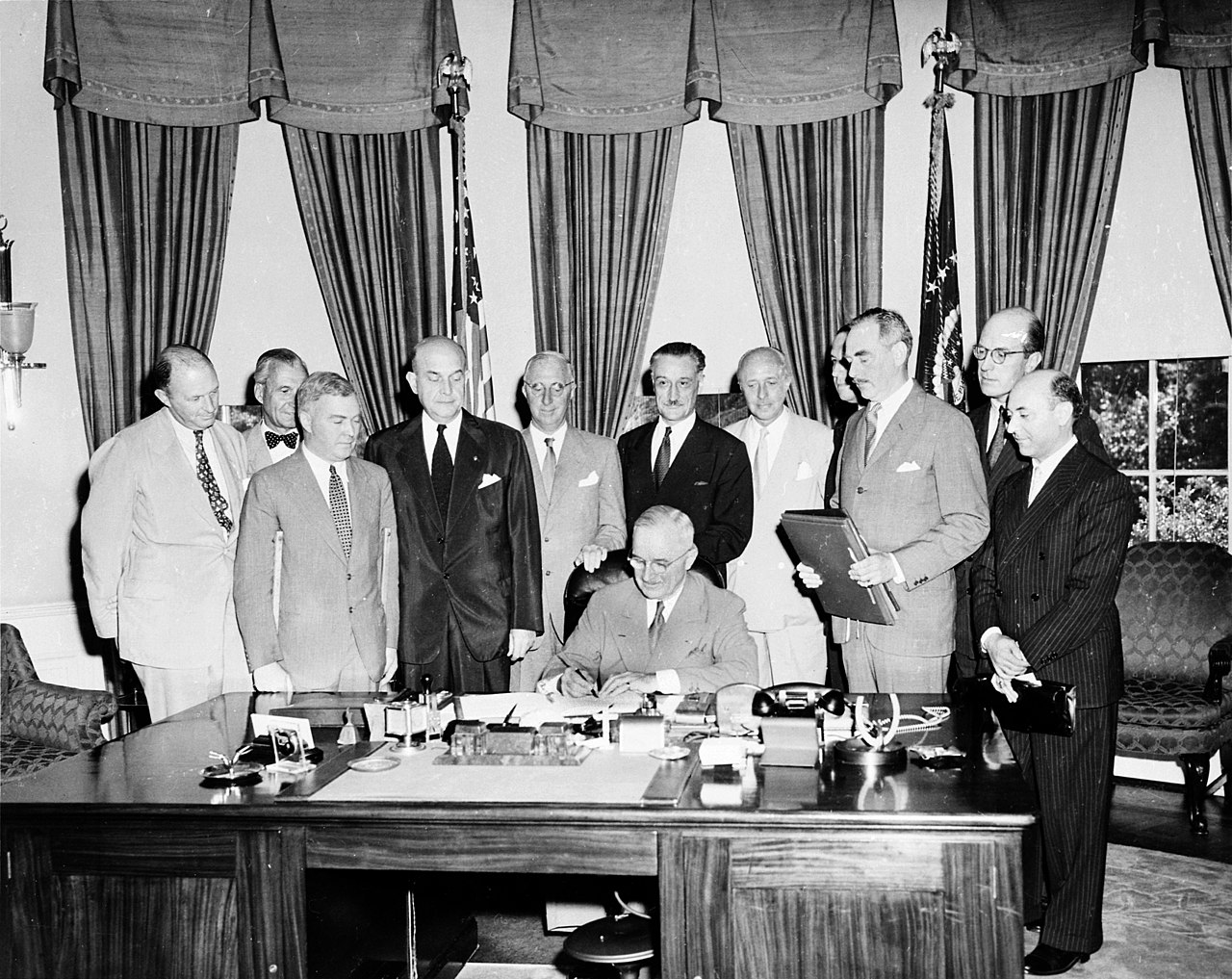
The cover photograph shows Truman on August 24, 1949, signing the proclamation that put the pact into effect after ratification.[5] It belongs with this essay because the image captures what the treaty text itself says in Article 11: collective security still had to move through domestic constitutional machinery before it could become binding alliance law.[1][4][5]
Timeline anchors
- 1948-03-17: Britain, France, Belgium, the Netherlands, and Luxembourg sign the Brussels Treaty, establishing the immediate Western European precedent for collective defense.[2]
- 1948-05-11: the Vandenberg Resolution clears political ground in Washington for a peacetime Atlantic security treaty consistent with the UN Charter.[2]
- 1949-02-16 to 1949-02-17: internal U.S. drafting memoranda show Article 5 wording still under negotiation, with multiple variants under active consideration.[3]
- 1949-04-04: the North Atlantic Treaty is signed in Washington, D.C.[1][2]
- 1949-07-21: the U.S. Senate gives advice and consent to ratification.[4]
- 1949-08-24: the treaty enters into force after ratifications are deposited, and Truman signs the proclamation bringing the pact into effect for the United States.[1][5]
1. The famous first clause is not the whole promise
The sentence everyone remembers is the opening one: an armed attack against one or more allies "shall be considered an attack against them all."[1] That line is politically essential. It tells a potential aggressor that the alliance will not treat an assault as a local incident. But the legal work of the article comes in the next stretch of the sentence, where each party agrees to assist the attacked ally by taking "such action as it deems necessary, including the use of armed force."[1]
Those words matter because they do two things at once. First, they make assistance obligatory. Article 5 does not say allies may respond if they feel like it; it says each of them will assist.[1] Second, they leave the form of that assistance open. The treaty does not require every ally to respond in an identical manner, nor does it convert the article into a self-executing declaration of war. The duty is collective, but the chosen measure remains nationally determined.[1][4]
That is why the automatic-war shorthand is too blunt. The text does not read "all parties shall immediately declare war." It reads as a commitment to respond, forthwith, with action each state judges necessary under Article 51 of the UN Charter.[1] In legal and political terms, that is a serious promise. In textual terms, it is still a mediated one.
Two neighboring articles sharpen the point. Article 6 limits the geography in which Article 5 applies, and Article 7 states that the treaty does not displace the rights and obligations of UN member states or the Security Council's primary responsibility for international peace and security.[1] In other words, the article is not written as a blank check for alliance action anywhere, in any form, under any rationale. It is bounded by place and by a broader UN legal frame.[1]
2. The drafting record shows that discretion was deliberate, not accidental
The most useful corrective to popular memory comes from the drafting record collected in Foreign Relations of the United States.[3] On February 16, 1949, Charles Bohlen described one proposed wording for Article 5 as the "minimum commitment" the State Department thought could still achieve the pact's political purpose.[3] That sentence tells us the negotiators were not stumbling into ambiguity. They were actively measuring how much obligation the United States could credibly undertake.
The draft variants make that calculation visible. One version would have committed parties to take "such military or other action as it deems necessary."[3] Another formulation preserved the obligation to assist but adjusted how directly military force appeared in the clause.[3] On February 17, Dean Acheson recorded that Truman preferred the draft "including the use of armed force," though he still treated a softer fallback draft as possible if necessary in dealing with Senator Tom Connally and Senate politics.[3]
This record matters for interpretation because it shows the final text's flexibility was not a lawyerly afterthought. It was the solution to two pressures that pulled in opposite directions. European allies wanted a pledge strong enough to deter Moscow. U.S. officials wanted language that sounded unmistakably serious but did not erase Congress or promise a constitutionally implausible automatic war trigger.[2][3][4]
The final sentence preserves both goals. It names armed force explicitly, which matters for credibility. But it embeds that possibility inside the narrower phrase "such action as it deems necessary," which matters for ratification and for the continued role of national decision-making.[1][3]
3. Article 11 is as important as Article 5 if you want to know what the treaty really does
Most casual readings stop at Article 5. The treaty itself does not. Article 11 states that the treaty shall be ratified and carried out by the parties "in accordance with their respective constitutional processes."[1] That clause is not ceremonial filler. It explains how the alliance could be both binding and politically saleable across different constitutional systems.
The modern Congressional Research Service summary makes the institutional point explicit. It notes that the Senate gave its advice and consent on July 21, 1949, that the United States joined on July 25, 1949, and that Article 11's constitutional-process language was changed from an earlier proposal in response to Senate Foreign Relations Committee concerns.[4] That is a strong clue about how the treaty was understood at birth. The alliance was not drafted as a way around legislatures. It was drafted in a way that could survive them.
This is also why the Truman photograph is more than a period illustration.[5] The alliance's famous guarantee did not spring to life at the instant diplomats signed the parchment on April 4. It became operative through ratification deposits, domestic legal steps, and formal proclamation.[1][4][5] The architecture of collective defense therefore ran through constitutional procedure from the start.
If you read Articles 5 and 11 together, the design becomes much clearer. Article 5 creates the duty to assist an ally under attack. Article 11 tells you that the duty is implemented by parties acting through their own lawful political structures.[1][4] The result is not weakness. It is a particular kind of strength: an alliance that pre-commits its members to common cause without pretending they are one undifferentiated state.
4. Why the automatic-war myth survives anyway
The myth survives because it expresses a truth about deterrence even while it obscures a truth about text. NATO needed adversaries to believe that an attack would widen the conflict dramatically.[2][6] For that purpose, the opening declaration of Article 5 did a lot of work. It converted a local attack into an alliance problem by definition.[1]
But deterrence language and constitutional mechanics are not the same thing. The treaty's power came from combining them, not from choosing one over the other. The founding documents and official histories consistently show the same architecture: a strong collective signal, an explicit possibility of armed force, immediate consultation and reporting duties, bounded territorial scope, and room for each ally to act through its own institutions.[1][2][3][4][6]
That combination explains NATO's durability better than the automatic-war myth does. An alliance built on a legally false promise would have been fragile from the beginning. An alliance built on a politically strong but constitutionally workable promise had a better chance to survive ratification, domestic debate, and long-term adaptation. The treaty lasted not because it erased national choice, but because it organized national choice in advance around a shared emergency.
What April 4, 1949 actually changed
The North Atlantic Treaty did not turn twelve countries into a single war-making machine.[1][4] What it did was narrower and, historically, more consequential. It declared that aggression in the North Atlantic area would no longer be treated as a purely bilateral or local matter. It bound each signatory to respond. It identified armed force as one available response. And it wrote that obligation in a form compatible with domestic constitutional procedure.[1][2][3][4]
That is why Article 5 still rewards close reading. Its achievement was not to abolish politics. Its achievement was to discipline politics ahead of time. The treaty made the alliance's first answer collective, even though the precise national form of that answer would still be chosen inside each capital. That is not automatic war. It is something more durable: pre-committed solidarity with room for constitutional action.
Sources
- NATO, The North Atlantic Treaty (official treaty text with Articles 5, 6, 7, and 11, plus the entry-into-force note).
- U.S. Department of State, Office of the Historian, North Atlantic Treaty Organization (NATO), 1949 (Cold War context, Brussels Treaty, U.S. constitutional concern, and negotiation background).
- U.S. Department of State, Office of the Historian, Foreign Relations of the United States, 1949, Western Europe, Volume IV, Documents 70 and 71 (Article 5 draft variants, "minimum commitment" language, and Truman-Acheson discussion of "including the use of armed force").
- Congressional Research Service, The North Atlantic Treaty: U.S. Legal Obligations and Congressional Authorities (Senate advice and consent on July 21, 1949, U.S. accession on July 25, 1949, and Article 11's constitutional-process history).
- Harry S. Truman Library & Museum, "Truman Signing North Atlantic Treaty Proclamation" (public-domain photograph record dated August 24, 1949).
- NATO, Founding treaty (official NATO overview emphasizing collective defense as the heart of the treaty and the 4 April 1949 signing context).