Before dawn on 23 January 1909, the Italian steamship Florida struck the White Star liner Republic in fog off Nantucket. One vessel was carrying emigrants toward New York; the other was taking passengers toward the Mediterranean. The collision left two damaged ships within reach of each other, but beyond sight of the help they needed.[1]
Wireless would make the rescue famous. Yet a distress call could only begin the work. Over the following day and night, safety depended on a succession of precarious arrangements: shelter aboard the ship that had caused the damage, rescuers finding one another in the fog, and small boats repeatedly crossing the water between them.
A voice beyond the ship
Republic had sailed from New York on 22 January. Her wireless operator, Jack Binns, worked for the Marconi company; on Nantucket, a shore station supplied the other end of the connection. PBS's account identifies Jack Irwin as the operator on the overnight watch who received the distress call and began directing other vessels toward the scene.[2]
That geography mattered. A ship could disappear into fog while remaining audible ashore. The shore operator could then contact vessels beyond the damaged transmitter's effective reach. A liner's emergency no longer had to wait for another ship to happen upon it.
Binns's account, published in the New York Times on 27 January, makes the equipment's survival feel contingent. The collision shattered his cabin, but his aerial remained intact. When the ship's electricity failed, batteries kept the transmitter working. He also described sending with a broken key lever held in place by hand.[4]
The machinery was useful because someone could still operate it under those conditions. Binns had to preserve a conversation: report the captain's needs, receive replies, and keep updating ships whose positions were changing. PBS describes the Nantucket station becoming a relay between Republic and the approaching Baltic. Hearing a weak signal was the beginning of a sustained task.[2]
The nearest refuge had a crushed bow
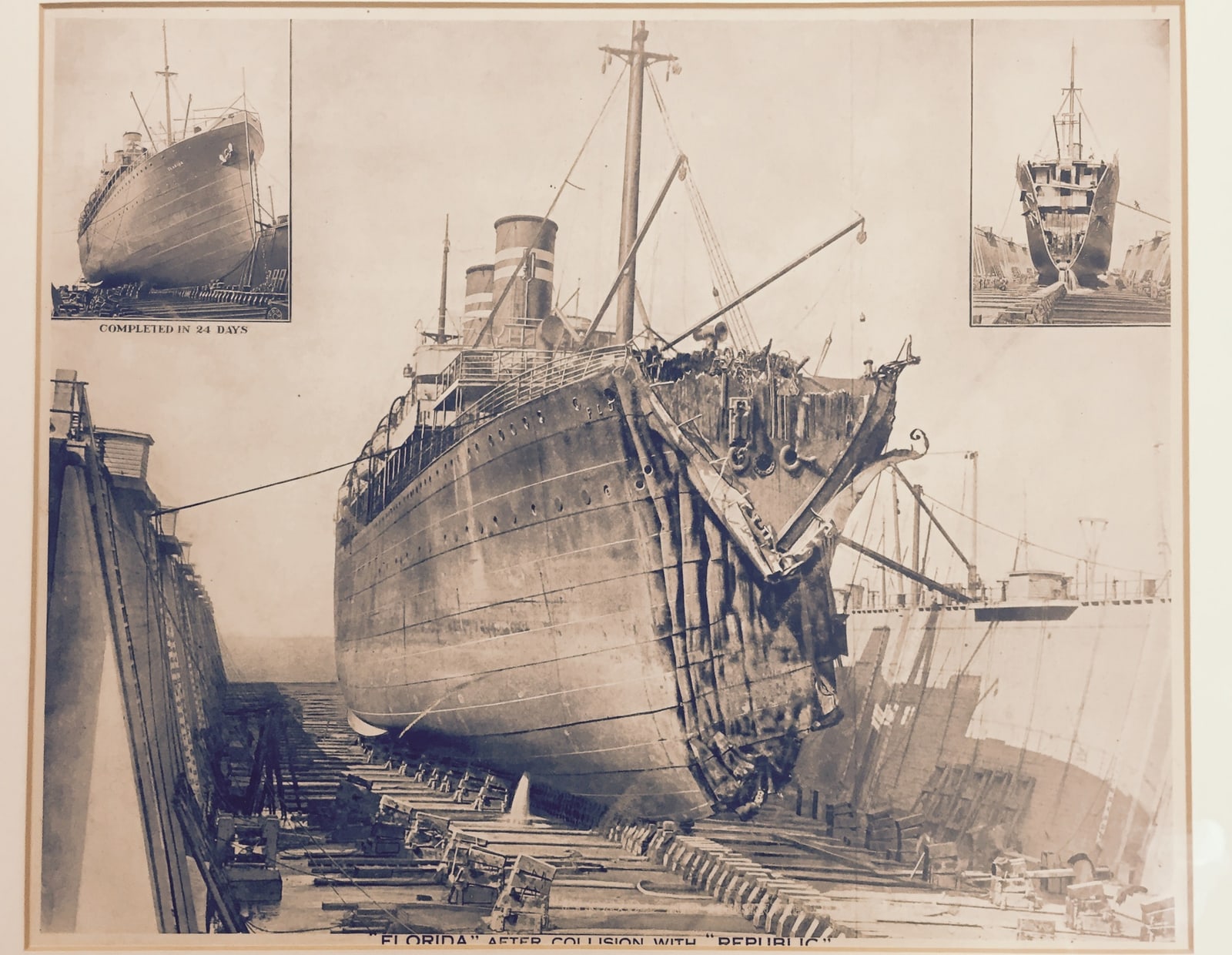
The first escape did not require waiting for Baltic. Republic's passengers were moved by boat to Florida, whose bow had been driven back in the collision. The damaged Italian ship became their temporary refuge while the wireless operator and others remained with Republic.[5]
The photograph gives that arrangement its proper unease. Steel plates buckle inward where the bow should project. Taken in dry dock afterward, it cannot tell us exactly how the ship behaved that morning, but it shows why arrival aboard Florida could not be treated as the end of the emergency.[3]
For the passengers, evacuation therefore meant entering a second uncertain situation. A ship large enough to receive them was already present; a sound ship capable of taking everyone onward still had to arrive. The distinction between getting off Republic and reaching safety shaped the rest of the day.
PBS's documentary reconstruction follows the passengers' wait aboard Florida while Baltic searched. It describes a second, exhausting transfer once the rescue liner reached them. The sequence is easy to lose in a story centered on Binns: the people being rescued had to make another journey after their first escape.[5]
Close enough to hear
By evening, Baltic was near enough for sound to help where visibility failed. In Binns's account, the ships used explosive sound signals; Captain Inman Sealby took a direction from the noise, and Binns transmitted steering instructions. As Baltic approached, its foghorn became clearer. The captain then warned it to proceed carefully.[4]
Wireless and sound were doing different jobs. The radio carried intelligible instructions through the fog. The report of an explosion helped establish which way to steer. Together they brought the ships into contact, but proximity introduced another danger: a rescue vessel also had to avoid striking the casualty it had come to help.
The revenue cutter Gresham experienced the same difficulty on a longer timescale. Its official report records departure within ten minutes of receiving a message on the morning of 23 January. Uncertain positions and fog kept it searching until late the following morning.[6]
That delay is a useful measure of the rescue's limits. News could travel much faster than a ship, and a ship could reach the general area long before it found the people who needed it. The hours separating those achievements had to be endured aboard the damaged vessels.
Another crossing in the dark
Contemporary witnesses complicate the image of a smooth evacuation. Writing in the Boston Post on 25 January, passenger and author James B. Connolly described boats waiting alongside Baltic, worsening conditions, and exhausted passengers. He questioned the delay before the transfers began. Binns praised the crews while acknowledging the difficulty of getting passengers from moving boats onto the ship.[4]
These accounts allow admiration without making the operation frictionless. Connolly's criticism does not establish every cause of delay; Binns's praise does not erase the risk. Both put the reader beside the boats, where a successful rescue still required each person to negotiate the last few feet.
The Institute for Telecommunication Sciences summarizes the wider operation as seven responding ships and the rescue, by rowboat, of the surviving passengers and crews. Its account also records six deaths in the collision. The achievement of bringing survivors to safety should not turn the disaster into a story without bereavement.[7]
The last boat
On 24 January, efforts continued to save Republic herself. Gresham took her in tow, with Furnessia helping steer from astern; Seneca later assisted. As the liner settled, the rescue arrangements became more explicit. A blue light would signal immediate danger, and a carpenter stood ready to cut the towing connection with an axe.[6]
The cutter's report places that blue signal at 8:10 p.m. A waiting lifeboat set off, and the tow was cut. Searchlights swept the water. At 8:45 the boat returned with Sealby and Second Officer Williams, recovered from floating wreckage.[6]
The ending brings the scale of the operation back to a small craft and two men in the water. Wireless had gathered the rescuers; preparation determined how quickly they could act when the ship finally disappeared.
A silver lifesaving medal in the National Maritime Museum offers a fitting record of that shared work. Made in 1909, it depicts Republic sending wireless messages on one face. The other honors the officers and crews of Republic, Baltic, and Florida, on behalf of saloon passengers from the first two liners.[8]
The medal joins the celebrated signal to the less easily commemorated labor that followed it. Its named ships also preserve an awkward truth: the vessel that struck Republic became an essential part of the rescue. Across those two days, help consisted of people making the next workable arrangement before the previous one failed.
Sources
- National Park Service, “Cape Cod National Seashore to Commemorate 100th Anniversary of the First Marconi Distress Message” (6 January 2009) — the two voyages, collision, and wireless rescue context.
- PBS, American Experience, “Rescuers and All Aboard” — Binns, the departure from New York, and the Nantucket shore station's relay work.
- Wikimedia Commons, “Florida After Collision with Republic” — archival photograph attributed to Martin & Ottaway, reproduced by Conklinj in 2015; image provenance and CC BY-SA 4.0 attribution.
- PBS, American Experience, “Newspaper Articles About the Collision” — public-domain reports, especially James B. Connolly in the Boston Post (25 January 1909) and John R. Binns in the New York Times (27 January 1909); equipment, navigation, and transfer testimony.
- PBS, American Experience, “Rescue at Sea” (15 February 1999), film description and transcript — the passengers' transfer to Florida, the wait for Baltic, and the second evacuation.
- U.S. Treasury Department, House Document 549, 61st Congress, 2nd session (17 January 1910), pp. 8–10 — official Gresham rescue report reproduced in “Use of Revenue-Cutter Service in Locating Yacht of John J. Astor”; search, towing arrangements, blue signal, and final boat rescue.
- Institute for Telecommunication Sciences, “January 1909: Maritime Radio Distress Call Saves 1,500 Lives” — responding vessels, rescue of survivors, and collision deaths.
- Royal Museums Greenwich, “Lifesaving award, S.S. Republic,” object MED0596 (1909) — the medal's imagery, recipient ships, and donor inscription.