The paper said Mary Prince could “go where she pleases.” John A. Wood signed it in London on 18 August 1828. He acknowledged that the woman he had brought from Antigua was free to take her belongings and leave his house. Yet when her supporters investigated whether she could return to Antigua as a free woman, the answer was devastating: there she would fall under his power again.[1]
Her husband, Daniel James, was in Antigua. Leaving Wood's household could protect her liberty while keeping her separated from the person she wanted to live with. Prince's 1829 petition to Parliament sought a way through that predicament. Read alongside the documents preserved in her 1831 book, the unsuccessful appeal asks a precise question: what did freedom amount to if going home could undo it?[1][2]
Permission to leave, a refusal to pay
Wood's notice survives in the supplement that abolitionist Thomas Pringle published with The History of Mary Prince. It is worth reading past its opening assurance. Wood offered two immediate choices: leave the house or return to Antigua. If Prince remained in his London household, he wrote, “on no consideration” would he give her wages or other payment for her services.[1]
The alternatives reveal the pressure concealed inside permission. Staying meant continued unpaid work. Leaving meant finding shelter and a living in an unfamiliar city. Returning meant exposing herself to enslavement. Wood could acknowledge her ability to walk out while withholding the arrangements that would let her build an independent life at home.
Pringle interpreted the notice as an attempt to make Prince exhaust her resources and come back on Wood's terms. That is the advocate's explanation of Wood's motives, rather than something the notice itself proves. What the printed document does establish is the combination of permission to depart and refusal to pay. The reader can distinguish the evidence from the inference without losing sight of how restricted her choices were.[1]
Prince nevertheless left. London's Moravian community helped her, and she eventually found employment with Pringle. Those connections mattered materially: a right to leave becomes more usable when someone supplies a bed, a meal, or paid work. London Museum's account places this network of assistance between her departure from the Woods and the publication of her story.[4]
A marriage across two legal conditions
Prince had married Daniel James, a free Black man, in Antigua at Christmas 1826. Historian Margôt Maddison-MacFadyen reconstructs the marriage and Prince's subsequent journey from her narrative and archival research. Their separation began when Prince accompanied the Woods to England in 1828; her wish to return belonged to a life already established in the Caribbean.[2]
That detail changes the meaning of the journey. In a simple escape story, distance from the enslaver marks progress. For Prince, the destination of freedom and the location of home had come apart. Remaining in England could preserve one while denying access to the other.
Pringle's supplement reports that legal advisers could find no means of forcing Wood to grant a manumission that would secure her position in Antigua. Supporters then tried negotiation, offering payment for her freedom. Wood refused an agreement. The document therefore records several distinct obstacles: the territorial limit of her liberty, the enslaver's refusal to relinquish his colonial claim, and the failure of an attempted financial settlement.[1]
These were the conditions behind the parliamentary appeal. Maddison-MacFadyen dates its presentation to 24 June 1829 and identifies its object as Prince's return to the West Indies without enslavement. Pringle's account describes Stephen Lushington's involvement and a proposed broader measure for people brought to England with their enslavers' consent. Prince's individual difficulty could become evidence of a category of cases requiring legislation.[1][2]
Being heard did not settle the case
The petition was unsuccessful. Pringle later insisted that it had been presented, contradicting Wood's account, but acknowledged that it had not produced the parliamentary discussion he wanted. His supplement records further efforts to obtain Prince's freedom after the Woods returned to Antigua. Presentation, publicity, and an enforceable change in her position were separate achievements; the first did not guarantee the others.[1][4]
The distinction matters because Prince's later fame can make the petition look like an inevitable step toward victory. In the documents, people negotiate, delay, write letters, and try again. A woman waiting to rejoin her husband lives through those intervals. The surviving correspondence makes delay part of the historical event, rather than empty space between dates.
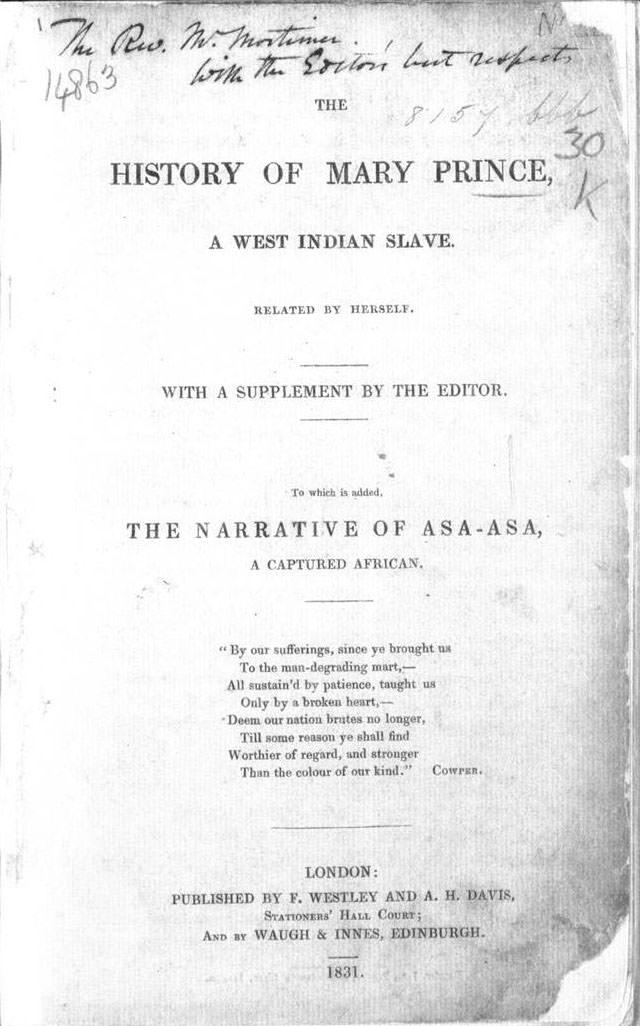
Publication created another audience. In 1831, Prince's account appeared in a book that quickly reached three editions. Yale's surviving copy announces her authorship on the title page and, immediately below, advertises an editor's supplement. The physical arrangement presents testimony together with a second voice authorized to explain and defend it.[3]
The book needs to be read with that collaboration visible. Prince told her story to Susanna Strickland, who wrote it down; Pringle edited it. In his preface, dated 25 January 1831, he described cutting repetition and correcting grammar while insisting that he preserved her account's substance. We have a powerful first-person narrative produced through named intermediaries. Its editorial history is part of the evidence.[1][4]
The return the archive cannot show
The documents make Prince's desired outcome unusually clear: she wanted freedom that would survive a journey back to her husband. They do not give us an equally clear ending. Both Yale and London Museum identify uncertainty about whether she eventually returned to the Caribbean or remained in England. A successful book and a place in abolitionist history cannot supply the missing record of her later movements.[3][4]
That gap leaves her original demand intact. Wood's notice treated departure from his house as sufficient proof of liberty. Prince's effort to secure her return tested freedom against something more demanding: the ability to choose a home and sustain a marriage without surrendering control over her own person. The petition's force lies in the distance between those two measures.
Sources
- Mary Prince, The History of Mary Prince, a West Indian Slave (1831), with Thomas Pringle's preface and supplement — especially the narrative's London passages and supplement pp. 24–31, including Wood's notice of 18 August 1828 and the negotiations surrounding the petition. Public-domain text, Project Gutenberg.
- Margôt Maddison-MacFadyen, “Mary Prince” — historical reconstruction of the marriage, journey to London, and petition presented on 24 June 1829, drawing on Prince's narrative and archival research.
- Yale Center for British Art, The History of Mary Prince (1831) — publication context, uncertainty about Prince's later life, and the title-page image of the Beinecke Library copy, Slavery Pamphlets 32.
- London Museum, “The life story of Mary Prince” — London's support network, the unsuccessful petition, the book's collaborative production, and the limits of the surviving biographical record.