The Reichstag fire has never stayed one event. On the night of February 27, 1933, flames ripped through the German parliament building in Berlin, and Marinus van der Lubbe, a twenty-four-year-old Dutch journeyman mason, was found at the scene.[4][5][6] By the following morning, the Nazi-led government had already translated the blaze into the Reichstag Fire Decree, suspending basic civil liberties in the name of national protection.[1][4] Less than a month later, with opponents arrested or intimidated and public life reordered under emergency power, the regime had the political corridor it needed to push Germany toward dictatorship.[1][3][5]
That is why the historiography matters. The sharp question is not only who lit the fire. It is also what kind of historical explanation we think we need in order to explain Hitler's seizure of power. One camp argues that van der Lubbe acted alone and that the real story is Nazi opportunism of extraordinary speed.[5][6][7] Another argues that lone-arsonist consensus became dominant for reasons that are themselves historically suspicious, and that Nazi complicity or assistance remains a live possibility rather than a discarded fantasy.[5][6] Both camps study the same building, but they assign different weight to courtroom proof, postwar memory, and the politics of who got believed.
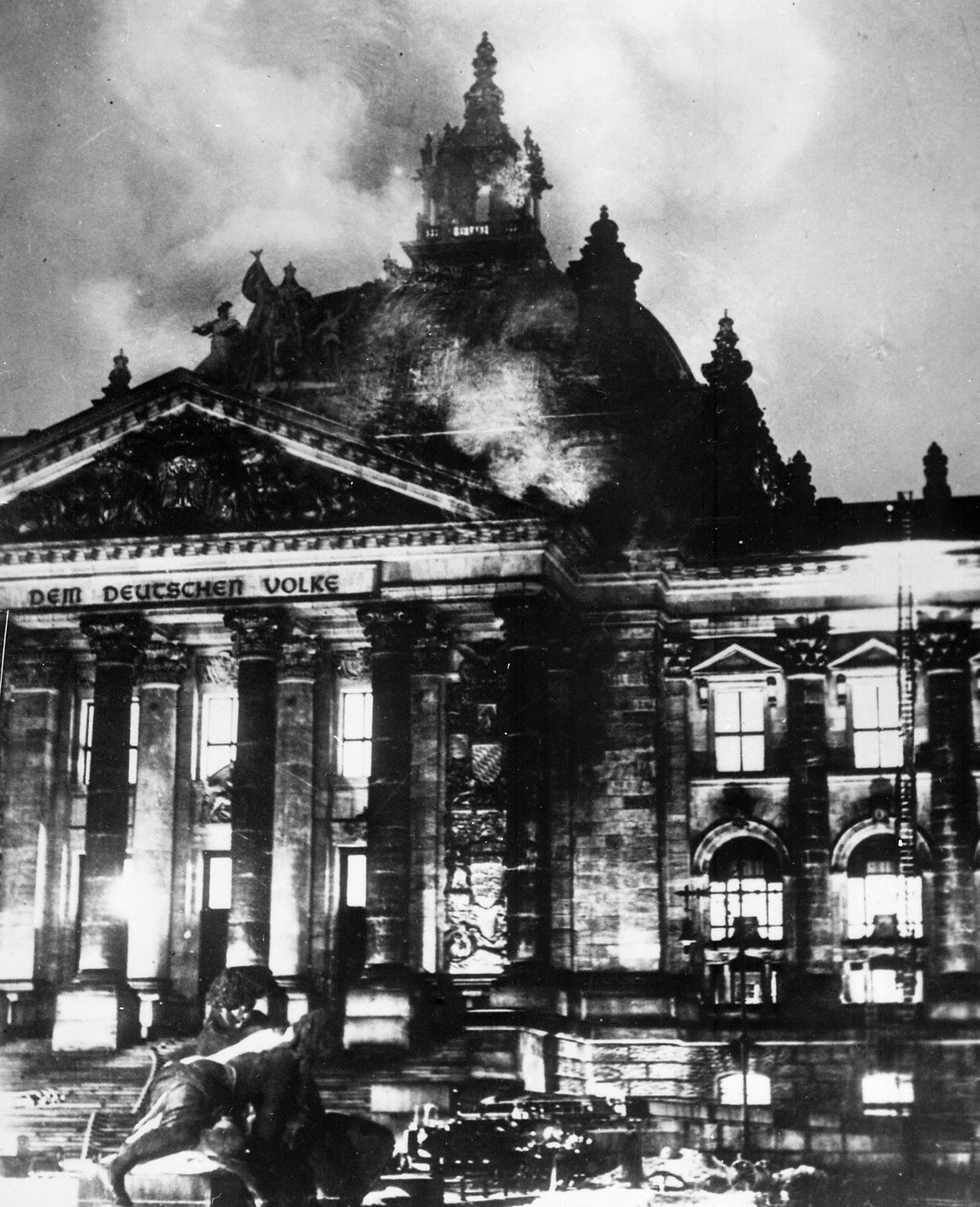
The cover image, an archival photograph of the Reichstag burning against the night sky, fits that double argument exactly.[8] It shows why the episode acquired such power so quickly. The event was visually simple, politically explosive, and ready-made for propaganda. The deeper dispute begins after that image: did the Nazis merely weaponize a fire they did not set, or did the fire itself already contain a layer of Nazi orchestration?
Timeline anchors
- 1933-02-27: the Reichstag catches fire in Berlin; van der Lubbe is arrested at the scene.[4][5][6]
- 1933-02-28: President Hindenburg signs the Decree of the Reich President for the Protection of the People and State, usually called the Reichstag Fire Decree.[1][4]
- 1933-03-05: Reichstag elections are held under emergency conditions; the Nazis still fail to win an outright majority on their own.[1][5]
- 1933-03-07: cabinet discussion shows ministers treating the fire as a legal and punitive opportunity, including talk of how quickly van der Lubbe could be executed and whether harsher penalties would survive legal review.[2]
- 1933-03-23: Otto Wels speaks against the Enabling Act, but the act passes and hands legislative power to Hitler's cabinet, with only the Social Democrats voting no.[3][5]
- 1933-12-23: the Leipzig trial convicts van der Lubbe while acquitting the other defendants, leaving the authorship question unresolved in political memory even as the dictatorship is already consolidated.[5]
Those dates matter because they separate the ignition problem from the regime-formation problem. Historians still argue about the first. The second moved with brutal speed.
What the event unquestionably did
Before turning to the two main interpretations, it helps to mark the ground that is not seriously in dispute. The fire gave Hitler and his allies an immediate pretext to suspend protections for speech, assembly, privacy, due process, and press freedom.[1][4] The decree was not a symbolic flourish. It opened the legal lane for mass arrests and for the practical neutralization of political opponents.[1][4] In other words, the building burned on one night, but the decree turned that night into a governing method.
The cabinet discussion from March 7, 1933 makes the atmosphere even clearer.[2] There, the fire no longer appears as a shocking emergency still awaiting neutral investigation. It appears as a case already folded into state strategy. The conversation recorded by GHDI shows ministers discussing punishment, legal revision, and the possibility of retroactive tightening, with concern focused less on fairness than on whether courts would accept the government's chosen speed and severity.[2] That source matters because it shows how quickly the event stopped being only forensic and became administrative.
Otto Wels's speech against the Enabling Act marks the other end of the same sequence.[3] His protest is often remembered because it was one of the last formal democratic refusals voiced inside the chamber. But the speech is also a timeline marker. By March 23, the fire had already done its regime work. The Reichstag was still meeting. Parliamentary language still existed. Yet the legal balance had already shifted so far that Wels's defense of constitutional politics functioned less as a brake than as a final record of opposition.[3]
Interpretation one: van der Lubbe acted alone, and the Nazis exploited the fire with perfect ruthlessness
This has been the dominant postwar interpretation for decades.[6][7] In Benjamin Carter Hett's summary of the field, a consensus formed from the 1960s onward around the view that van der Lubbe set the fire by himself and that no direct Nazi operational role is needed to explain the event.[6] A more recent book pushing this line is Sven Felix Kellerhoff's The Reichstag Fire: The Case Against the Nazi Conspiracy, which presents itself as a source-based defense of the anti-conspiracy position.[7]
This reading has real strengths. It does not depend on hidden tunnels, omniscient plotting, or weakly sourced rumor. It can point to van der Lubbe's repeated confessions, his prior incendiary activism, and the simple fact that authoritarian movements often exploit crises they did not engineer.[5][7] It also resists the temptation to turn every decisive dictatorship move into a secret-mastermind story. Under this interpretation, the Nazis did not need to set the fire in order to use it. They needed only ideological readiness, a prepared police apparatus, and the willingness to turn a spectacular crime into a state-of-exception machine before evidence had settled.
That emphasis on opportunism is historically serious, not evasive. It reminds us that regimes can destroy constitutional orders by reacting faster than their opponents, even when the original spark comes from somewhere else. A lone-arsonist explanation therefore does not soften the indictment of Hitler's government. It simply relocates the center of guilt from authorship of the blaze to speed of political conversion.[1][4][5][7]
Interpretation two: the single-culprit consensus hardened for political reasons, and Nazi complicity remains plausible
The revisionist challenge does not claim that every old conspiracy story was sound. Its stronger point is about how historical authority got built.[6] Hett's 2015 article argues that the single-culprit narrative was developed by former Nazis, while accounts stressing Nazi involvement more often came from resistance figures or victims of Nazism, and that postwar historians showed a marked preference for perpetrator testimony over victim testimony.[6] In that framing, the debate is not simply about whether one man could carry enough combustibles. It is also about why certain witnesses became legible as sober and others as contaminated.
That matters because the fire's political aftermath was so immediate.[1][2][4] The decree followed within hours. The election campaign that followed took place under a transformed coercive environment. And by early March, cabinet ministers were already talking in the language of exemplary punishment and legal adjustment.[1][2] For historians suspicious of the lone-arsonist account, that speed does not prove Nazi operational authorship by itself. But it does keep alive the question of whether the regime's preparedness was merely opportunistic or partly connected to deeper foreknowledge and assistance.[6]
The strongest version of this interpretation is therefore more disciplined than "the Nazis obviously did it." It says instead that the postwar closure around van der Lubbe-as-sole-arsonist may have been too confident, too dependent on compromised intermediaries, and too willing to separate the fire from the interests of the men who benefited from it most dramatically.[6] On that reading, the authorship question remains open enough that certainty should be treated with caution, especially when certainty itself has a history.
Where the historiography really bites
The most useful way to map the debate is to see that the two camps are answering slightly different questions.
The lone-arsonist camp asks a narrow causal question: who physically started the fire, and what level of evidence is sufficient to attach additional perpetrators?[5][7] It is skeptical of claims that outrun the documentary record.
The complicity camp asks a wider historical question: how did one interpretation become authoritative, whose testimony got filtered out, and how should historians handle a case in which the beneficiaries also shaped the archive and the postwar story about it?[6]
Once those question-types are separated, the episode becomes easier to read. The real hinge of February-March 1933 was not that all uncertainty vanished. It was that the Nazi state acted before uncertainty could matter. Even if van der Lubbe acted alone, the dictatorship still used the fire to suspend rights, reshape policing, and hollow out parliamentary government.[1][3][4][5] If Nazi complicity eventually proved stronger than today's dominant account allows, that would deepen the moral and operational indictment, but it would not overturn the visible sequence by which emergency power became normal government.[1][2][4][6]
That is why the safest working conclusion is not "the mystery does not matter." The safer conclusion is narrower and harder: the fire became historically decisive because legality collapsed faster than certainty formed. Historiography still disputes the match that lit the chamber. It does not seriously dispute what the regime made from the smoke.
Sources
- German History in Documents and Images, "Decree of the Reich President for the Protection of the People and State ('Reichstag Fire Decree') (February 28, 1933)."
- German History in Documents and Images, "Cabinet Discussion of the Reichstag Fire and Necessary Changes in the Law (March 7, 1933)."
- German History in Documents and Images, "Social Democratic Delegate Otto Wels Speaks out against the 'Enabling Act' (March 23, 1933)."
- United States Holocaust Memorial Museum, "Decree of the Reich President for the Protection of the People and State (Reichstag Fire Decree)."
- Encyclopaedia Britannica, "Reichstag fire."
- Benjamin Carter Hett, "'This Story Is about Something Fundamental': Nazi Criminals, History, Memory, and the Reichstag Fire," Central European History 48, no. 2 (2015).
- Sven Felix Kellerhoff, The Reichstag Fire: The Case Against the Nazi Conspiracy. Casemate Publishers edition page.
- Wikimedia Commons, "File:Reichstagsbrand.jpg."
Editor’s Pick Review
This article takes the merged standard/add-on editor-pick slot because it has the strongest last-24-hour balance of historical consequence, argumentative clarity, source discipline, and bilingual execution. The central move is unusually clean: it separates the still-contested ignition question from the much firmer regime-formation question, so the piece can treat forensic uncertainty seriously while still showing how emergency law, election pressure, and the Enabling Act turned the fire into a governing break. The source stack is also stronger than the normal history candidate pool, with primary documents from German History in Documents and Images alongside USHMM, Britannica, Hett, Kellerhoff, and the archival image record.
It also passes the stricter visual-policy gate without strain. The cover is an immersive, topic-grounded archival photograph of the Reichstag burning on the night in question, not an analytical chart, debate-map graphic, or decorative Weimar-era filler. The Chinese edition preserves the same historiographic distinction with controlled rhythm, stable legal-political terminology, and low translationese, which makes the article work as an editor pick across both English and Chinese surfaces.