The Exxon Valdez spill is usually remembered through its aftermath: black water, oiled birds, ruined fisheries, and beaches that had to be cleaned for years.[1][4][5] That memory is accurate, but it starts too late in the sequence. By the time the disaster reached television as an ecological image, it had already become a policy disaster. The sharper historical question is why one grounding in Prince William Sound forced such a fast national rethink of oil-spill governance. The answer begins before the reef. It lies in a long runway of warnings, weakened response capacity, and a first day in which the system discovered that its plans could not move at the speed of the oil.[1][2][3]
Shortly after midnight on March 24, 1989, the tanker struck Bligh Reef after leaving Valdez with 53 million gallons of North Slope crude bound for California.[1][3] Within hours, roughly 10.9 million or more than 11 million gallons had escaped into the Sound.[1][3][5] Scale mattered, but scale alone does not explain why this spill became such a durable turning point. The 1989 report to the President concluded that government and industry planning had been "unequal to the task."[2] NOAA's later reconstruction shows why that judgment arrived so quickly: Alyeska had disbanded its full-time spill team in 1981, Alaska officials had written blunt warning memos in 1984, and a response drill that same year had already exposed serious weaknesses.[2][3]
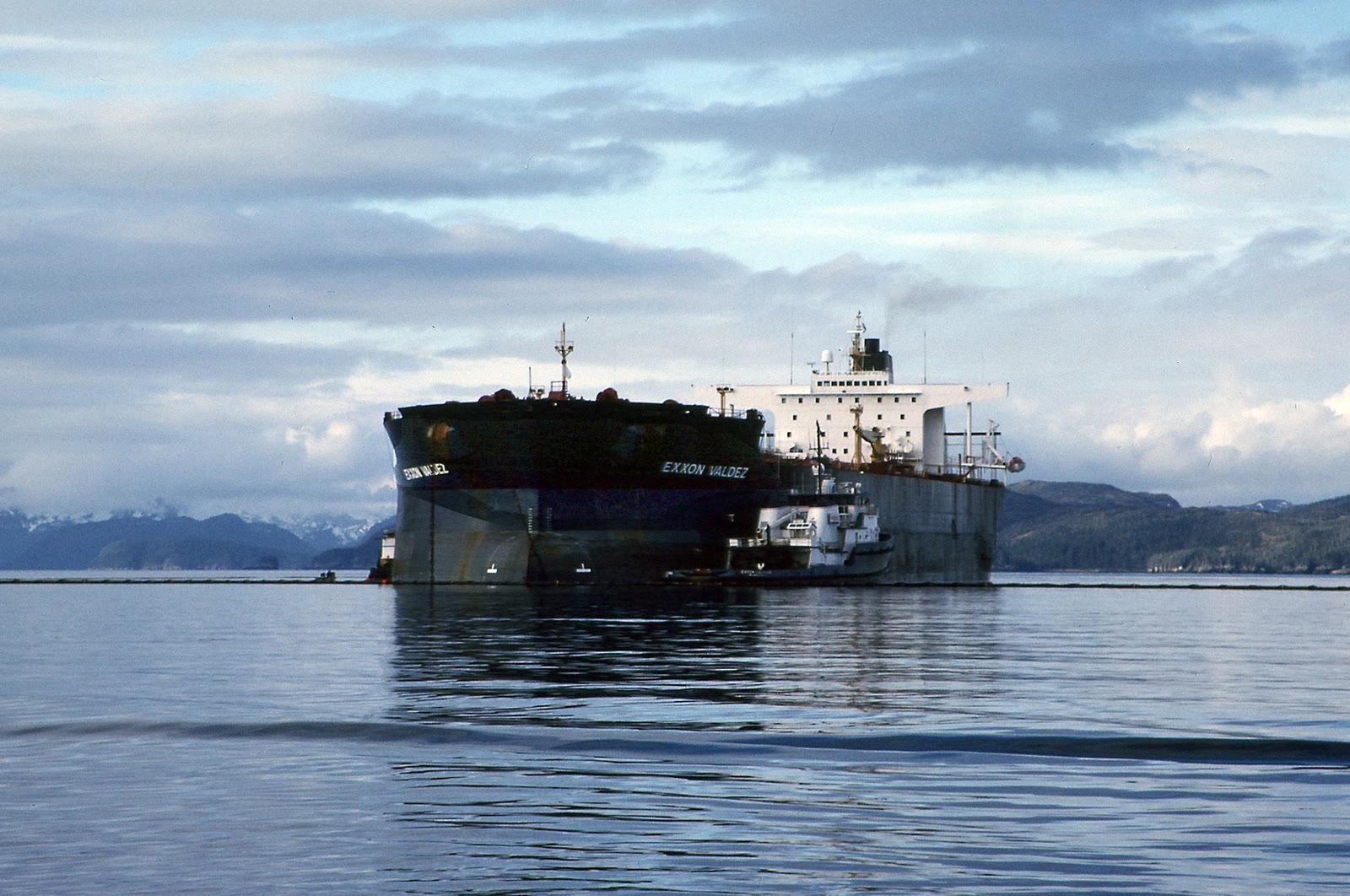
The cover image catches the event at exactly the right level.[6] It shows the tanker still present inside the disaster rather than a later shoreline abstraction. That matters because the crucial historical hinge was not only ecological spread. It was the instant when a navigational accident forced the United States to discover how little real first-day capacity sat behind its contingency language.[1][2][3]
Timeline anchors before the spill became law and memory
- 1973: the Trans-Alaska Pipeline Authorization Act cleared the path that would connect Prudhoe Bay oil to the tanker port at Valdez.[3]
- 1981: Alyeska disbanded its full-time oil-spill team and reassigned those workers elsewhere.[3]
- 1984: Alaska Department of Environmental Conservation staff warned that response equipment had been dismantled, and a spill-response drill was judged a failure.[3]
- January 1989: two smaller spills at the terminal drew renewed attention to cleanup problems and response capacity.[3]
- Late March 23 / early March 24, 1989: the Exxon Valdez loaded crude, departed Valdez after 9:00 p.m., and struck Bligh Reef a little over three hours later.[3]
- March 25, 1989: the Alaska Regional Response Team was convened by teleconference and the National Response Team was activated.[1]
- 1990: Congress passed the Oil Pollution Act, the clearest policy consequence of the spill.[1][5]
These dates matter because they keep the event from shrinking into a single bad night. The grounding was sudden. The institutional vulnerability behind it was not.
1. The reef was a test of a system that had already been warned
The spill's real prehistory begins with Alaska oil becoming a national logistics project. NOAA's retrospective traces the chain clearly: Prudhoe Bay's oil reserves were confirmed in 1968, the 1973 oil embargo turned Alaskan petroleum into a national security issue, and the pipeline-to-tanker system through Valdez became the infrastructure that would move that crude south.[3] Once that system existed, the crucial question was no longer whether oil would travel through Prince William Sound. It was how seriously operators and regulators treated failure inside that route.
Here the pre-spill record is unusually blunt. In 1981, despite complaints from Alaska officials, Alyeska chose to disband its full-time spill-response team.[3] In May 1984, field officers in Valdez wrote a memo warning that pollution-abatement equipment had been dismantled and that Alyeska lacked the ability to handle a major spill.[3] Later that same year, another memo detailed continuing shortcomings, and an oil-spill practice drill was judged a failure by state and federal observers.[3]
That sequence matters because it changes the event's moral geometry. The spill was not a pure bolt from the blue. It landed inside a regime that had already been told where its response assumptions were thin. Even the approved contingency planning carried a revealing confidence. In 1987, Alyeska's plan described how it would manage a spill of 8.4 million gallons, while also treating a catastrophic event as highly unlikely.[3] On paper, that sounded like foresight. In practice, it encouraged the system to confuse scenario-writing with readiness.
The alarm had not even gone fully quiet by the time the tanker sailed. In January 1989, the Valdez terminal experienced two smaller spills that again drew attention to response problems. Alyeska promised new boom, new response boats, and a high-tech skimmer, but some of that equipment was still scheduled for future delivery rather than present use.[3] This is the piece of prehistory that makes the later failure feel so sharp. The Sound had already staged a warning rehearsal. The system answered with partial promises and future procurement.
2. The night of March 23-24 turned preparedness language into open water
NOAA's chronology lets the event itself be reconstructed with unusual precision. On March 22, the Exxon Valdez arrived at the marine terminal and began ballast discharge and loading.[3] Loading finished late on March 23, and shortly after 9:00 p.m. the tanker departed with 53 million gallons of crude.[3] Early on March 24, a little over three hours out, it struck Bligh Reef.[3] EPA's profile compresses the immediate result into one brutal line: more than 11 million gallons of crude spilled into Prince William Sound.[1]
From that point forward, the event became a race between spreading oil and response capacity. EPA's report to the President described the early reality in stark terms. The slick spread across more than 3,000 square miles and onto over 350 miles of beaches in Prince William Sound.[2] NOAA's restoration page describes the longer tally differently, emphasizing eventual injury to more than 1,300 miles of shoreline.[5] Those measurements are not contradictory. They show the same disaster at different stages and through different lenses: immediate spread, then cumulative shoreline consequence.
The official first actions also show how quickly the federal state had to enter. Because the spill occurred in open navigable waters, the U.S. Coast Guard federal on-scene structure applied at once.[1] The port of Valdez was closed to traffic, investigators moved to assess damage, and by noon on March 25 the Alaska Regional Response Team had been assembled by teleconference, followed by activation of the National Response Team.[1] Under the existing contingency structure, Alyeska initially assumed cleanup responsibility and opened operations centers in Valdez and Anchorage.[1]
Yet the point of the event reconstruction is that administrative movement and operational sufficiency were not the same thing. The 1989 presidential report says initial industry efforts to get equipment on scene were "unreasonably slow," and once equipment arrived, it still could not cope with the spill's magnitude.[2] That is the hinge. The nation did not merely witness a tanker accident. It witnessed the public failure of the entire first-response imagination behind late-Cold War oil transport.
3. The lost first day made cleanup into a second disaster
EPA's spill profile is especially useful here because it shows the cleanup not as one coherent operation but as a series of constrained experiments.[1] Three methods were tried early: burning, mechanical recovery, and chemical dispersants.[1] Each reveals a different kind of inadequacy.
The trial burn came first. Responders used a fire-resistant boom, filled it with oil away from the main slick, and ignited the contained pool.[1] The attempt worked once, but unfavorable weather prevented further burning.[1] Mechanical cleanup followed, yet skimmers were not readily available in the first 24 hours.[1] Thick oil and heavy kelp clogged equipment. Damaged skimmers took time to repair. Even moving recovered oil from temporary storage to more permanent containers proved difficult because the crude was so heavy.[1]
Dispersants exposed a third limit. Alyeska had less than 4,000 gallons of dispersant in Valdez and lacked its own application aircraft or equipment.[1] A private company applied dispersant by helicopter on March 24, but the Coast Guard concluded the technique was not working because there was too little wave action to mix it effectively into the water column.[1] Use was discontinued.[1]
What emerges from these details is not simply a picture of harsh weather and remote geography, though both mattered.[1][2] It is a picture of mismatch. The spill was large, the region rugged, the oil difficult, the logistics slow, and the tools either absent, clogged, weather-limited, or politically contentious. In that sense the first day was "lost" twice: once to the grounding itself, and again to the revelation that no method could quickly compress the gap between spill rate and response rate.
This also helps explain why later cleanup debates became so charged. NOAA's response page notes that shoreline work included hot-water washing and mechanical scrubbing, and that long-term monitoring from 1989 to 2000 was needed to determine how recovery differed across treated and untreated habitats.[4] The spill therefore produced a second-order historical lesson. The country discovered not only that it was unready for a major spill. It also discovered that cleanup technology itself carried ecological tradeoffs that had not been fully settled in advance.[2][4]
4. March 1989 turned one tanker accident into a new federal oil state
The strongest evidence that Exxon Valdez became policy history lies in the speed and direction of official judgment. The presidential report did not frame the spill as a freak episode that only required better luck next time. It identified deficient preparedness, inadequate equipment, weak planning for worst-case scenarios, unclear responsibilities, and the need for liability reform and stronger federal planning.[2] That diagnosis moved the debate away from individual fault alone and toward system design.
The legislative outcome is visible on both EPA and NOAA pages. EPA states that Congress responded with the Oil Pollution Act of 1990, which tightened vessel and owner regulation, improved captain-to-traffic-center communication, and pushed tanker safety toward better hull protection.[1] NOAA's restoration page adds that the spill's policy afterlife included the creation of the institutional world in which modern restoration and assessment programs would operate; it explicitly ties the spill to the Oil Pollution Act and to the establishment of NOAA's DARRP framework.[5]
The financial cleanup also belonged to this transition from accident to statecraft. NOAA's DARRP page records Exxon's 1991 settlement in three parts: a $25 million criminal plea agreement, $100 million in criminal restitution, and a $900 million civil settlement.[5] That settlement funded decades of restoration, monitoring, and habitat protection.[5] In other words, the spill's history did not end when the tanker stopped leaking. It continued through legal design, restoration finance, and a new expectation that large spills would be treated as long-tail public injuries rather than short, containable incidents.
Why this event reconstruction still matters
The most useful way to remember Exxon Valdez is therefore sequentially. First came the infrastructure story: pipeline oil, tanker routes, contingency plans, and repeated warnings.[3] Then came the navigational accident at Bligh Reef.[1][3] Then came the first-day operational failure, when equipment, geography, weather, and organizational capacity fell badly out of alignment.[1][2] Only after that did the spill become the familiar environmental symbol of oiled wildlife and blackened shorelines.[1][4][5]
That sequence is what made March 1989 such a turning point. The ecological damage was immense, but the national shock came from something colder and more administrative. One tanker accident revealed that the United States had built a high-throughput oil corridor through a sensitive place without building equally convincing first-day capacity for a major failure inside it. Exxon Valdez entered history as a spill. It stayed in history because it exposed the distance between contingency language and operational truth.
Sources
- U.S. Environmental Protection Agency, "Exxon Valdez Spill Profile" - official overview of the grounding, first response steps, cleanup methods, and the Oil Pollution Act aftermath.
- U.S. Environmental Protection Agency / National Response Team, The Exxon Valdez Oil Spill: A Report to the President (Executive Summary) - official 1989 assessment of preparedness failures, early response limits, and policy lessons.
- NOAA Office of Response and Restoration, "Looking Back: What Led up to the Exxon Valdez Oil Spill?" - prehistory of the pipeline system, Alyeska warnings, drills, and the March 23-24 chronology.
- NOAA Office of Response and Restoration, "Response to the Exxon Valdez Spill" - NOAA's on-scene role, shoreline treatment methods, and the 1989-2000 monitoring program.
- NOAA Damage Assessment, Remediation, and Restoration Program, "Exxon Valdez" - shoreline impact totals, wildlife losses, 1991 settlement structure, restoration work, and the spill's link to the Oil Pollution Act of 1990.
- Wikimedia Commons, "File: Exxon Valdez Oil Spill (13266806523).jpg" - NOAA archival image source page for the grounded tanker photograph used here.