In July 1951, diplomats in Geneva wrote a treaty with two different clocks inside it. One clock stopped at 1 January 1951: the Convention's general definition covered people made refugees by events before that date. The other clock had no obvious end. It joined a test for refugee status to rules about work, courts, documents, movement, expulsion, and—most importantly—return to danger.[1]
That mismatch is the key to the Convention's survival. The dateline made the bargain look backward, toward a Europe still crowded with the consequences of war and persecution. The legal machinery built around it was capable of travelling. In 1967, states did not reopen all forty-six articles and negotiate a replacement. They adopted a short, independent Protocol that told its parties to use the Convention's core as though the limiting date had been omitted.[2][3][5]
The result was not a universal promise that anyone could enter any country. Nor did the text protect every person displaced by war, poverty, or disaster. It did something narrower and more durable: it defined a protected relationship between a person outside the protection of their country and the state in whose jurisdiction they now stood. Read closely, the Convention lasts because its central obligations were difficult to dilute, while its most obvious historical boundary was designed in a form that could be lifted.
A postwar treaty written as a state bargain
The Convention came out of a sequence, not a single enlightened afternoon. On 14 December 1950, the UN General Assembly both established the Office of the High Commissioner for Refugees and decided to convene a diplomatic conference to finish a refugee convention. The new office began work on 1 January 1951 with an initially three-year mandate. The conference met in Geneva from 2 to 25 July 1951, and the Convention opened for signature on 28 July. The treaty entered into force on 22 April 1954, after the sixth ratification or accession.[3][4]
Those dates reveal the institutional mood. The United Nations was willing to create an international protection office, but states still controlled borders, legal status, employment, welfare, and naturalization. Guy Goodwin-Gill's history for the UN Audiovisual Library of International Law describes the Convention's form as an agreement among states about how they would treat refugees after a border crossing, rather than a system for preventing flight or protecting people displaced inside their own countries.[3]
The preamble states the tension openly. It connects refugee protection to fundamental rights, then acknowledges that asylum can place heavy burdens on particular countries and cannot be addressed without international cooperation.[1] Yet the operative articles do not allocate those burdens among states. The document is strongest after a person has reached a state's jurisdiction: it determines who fits the category, what standards follow, and where state power must stop.
Article 1 turns flight into a legal test
Article 1 does more than attach the word refugee to a sympathetic story. Its general definition assembles several conditions. A person must be outside the country of nationality—or, if stateless, outside the country of former habitual residence. The person must be unable or unwilling to rely on that country's protection because of a well-founded fear of persecution. And the feared persecution must be connected to race, religion, nationality, membership of a particular social group, or political opinion.[1][3]
Each part narrows the category. Crossing an international frontier distinguishes Convention refugees from internally displaced people. “Well-founded” joins a person's fear to an assessment of risk. The five protected grounds demand a connection between persecution and the reason for it; the Convention does not simply define a refugee as anyone escaping serious hardship. At the same time, “unable or unwilling” recognizes that protection can fail because a government persecutes, tolerates persecution, or cannot prevent it.[1][3]
The article also contains exit doors. Refugee status can cease after voluntary re-establishment, effective acquisition of a new nationality, or a sufficiently durable change in the circumstances that produced the fear. Separate clauses exclude people already receiving certain UN protection or assistance and people for whom there are serious reasons to consider that they committed war crimes, serious non-political crimes, or acts contrary to UN purposes.[1]
This architecture matters because status is neither an award for innocence in general nor a permanent identity assigned to everyone who moves under pressure. It is a legal answer to a particular protection failure. The definition is demanding, but once it is met, the rest of the Convention has someone to act upon.
Article 33 makes return the red line
The Convention's moral centre is Article 33, the rule of non-refoulement. It says a contracting state must not expel or return a refugee “in any manner whatsoever” to a territory where life or freedom would be threatened for one of the five Convention reasons.[1] The phrasing looks beyond the label attached to a state action. Deportation, removal, or transfer cannot escape the rule merely by changing its administrative name.
The protection is powerful but not unqualified. Article 33(2) withholds its benefit when reasonable grounds identify a refugee as a danger to the host country's security, or when a final conviction for a particularly serious crime makes that person a danger to the community. The drafting history shows that an earlier proposal contained no such exception; the 1951 conference added one.[3] That history keeps two boundaries visible at once: the return ban was meant to be broad, and the final bargain still preserved a narrow security-and-danger escape valve.
What states were not allowed to do is equally telling. Article 42 permitted reservations to many Convention provisions but not to Article 1, the non-discrimination and religion articles, basic access to courts, or Article 33.[1] A state could qualify some social or administrative commitments when joining. It could not join while reserving the right to invent its own refugee definition or disregard the central return prohibition.
Articles 31 and 32 reinforce the sequence. Article 31 limits penalties for refugees who arrive without authorization after coming directly from danger, provided they present themselves promptly and show good cause. Article 32 restricts expulsion of a lawfully present refugee to national-security or public-order grounds and requires a lawful decision with procedural safeguards. Article 33 then asks the final question even when removal is contemplated: removal to where?[1]
These clauses do not create an unrestricted right to choose a destination. They recognize a more basic reality. Flight from persecution may not arrive with a visa, and a state's power to regulate presence does not include a general licence to send a protected person into the threatened territory.
The dateline was a fence with a hinge
The Convention's most conspicuous limit sits inside the same Article 1 definition. It originally required the well-founded fear to result from “events occurring before 1 January 1951.” States then chose between two declarations: events in Europe, or events in Europe or elsewhere, before that date.[1] The original treaty was therefore not automatically Europe-only, but every version was time-bound.
That wording converted uncertainty into a manageable commitment. Governments could accept rules for a known postwar problem without signing what they feared might be an unlimited obligation toward future refugee movements. Goodwin-Gill characterizes this as reluctance to write a blank cheque; he also points out the resulting mismatch, because UNHCR's mandate was general while the treaty's definition looked backward.[3]
The date did not merely make the Convention old-fashioned later. It guaranteed that a new persecution beginning after 1950 could not, by itself, bring its victims inside the original general definition. Decolonization, new wars, and new regimes produced precisely the cases that the legal machinery could address but the temporal gate could not admit. The defect was located in a few words, however, rather than distributed across the whole treaty.
That is the hinge. The delegates had negotiated a reusable definition of persecution and lost protection, a non-return rule, and standards of treatment. They had attached those elements to an expiring intake rule. The later task was to detach the date without dismantling what followed.
The 1967 Protocol removes words instead of reopening the treaty
By April 1965, legal experts meeting at Bellagio were considering how to close the gap. They rejected a complete revision and favoured a protocol. After consultation through UNHCR, the Economic and Social Council, and the General Assembly, the Protocol was opened for accession in New York on 31 January 1967 and entered into force on 4 October 1967.[3][5]
Its method is remarkably economical. Article I requires parties to apply Articles 2 through 34 of the Convention. For the refugee definition, it instructs them to read Article 1 as if the phrases tying status to events before 1 January 1951 were omitted. It also directs application without a geographic limitation, subject to a narrow carry-over for existing declarations by Convention parties.[2]
The Protocol is often described as an amendment, but legally it is an independent instrument. A state can accede to it without becoming a party to the Convention itself. What the state accepts is the substantive Convention package—definition, treatment standards, and non-refoulement—without the old dateline.[3] This was modular treaty design before the phrase became fashionable: preserve the difficult bargain, replace the obsolete gate.
The move also clarifies what did not change. The Protocol did not broaden the five persecution grounds, create protection for every person fleeing armed conflict, grant a general right of admission, assign responsibility for an asylum claim to a particular state, or build a mandatory system for sharing costs. Regional instruments and later human-rights law would address some gaps, but the 1951 framework retained its characteristic shape.[3]
A durable instrument, not a complete one
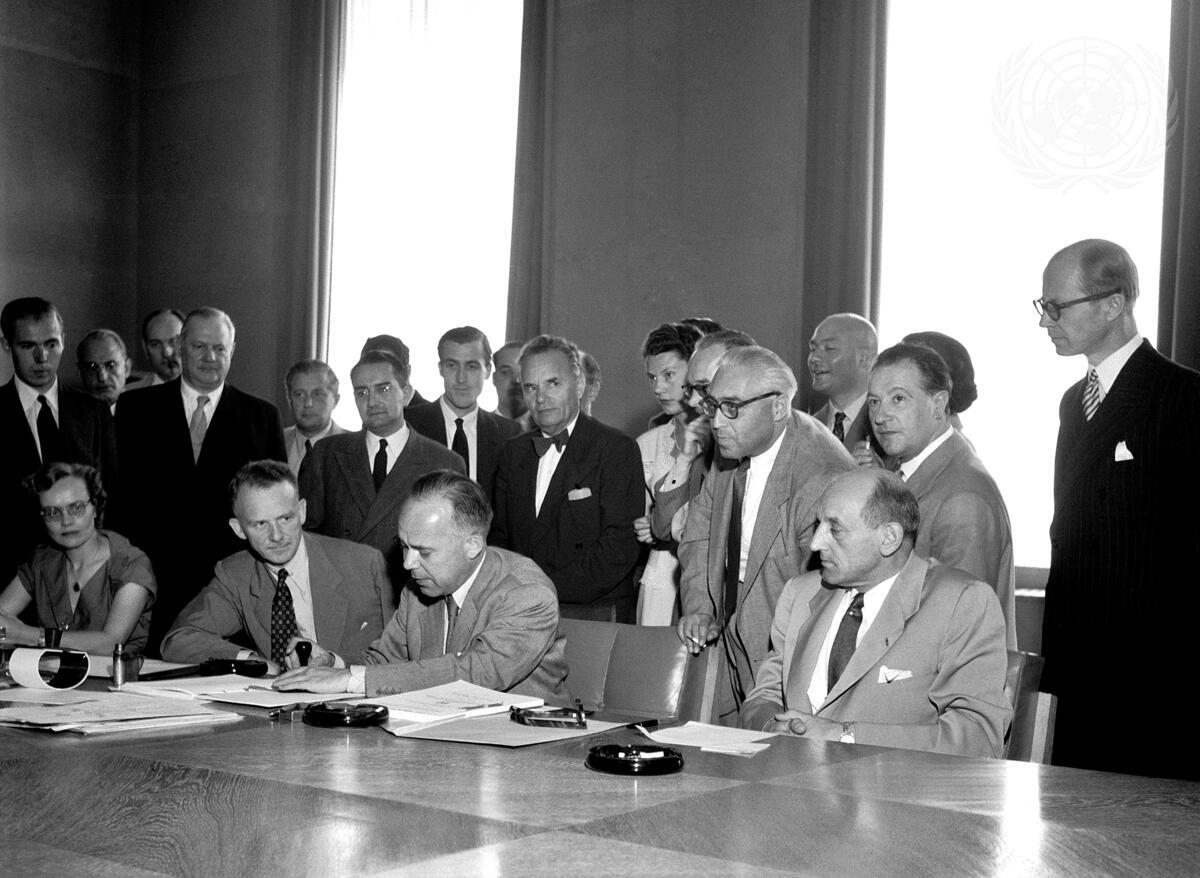
The photograph from Geneva shows law being made at table scale: papers, ashtrays, translators, staff, and delegates leaning into a text.[6] Its later archival correction is a useful warning. Margaret Kitchen, the deputy executive secretary who helped keep the conference working, sat visibly at the table while disappearing from the original caption. A protection system can be consequential and still leave people or categories outside its frame.
The Convention should be judged with the same double vision. Its original dateline and optional European boundary were political limits, not timeless principles. Its definition remains narrower than displacement itself. Its return rule has exceptions, and its articles do not solve admission or responsibility-sharing. None of those absences should be hidden behind anniversary language.[1][3]
But the close reading also explains why the text was not discarded when the postwar moment passed. Article 1 translated failed national protection into an international legal category. Article 33 made return to threatened territory a red line that parties could not reserve away. The surrounding articles turned recognition into a lived status through courts, papers, movement, work, education, and social protection. Then the Protocol removed the date without forcing every promise back onto the negotiating table.[1][2][3]
The Refugee Convention survived its own historical fence because the fence was not the foundation. The foundation was a sequence: identify the protection failure, attach standards to the person who meets the test, and constrain what a state may do next. In 1967, states widened the sequence's reach by deleting a deadline. The incompleteness remained, but so did the protection.
Sources
- United Nations Treaty Series, Convention relating to the Status of Refugees (Geneva, July 28, 1951), vol. 189, no. 2545 — official English treaty text, including Articles 1, 31–33, and 42.
- United Nations, Protocol relating to the Status of Refugees (New York, January 31, 1967) — certified official text, including the removal of the Convention's temporal and geographic limits.
- Guy S. Goodwin-Gill, United Nations Audiovisual Library of International Law, “Convention relating to the Status of Refugees, 1951, and Protocol relating to the Status of Refugees, 1967” (2008) — historical context, drafting history, non-refoulement, Protocol design, and limits of scope.
- United Nations Treaty Collection, “Convention relating to the Status of Refugees,” registration no. 2545 — official conclusion date, entry into force, authentic texts, and treaty actions.
- United Nations Treaty Collection, “Protocol relating to the Status of Refugees,” chapter V, no. 5 — official accession date, entry into force, procedural note, and treaty status.
- United Nations Archives and Records Management Section, “UN Photo: A Woman Rediscovered” (July 5, 2022) — source page for the 1951 conference photograph and the archival identification of Margaret Kitchen Bruce.