In 1943, one of the Anglo-American alliance's strategic problems was how an American soldier should enter a British pub. A Welcome to Britain treats the answer with a light touch: do not expect ice in the beer, do not mistake reserve for hostility, and remember that a room used for drinking is also a neighbourhood's social centre. Yet the film's scale is larger than its jokes. An invasion force was assembling in a country already worn by bombing, rationing, and four years of war. A quarrel in a bar, on a train, or around a dinner table could become friction inside the coalition preparing to cross the Channel.
Between January 1942 and December 1945, about 1.5 million American service personnel passed through Britain; around 150,000 were Black. The U.S. military brought its formally segregated units with it. British civilians often received Black troops more freely than white Americans expected, while British officials also made pragmatic accommodations to American segregation. The result was not a simple contrast between a prejudiced United States and a tolerant Britain. It was a collision among Jim Crow institutions, British social practice, imperial racism, local choices, and the military demand that allies remain workable.[5][7]
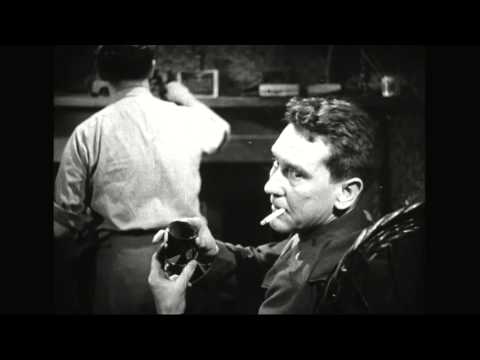
The film asks viewers to encounter that collision through performance. Actor and U.S. Army Air Forces captain Burgess Meredith plays an affable guide who claims expertise after only three weeks in the country. The British War Office presented the picture; the British Ministry of Information made it on the War Office's behalf with assistance from the U.S. Office of War Information. It was shown to arriving American forces, and the BFI National Archive now preserves the government film on behalf of The National Archives.[2][3][10] The embedded National Archives version runs about 38 minutes and is catalogued as an edited cut, while British institutional records describe the film as a six-reel work running roughly 55–56 minutes. Timestamps below refer to the embedded cut.[1][3][10][11] Watch how Meredith turns national difference into a series of manageable gestures—and then watch what happens when a Black GI enters the frame. At that moment, etiquette reaches a boundary it cannot repair.
An Alliance Reduced to Human Scale
The opening minutes establish the film's method. Rather than begin with strategy rooms or combined commands, it gives Meredith a pub, a railway platform, a cup of tea, and a direct line to the camera. The joke about his three-week expertise makes him useful: he is American enough to share the viewer's uncertainty but newly initiated enough to translate. Britain becomes legible through somebody who has just learned the rules himself.[1][2]
Those rules had already circulated in print. The War Department's 1942 Instructions for American Servicemen in Britain explained British reserve, wartime scarcity, accents, sport, pubs, women in uniform, and the danger of eating too much of a host family's weekly ration. Its bluntest logic was military: insulting one's hosts was not merely rude but damaging to the war effort.[4] The film makes the same argument without looking like a manual. Meredith's glances, comic hesitation, and movement through ordinary spaces turn discipline into charm.
This is propaganda in the broad and revealing sense: it organizes perception before it asks for action. A quiet passenger is not aloof; warm beer is not backward; a shabby street is evidence of endurance rather than national decline. Each correction protects the alliance from a possible American misreading. Recent scholarship on the film describes these routines as part of the social work by which allies learned to occupy the same space.[9] That reading is persuasive, but the camera adds a sharper point. Coalition warfare had to be reproduced off duty. The pub and the tea table were small institutions of combined command.
The film's Britain is therefore both observed and manufactured. It offers real conditions—blackouts, shortages, delayed mail, bomb damage—inside a friendly national character assembled for American consumption. The distinction matters. The picture does not simply document how Britons were. It selects the version of Britain most useful to keeping hundreds of thousands of foreign troops patient, respectful, and cooperative.
Around 25:00, Courtesy Meets the Segregated Army
Near the film's two-thirds point, a British woman who has been chatting with Meredith and a Black GI invites both men to tea if they visit Birmingham. When she leaves, the Black soldier tactfully steps away. Meredith turns to the camera and tells his implied white audience that Britain has fewer social restrictions. His key instruction is situational: “the point is we're not at home.”[1][2]
The sentence is more limited than it first appears. It does not argue that segregation is unjust everywhere, order the Army to integrate, or give the Black soldier space to describe his own experience. It asks white Americans to suspend the export of certain prejudices while abroad. Tolerance appears as good guest behaviour, not equal citizenship. The alliance is protected; the institution producing the problem remains intact.
The scene's staging makes that limit visible. The invitation comes from an older white British woman, which drains the encounter of the sexual anxiety that often inflamed white American hostility to relationships between Black GIs and British women. Meredith controls the explanation. Major General John C. H. Lee then appears as white command authority and speaks of citizenship and opportunity while presiding over a Services of Supply organisation in which Black troops were heavily concentrated. The film acknowledges racial injustice through voices chosen to keep the lesson safe.[2][5]
Most strikingly, Imperial War Museums says it has not been able to identify the Black GI at the centre of the sequence. Its researchers can name Meredith, Lee, and many of the white participants, but not the man whose polite conduct supplies the film's evidence.[2] He is essential to the demonstration and unnamed in the available record. That archival imbalance mirrors the military one: Black service made Allied logistics possible while Black servicemen were frequently recorded as a category, a labour force, or a social “problem” rather than as individuals.
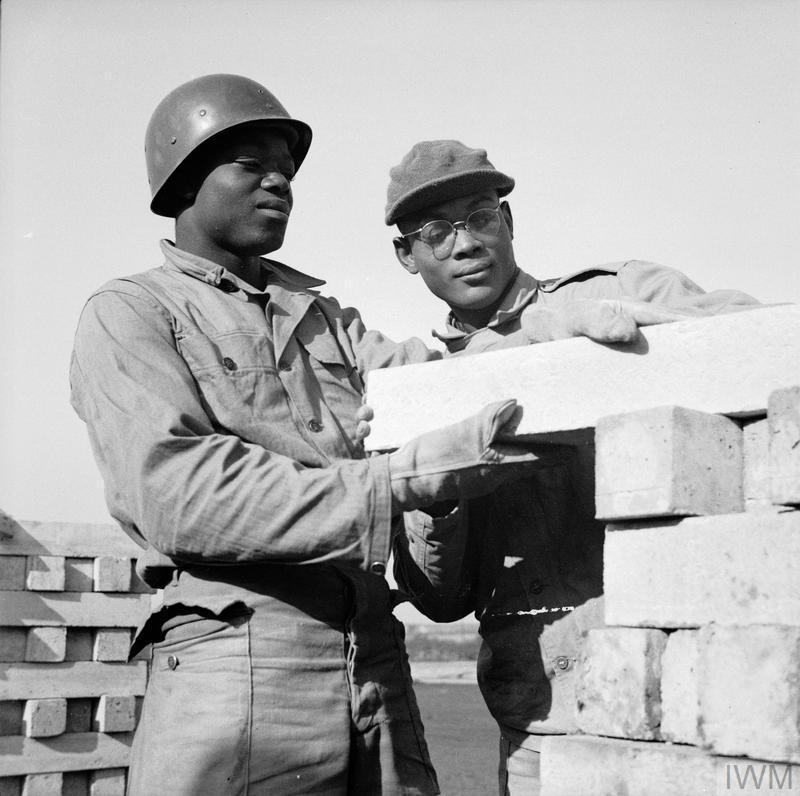
The hero photograph changes the emphasis. Made by War Office photographer Alphonsus J. P. O'Brien on October 7, 1943, it shows Black American soldiers engaged in railway construction in Britain.[8] The image does not refute the film's tea invitation; it restores the work outside its frame. Black units drove trucks, laid rail, built airfields, catered, and moved supplies for the force gathering toward the invasion. The smiling lesson in manners rested on segregated labour that was indispensable to coalition power.[5]
What the Film Smooths Over
The warm British welcome was real for many Black troops, but it was neither universal nor structurally uncomplicated. Imperial War Museums' synthesis draws on Black veterans and British witnesses who remembered a freedom from the formal colour bar they knew in the United States. The same account notes British prejudice, restrictions imposed by American commanders, and a 1942 British Cabinet preference for avoiding excessive local intimacy with Black soldiers because officials feared friction with a crucial ally.[5] Britain could reject an imported colour bar in one pub and accommodate it at government level.
The film similarly turns conflict into a matter of individual adjustment. Events on the ground show why that was insufficient. At Bamber Bridge on June 24, 1943, white U.S. military police attempted to arrest Black soldiers from the 1511th Quartermaster unit after a confrontation over dress regulations at a local pub. The dispute escalated into gunfire; one Black soldier, Private William Crossland, was killed, and seven people were injured. Subsequent accounts placed substantial blame on discriminatory policing and poor command.[6][7]
Bamber Bridge should not be used as a sensational “real story” that makes the film false. The relationship is more instructive than that. Both the training picture and the violence belonged to the same effort to station a segregated American mass army within a society governed by a different racial order. The film tried to prevent collision through cultural education. Bamber Bridge exposed what education could not neutralize while the Army kept separate units, unequal assignments, racially charged policing, and white command power in place.
This gives the film two defensible readings. In the first, A Welcome to Britain was unusually direct for a wartime orientation picture: it told white Americans that their home conventions had no automatic authority in an ally's country and presented respectful social contact with a Black soldier as ordinary. In the second, it converted a structural injustice into a temporary etiquette problem, asking prejudice to become less disruptive without asking segregation to end. The same scene supports both interpretations. Its challenge to white viewers is real; so is the narrowness of the remedy.
The Pronoun Test
A useful way to watch the entire film is to ask who “we” means at each moment. Sometimes it joins Americans: we are strangers learning the habits of our hosts. Sometimes it joins the allies: we share a war, shortages, danger, and an approaching invasion. In the race sequence, however, the pronoun contracts. Meredith speaks as though the audience that must manage its reaction is white, while the Black GI becomes the person being discussed.
That shift reveals the film's deepest assumption. It imagines the typical American soldier as white even though Black troops were present in great numbers and central to the service-and-supply system. The unidentified actor does not receive the same comic intimacy Meredith offers the viewer. He performs perfect courtesy and then yields the explanatory space. The picture can include him visually without fully admitting him into its speaking “we.”
The boundary did not remain fixed. Black wartime service, the Double V campaign, pressure from civil-rights organisations, postwar violence against veterans, and the military's own manpower experience all fed the political struggle that produced President Harry Truman's July 26, 1948, Executive Order 9981. Even then, the order's promise of equality did not integrate every service immediately; Army resistance, the Fahy Committee, policy revisions, and the Korean War all shaped the longer implementation.[6][7] The 1943 film belongs before that change, at a moment when officials could praise fair opportunity and preserve segregation in the same sequence.
That is why A Welcome to Britain deserves more than nostalgic viewing. Its warm beer, tea, accents, queues, and jokes show culture being engineered for coalition. Its Black GI shows the cost of defining alliance friction as a problem of manners alone. Courtesy mattered: armies made of millions of people cannot cooperate without it. But courtesy could make a segregated system function more smoothly without making the system just.
The film's achievement and failure occupy the same frame. It taught Americans that entering another country required humility. It stopped short of asking whether returning home should require transformation. The soldier the film presents as coming from Birmingham, Alabama, is left standing at that threshold—welcomed to tea, necessary to the war, and still outside the film's “we.”
Sources
- U.S. National Archives, “Welcome to Britain, 1943” — official YouTube upload of a 38-minute archival edit of the wartime training film.
- Imperial War Museums, “Welcome to Britain: An Introduction for American Troops” — production context, curatorial introduction, transcript excerpts, and discussion of the unidentified Black GI.
- BFI Player, “A Welcome to Britain” (1943) — British Film Institute catalogue, credits, subjects, and preservation provenance.
- Imperial War Museums, “Tips for American Servicemen in Britain During the Second World War” — excerpts from the War Department's 1942 orientation handbook and its advice on reserve, rationing, pubs, and alliance conduct.
- Emily Charles, Imperial War Museums, “They treated us royally? Black Americans in Britain during WW2” — troop numbers, segregated labour, British policy, local encounters, and veteran testimony.
- Thomas Richardson, U.S. National Archives, “Victory at Home and Abroad: Combating Segregation in the Armed Forces” (February 18, 2021) — the Double V campaign, Bamber Bridge, and the postwar desegregation context.
- Morris J. MacGregor Jr., U.S. Army Center of Military History, Integration of the Armed Forces, 1940–1965 — official history of wartime segregation, conflict in Britain, Executive Order 9981, and implementation.
- Imperial War Museums, “Americans in Britain, 1942–1945,” catalogue no. H 33450 — object record for the October 7, 1943 War Office railway photograph used as the article image.
- Brent J. Steele, “How to behave in Britain: co-presencing Anglo-American forces in the Second World War,” Australian Journal of International Affairs 80, no. 1 (published online 2025; issue 2026), DOI 10.1080/10357718.2025.2587690 — analysis of the film's cultural education and everyday alliance routines.
- Imperial War Museums Film Archive, “A Welcome to Britain,” film no. COI 938 — opening-title production attribution, format, six-reel length, and 56-minute running time.
- U.S. National Archives Catalog, “Welcome to Britain,” NAID 7460305 — official catalogue record identifying the National Archives copy as edited.