The smallest version of the Radium Girls story is easy to remember: young women painted glowing watch dials, licked their brushes, became ill, and eventually proved that radium was dangerous. That version is true in outline, but it makes the history feel like a grim parable about naive faith in a miracle substance. The evidence points to something sharper. The dial painters' story was a workplace system before it was a courtroom legend: a production method, a gendered labor market, a medical delay, a corporate defense strategy, and finally a struggle to make internal exposure legible to law.[1][2][3]
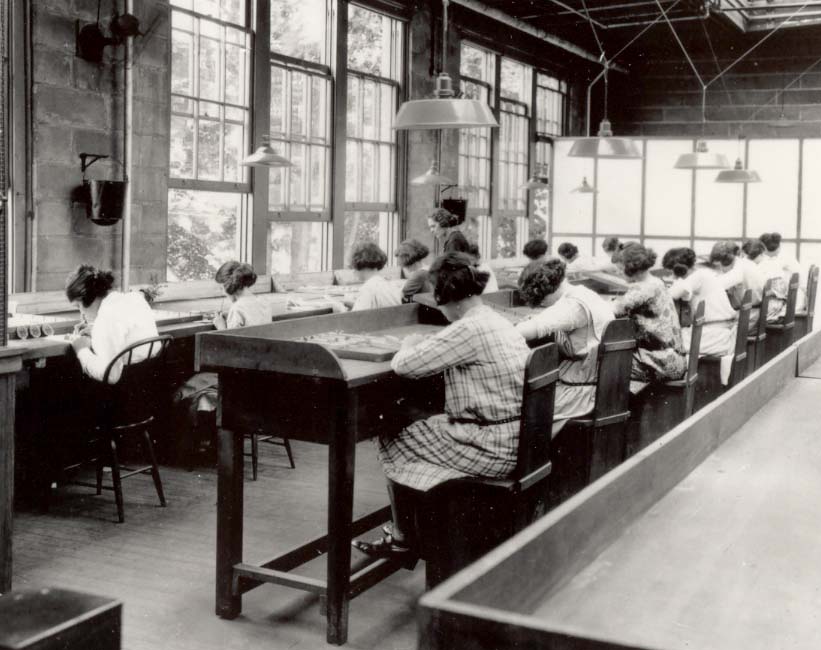
The photograph above shows women in a United States Radium Corporation dial room around 1922.[6] It has none of the lurid glow that later retellings often emphasize. Its force is quieter. The workers sit in ordered rows, close to one another and close to the materials. The scene looks ordinary because ordinary procedure was the danger. The historical question is not only why radium fascinated the early twentieth century. It is how a hazard could be made routine enough that the people ingesting it had to fight to make their own injuries count as evidence.
Myth: the danger was invisible because everyone simply trusted radium
Radium really did carry a powerful aura after Marie and Pierre Curie's 1898 discovery. National Archives and Britannica accounts both describe a commercial and medical culture in which radium could be treated as modern, therapeutic, fashionable, and technically useful.[1][5] The paint used in dial work joined radium with zinc sulfide to create a soft glow; the product name Undark made the sales pitch almost literal.[1] During World War I and afterward, luminous watch and instrument dials had obvious value because they could be read in darkness.[1][4]
That context matters, but it does not excuse the workplace mechanism. The women were not merely handling a mysterious consumer novelty. They were instructed in a specific technique: lip-pointing, shaping a fine brush tip between the lips before painting tiny numerals and hands.[1][2][3][4] The National Archives summary is direct about the exposure route: each dial could mean a small ingestion of radium-bearing paint.[1] The EPA explains why that mattered biologically: radium behaves enough like calcium in the body that ingested material can be deposited in bone, where internal radiation damages tissue.[4]
So the myth needs correction. The problem was not only that radium's dangers were poorly understood by the public. The problem was that a production method placed the burden of precision inside the workers' mouths. The brush tip became the transfer point between industrial demand and human bone.
Evidence: the first warning signs appeared in bodies before they appeared in policy
The timeline is important because the case moved slowly while the injuries moved through living bodies. The Radium Luminous Material Corporation opened its Orange, New Jersey, plant in 1917, later reorganizing as the United States Radium Corporation.[1][3] Rutgers' finding aid says the Orange plant employed more than a hundred workers, mainly women, painting radium-lighted watches and instruments.[3] By 1921, company structure had shifted, and by the early 1920s consequences were emerging among former dial painters.[1]
Those consequences first appeared in a place that made medical denial easier and human suffering harder to ignore: the mouth. The National Archives account describes rotting teeth, persistent pain, and necrosis of jawbone, followed in some cases by anemia, fatigue, miscarriages, and fragile bones.[1] Britannica's narrative of Mollie Maggia shows why the injuries did not immediately become a clean legal case. Her symptoms began as dental trouble, then escalated into catastrophic jaw disease; doctors initially misidentified the cause, and she died in 1922.[5]
That sequence shows how industrial disease can hide in ordinary categories. A toothache looks private. A miscarriage can be treated as domestic misfortune. Fatigue can be dismissed as weakness. The dial painters' claim had to connect scattered symptoms back to a shared room, a shared technique, and a shared material. That required scientific measurement as well as testimony.
Myth: the case was won once the public understood the tragedy
Public sympathy did matter, but sympathy was not the same as enforceable responsibility. Former employees began bringing complaints and lawsuits against USRC in 1923, and litigation continued for years.[1] The company settled some claims while denying liability, and the legal field remained narrow because statutes of limitation could work against workers whose illness appeared after they had left the job.[1]
This is where the role of measurement becomes central. Rutgers credits Harrison S. Martland, Essex County's chief medical examiner, with recognizing the cause of death in the dial painters and publishing the 1925 connection between radium, bone disease, and aplastic anemias.[3] Britannica similarly treats Martland's test as a turning point because it helped prove that radium was poisoning the painters from inside the body.[5] NIST's account adds another layer: physicist Elizabeth Hughes helped attorney Raymond Berry by measuring radiation evidence for the New Jersey women who sued USRC.[2]
The strong historical point is that the women needed more than a moving story. They needed a way to translate pain into admissible proof. The body had to be made measurable. Breath, bone, jaw, anemia, and radioactivity had to become a chain a court and the press could follow.[2][3][5]
Evidence: the settlement was a victory with hard limits
Grace Fryer, Katherine Schaub, Edna Hussman, Albina Larice, and Quinta McDonald became the best-known New Jersey plaintiffs. NIST describes the company seeking delay in 1928, while public criticism rose because the women might not live to see the trial.[2] The result was an early-June 1928 settlement: NIST gives the terms as $10,000, medical bills, and a $600 yearly pension; the National Archives notes the settlement agreement dated June 8 and the same annuity-and-medical structure, while also preserving the uncertainty that some accounts state a higher lump sum.[1][2]
That settlement mattered because it made the case public and gave the plaintiffs some material relief. It also shows the boundary of the victory. USRC did not admit liability.[1] Many dial painters received little or no compensation.[1] In 1936, the U.S. District Court for New Jersey ruled against Vincent LaPorte, widower of former dial painter Irene LaPorte, on a fraudulent-concealment theory, with statute-of-limit consequences that helped end several claims.[1]
The Illinois line of the story pushed the issue further. Britannica identifies Catherine Wolfe Donohue's successful 1938 action against Radium Dial as the later point at which the issue was finally settled in a broader labor-safety sense.[5] That matters because the Radium Girls were not a single case with a clean ending. They were a chain of cases, localities, medical records, press cycles, and partial legal openings.
Why the myth-vs-evidence frame changes the memory
The familiar memory emphasizes glow because glow is narratively powerful. The workers' clothes and hair could shine after a shift; some retellings linger on teeth painted for fun or on the eerie beauty of the material.[1][5] Those details are memorable, and they belong to the story. But if they become the whole story, the history turns into spectacle.
The evidence-led memory is more useful. It begins with a factory procedure, then follows the path from ingestion to bone deposition, from symptoms to measurement, from lawsuits to settlements, and from contaminated records to archival recovery. The National Archives account even notes that some original paper records were radioactive and later disposed of as contaminated waste after EPA scanning, while the digitized records entered the catalog.[1] That archival detail is a brutal historical echo: the paperwork of the case carried traces of the same material that injured the workers.
The Radium Girls matter because they forced a hidden industrial injury into public form. Their story did not end radium use overnight; the EPA notes that radium was still used on dials into the twentieth century before being replaced by the 1970s.[4] What changed was the evidentiary field. Employers, doctors, regulators, and courts could no longer treat the luminous dial room as merely a clever modern workplace. It had become a site where gendered labor, scientific measurement, and legal responsibility met under the hard light of occupational disease.
Sources
- National Archives, "The Radium Girls at the National Archives" - archival overview of USRC/RLMC records, Undark, lip-pointing, illness pattern, lawsuits, settlements, and contaminated records.
- NIST, "New Jersey's 'Radium Girls' and the NIST-Trained Scientist Who Came to Their Aid" - Elizabeth Hughes, measurement evidence, 1928 litigation pressure, and settlement terms.
- Rutgers Archives and Special Collections, "United States Radium Corporation Records; Guide to the" - finding aid for USRC records, plant chronology, exposure route, and Harrison Martland context.
- U.S. Environmental Protection Agency, "Radioactivity in Antiques" - explanation of radium dial paint, lip-pointing, internal exposure, bone deposition, and later replacement of radium dials.
- Encyclopaedia Britannica, "Radium Girls: The Women Who Fought for Their Lives in a Killer Workplace" - narrative synthesis of radium culture, Mollie Maggia, Martland, litigation, and Catherine Wolfe Donohue.
- Wikimedia Commons, "All women or girls using radium paint with no protection or warnings in 1922..." - source page for the archival USRC factory photograph used as the article image.