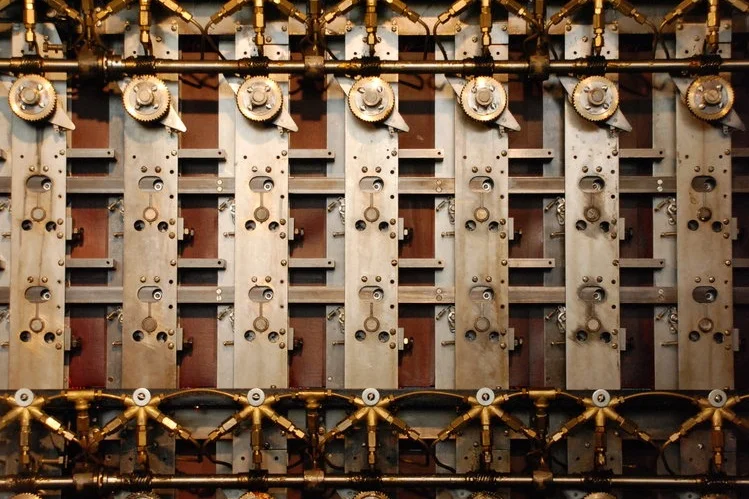
The Turing-Welchman Bombe is often flattened into a simple legend: Alan Turing built a machine, the machine broke Enigma, and the supposedly unbreakable German cipher collapsed. That version catches the drama and loses the mechanism. The Bombe did not win by trying every possible Enigma setting in a blind storm of brute force. It worked because Bletchley Park converted a human guess about a message into an electrical test that could reject impossible settings at speed.[1][2][3]
That distinction matters. Enigma looked vast because the machine mixed rotor order, wheel positions, ring settings, and plugboard substitutions. The National Security Agency's history notes a theoretical possibility count of 3 x 10^114, while also stressing that German practice never reached that theoretical maximum.[2] The practical breakthrough was not pretending that the whole universe of settings could be walked exhaustively. It was finding a way to shrink the problem before the machine began to run.
The lead image shows the reconstructed Bombe now displayed at The National Museum of Computing at Bletchley Park.[1] It is a useful photograph precisely because the Bombe's history is physical: drums, cables, commutators, checking machines, heat, shifts, maintenance, and people turning probable text into repeatable procedure. The causal chain below follows that physicality from Polish inheritance in 1939 to wartime scale by 1945.[1][2][4]
Timeline anchors: the machine came from a chain, not a miracle
- Late 1920s: German military adoption of Enigma made rotor-machine encryption central to secure communications.[2]
- 1938: Polish mathematicians used their prewar methods and Bomba machine against earlier Enigma procedures, creating the inheritance British codebreakers later built upon.[1][2]
- July 1939: Polish cryptanalysts shared crucial Enigma knowledge with British and French counterparts before the invasion of Poland changed the war's tempo.[2][4]
- November 1, 1939: a Bletchley report signed by Dilly Knox, Peter Twinn, Gordon Welchman, Alan Turing, and J. R. Jeffreys recorded that a larger "bomb machine" was already on order at the British Tabulating Machine Company.[5]
- March 1940: the first British Bombe, known as Victory, reached Bletchley Park and began helping with Air Force Enigma traffic.[1][5]
- August 1940: the improved Turing-Welchman Bombe, Agnus Dei or Agnes, became operational with Welchman's diagonal-board refinement.[1]
- 1945: the wartime Bombe operation had grown into hundreds of machines and a large operating staff, with The National Museum of Computing summarizing the deployment as 211 Bombes involving 1,676 female WRNS personnel and 263 male RAF personnel.[1]
Those dates change the story's shape. The Bombe was not a single invention detached from prior work. It was a succession of transfers: Polish mathematics to British design, mathematical hypothesis to electromechanical test, machine stop to checking room, and one day's key to the larger flow of intercepted messages.
Step one: a crib turned a cipher problem into a testable hypothesis
The first lever was the crib. A crib was a guessed piece of plaintext aligned against ciphertext: a weather phrase, a routine opening, a procedural formula, or another stereotyped fragment that German operators tended to send.[3] The guess did not need to be poetic. It needed to be probable enough to deserve testing and structured enough to constrain the machine.
Enigma had one exploitable feature that made this alignment useful: a letter could not encipher as itself.[1][3] If a proposed crib put the same letter in the same position as the ciphertext, the alignment could be rejected before any machine work. If it avoided that clash, it could be developed further into a pattern of relationships between plaintext letters and cipher letters.[3]
This is where the myth of brute force starts to fail. The codebreakers were not feeding the Bombe a blank universe. They were feeding it a structured claim: if this piece of expected German text sits here in the message, then these letter relationships must all be compatible with one Enigma setting. The machine's job was to find settings that did not immediately contradict those relationships.[1][3]
Frank Carter's technical history of the Bombe describes Turing's procedure as one that used a crib to cut the key space to a little over one million possibilities and, crucially, did so without needing prior knowledge of plugboard pairings.[3] That is the mechanism in miniature. The crib supplied pressure. The Enigma property supplied a way to reject. The machine supplied speed.
Step two: a menu made the hypothesis wireable
A crib alone was not yet a Bombe run. It had to become a menu. In Bletchley language, a menu was a wiring plan: a set of letter relationships derived from the crib and ciphertext, then plugged onto the back of the Bombe through cables.[3] Tony Sale's reconstruction notes describe the menu as instructions for setting up the Bombe to search for an Enigma configuration satisfying the menu's constraints.[6]
Menus mattered because they changed the problem from reading German into building an electrical circuit. The codebreaker aligned the guessed text with the cipher text, marked the relationships, avoided impossible self-encipherments, and looked for loops or connected webs strong enough to make the run productive.[3][6] A weak menu could generate too many stops or fail when wheel turnover disrupted the assumed relationships. A strong menu concentrated the search.
That workflow put human skill before machine speed. The Bombe could run fast, but it was only as useful as the menu it was given. A good crib had to be plausible in German operational life. A good alignment had to survive the no-self-encipherment test. A good menu had to create enough connected structure to make false candidates manageable.[3][6]
This is why Bletchley Park should be understood as an analytic factory rather than a room with one magic machine. Intercepts arrived from listening stations; traffic analysts and cryptanalysts inferred habits; menu-makers turned guesses into circuits; operators ran the Bombes; checking staff tested stops; translators and intelligence officers then converted decrypts into usable reports.[1][2][3] The Bombe sat at the center of that chain, but it did not replace the chain.
Step three: the diagonal board made more menus usable
Gordon Welchman's diagonal board was the key refinement that made the British Bombe more powerful than Turing's first scheme alone. The plugboard, or stecker, was reciprocal: if one letter was plugged to another, the relation worked both ways. Welchman's board exploited that symmetry by connecting possible stecker relationships across a lattice of letter possibilities.[3][4]
The practical consequence was throughput. Carter explains that the diagonal board allowed many more menus to be used and significantly reduced random stops.[3] The National Museum of Computing says the same thing in operational language: Welchman's diagonal board dramatically cut invalid stops and raised the system's usefulness.[1]
This was not a cosmetic improvement. Every false stop consumed scarce human attention. A machine that stopped too often could bury the correct candidate inside noise. A machine that rejected more impossibilities before handing work back to people made the whole workflow more effective. Welchman's contribution therefore belongs inside the causal story, not as a footnote after Turing.[1][3][4]
It also clarifies what "automation" meant in this setting. The Bombe did not produce a plain-language German message at the end of a run. It produced candidate settings that needed checking. Automation narrowed the path. Human checking still finished it.
Step four: scale turned a clever method into wartime intelligence
The first Bombe mattered, but one machine was not enough for wartime traffic. Enigma settings changed frequently, and different networks used different keys.[1][2] The National Museum of Computing describes the Bombe's task as discovering the daily key: wheel order, wheel settings, and plugboard configuration, so that thousands of intercepted messages could be deciphered.[1] Some keys were broken in 2-4 hours; some were never broken.[1]
That unevenness is important. Bletchley did not "break Enigma" once. It attacked daily operational systems under time pressure. A solved key had value because it opened a set of traffic while the information was still alive. A late solution could be historically interesting and operationally weak.
Scaling the machine operation therefore changed the intelligence value. By the end of the war, the British Bombe operation had become a distributed industrial process, with outstations such as Stanmore and Eastcote and a large operating staff.[1] The reconstruction history preserves the same point in material form: the rebuilt machine required surviving drawings, veteran engineering memory, a steel frame, remade drums, and miles of wiring before it could operate again.[1] The physical infrastructure was part of the cryptanalysis.
The NSA history also helps keep Allied credit properly distributed. British work built on Polish breakthroughs, while later U.S. Navy bombe work became crucial for naval Enigma traffic.[2] The right historical claim is not that one man or one machine single-handedly defeated a cipher. The stronger claim is that a transnational cryptanalytic inheritance became a production system.
Why the mechanism still matters
The Bombe's deeper lesson is about problem reduction. The codebreakers did not make Enigma easy. They made it conditionally searchable. The sequence was: infer a likely phrase, convert it into a menu, exploit Enigma's structural constraints, run an electromechanical search, reject false stops, check candidates, and then fold the result into the intelligence pipeline.[1][2][3][6]
That causal mechanism is more interesting than the legend because it explains both success and limits. The Bombe needed cribs. It needed enough operator habits to make guesses possible. It needed menus strong enough to run. It needed machines, maintenance, outstations, and checkers. When those conditions were present, Enigma traffic could become readable in time to matter. When they were missing, the machine did not magically supply them.[1][2][3]
Seen this way, the Bombe belongs in the history of computing, but not simply as a primitive computer ancestor. It belongs in the history of organized reasoning. Bletchley Park turned a huge theoretical key space into a sequence of smaller decisions, each one narrow enough to be handled by people and machines together. That is why the reconstructed machine still looks important. Its drums and cables preserve a wartime method: do not solve the whole impossibility; build a process that makes the right part searchable.
Sources
- The National Museum of Computing, "The Turing-Welchman Bombe" - museum account of the reconstructed Bombe, wartime deployment figures, cribs, diagonal board, and operational workflow.
- Jennifer Wilcox, Solving the Enigma: History of the Cryptanalytic Bombe. National Security Agency Center for Cryptologic History.
- Frank Carter, "The Turing Bombe." The Rutherford Journal - technical explanation of cribs, menus, the diagonal board, stops, and the reconstructed Bombe demonstration.
- GCHQ, "Alan Turing" - official biographical note on Turing's recruitment, Polish foundations, and the Bombe as a special-purpose cryptanalytic machine.
- Alan Turing Home Page, "Report on Enigma decipherment, 1 November 1939" - transcription of British National Archives HW 14/2 documenting early Bletchley needs and the larger Bombe under construction.
- Tony Sale, Virtual Wartime Bletchley Park, "Menus" - reconstruction explanation of how cribs became Bombe menus and why loops, clashes, and wheel turnover mattered.