The Helsinki Final Act is easy to remember as a Cold War bargain: the Soviet bloc wanted postwar European borders treated as settled, while Western governments wanted human rights and freer contacts written into the same diplomatic package.[2][3] That summary is useful, but it hides the more interesting textual mechanism. Helsinki mattered because it made two kinds of language share the same page. Sovereignty, territorial integrity, non-intervention, human rights, movement of people, circulation of information, and follow-up review were not separate pamphlets. They were parts of one political document adopted by 35 participating states on August 1, 1975.[1][2]
That structure gave the Final Act its afterlife. It was not a treaty, and it did not create a court that could compel compliance.[3] Yet it created a public standard that governments had signed, cited, and promised to revisit. Once that happened, dissidents could stop sounding like petitioners asking for mercy and start sounding like auditors asking whether a signatory state was keeping its own word.[4][5][6]
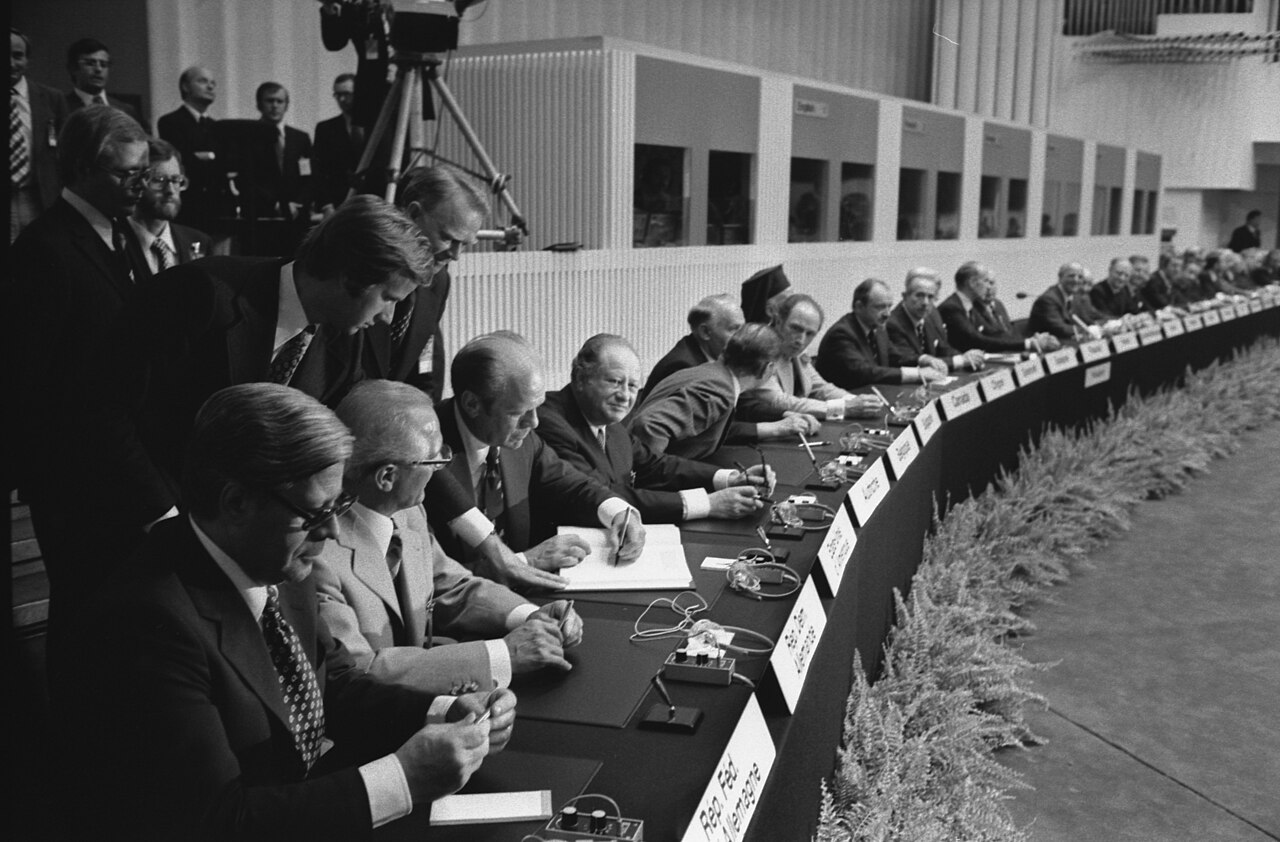
The lead image shows Ford signing the Final Act as it passed among leaders at Finlandia Hall.[7] The photograph is a state photograph, full of ceremony and penmanship. It captures the official surface of Helsinki. The article below reads the deeper operating logic underneath that surface: how a nonbinding document became useful precisely because it linked state security to public scrutiny.
Timeline anchors: the text grew out of detente, then escaped its diplomatic frame
- 1954: the Soviet Union had already sought a European security conference, hoping for recognition of postwar boundaries in Eastern Europe.[2]
- 1972: preparatory talks began in Helsinki as detente made a pan-European security negotiation more workable.[2][3]
- July 3, 1973: the Conference on Security and Co-operation in Europe opened at Helsinki; expert negotiations then continued in Geneva until July 21, 1975.[1][2]
- August 1, 1975: the United States, Canada, the Soviet Union, and European states except Albania concluded the Final Act in Helsinki.[1][2][3]
- May 12, 1976: the Moscow Public Group to Promote Observance of the Helsinki Accords announced its formation and began sending information on Soviet violations to CSCE states and public opinion.[4]
- 1977-1978: the first follow-up meeting took place in Belgrade, turning Helsinki from a signed document into a review process.[1][2]
Those dates show the hinge. The Final Act began as a settlement-oriented security negotiation, but its wording created a process that activists could use. The text did not overthrow a state. It changed the grammar of accusation.
First movement: sovereignty comes first, but it does not get the whole document
The Final Act's opening security principles are deliberately state-centered. Principle I affirms sovereign equality and the right of every state to choose and develop its political, social, economic, and cultural systems.[1] Principle III treats European frontiers as inviolable. Principle IV requires respect for territorial integrity. Principle VI bars intervention in internal affairs.[1]
Read in isolation, those provisions look like a diplomatic victory for governments that wanted external criticism kept outside the border. The U.S. State Department's historical summary makes the point plainly: the Soviet aim was recognition of the post-World War II boundary order, while Western governments feared that such a conference might strengthen Soviet control in Eastern Europe.[2] Britannica frames the same exchange as a trade: frontier stability and noninterference on one side, human rights, contacts, travel, and information flow on the other.[3]
The first close-reading point is that Helsinki does not resolve that tension. It preserves it. The document gives states the reassurance language they wanted, but then refuses to let sovereignty remain self-enclosed. Principle I says states may choose their systems; later clauses say human rights and fundamental freedoms have universal significance.[1] Principle VI protects domestic jurisdiction; later language confirms that individuals may know and act upon their rights.[1] The text is built as a controlled contradiction.
That contradiction was not a drafting flaw. It was the price of making 35 governments sign the same instrument. If the document had contained only inviolable borders and non-intervention, it would have been a status-quo settlement. If it had contained only rights language, the Soviet bloc would not have accepted it. Helsinki's historical force comes from the fact that both sides signed a document whose pieces could later be read against each other.[1][2][3]
Second movement: Principle VII changes the scale from state rights to human rights
Principle VII is the hinge clause. It begins with participating states pledging to respect human rights and fundamental freedoms for all, including freedom of thought, conscience, religion, or belief.[1] It then moves from a general pledge to a stronger account of where those rights come from: civil, political, economic, social, cultural, and other rights derive from human dignity and are essential to free and full development.[1]
The most consequential sentence is compact: the states confirm the "right of the individual to know and act upon his rights and duties."[1] That phrase mattered because it gave citizens a role inside what had otherwise looked like interstate diplomacy. A state could still claim sovereign equality, but its citizens could answer with a signed document saying the individual had standing to know and act.
This is where the document starts to become inspectable. Principle VII does not merely say that governments should be humane. It describes rights as universal, links them to peace and friendly relations, and places them in a field where joint and separate promotion is expected.[1] That wording made domestic repression harder to treat as only domestic. Abuse inside a signatory state could be recoded as a failure in a shared European security framework.[1][4]
That move explains why Helsinki's afterlife grew from language rather than enforcement. The document had no police power. It had something different: a signed vocabulary that let outsiders and insiders ask a specific question. If a government had promised to respect rights, encourage their exercise, and recognize an individual's right to know and act, what exactly counted as compliance?[1][4][5]
Third movement: Basket III turns rights into movement, contact, and information
The familiar phrase "Basket III" can sound bureaucratic, but the contents were concrete. The U.S. historian's account summarizes the third basket as human rights, emigration, family reunification across borders, cultural exchange, and freedom of the press.[2] Britannica similarly notes that Western governments pressed for respect for human rights, wider East-West contacts, travel, and freer information flow.[3]
That concreteness matters. Helsinki did not leave human rights at the level of ceremonial principle. It connected them to practices that authoritarian systems found difficult to compartmentalize: who may visit relatives, who may leave, who may receive books and broadcasts, who may work as a journalist, and how ideas cross borders.[1][2][3] In other words, Basket III translated rights into traffic.
That is why the text could generate pressure even without treaty status. It gave monitors a checklist of ordinary life. A refusal of emigration, a blocked family visit, a punished religious practice, censorship, or retaliation against a journalist could be read not only as cruelty, but as evidence that a state was violating the humanitarian commitments it had signed.[1][4][5]
The effect was cumulative rather than immediate. In 1975, the Final Act looked to many Western critics like too much recognition of Soviet gains.[2][3] By the late 1970s and early 1980s, the human-rights provisions had become a continuing East-West point of contention, with Soviet officials describing them as internal matters and Western governments treating them as legitimate subjects of review.[3]
Fourth movement: follow-up turns the signature into a process
The last crucial piece is the least dramatic: follow-up. The Final Act called for further meetings, with the first set for Belgrade in 1977 after a preparatory meeting in June of that year.[1] This clause turned the document from a one-day summit souvenir into a recurring forum.
The Moscow Helsinki Group understood that mechanism with precision. Its own formation statement, as summarized by the U.S. Helsinki Commission, said the group wanted to inform CSCE states and public opinion about Soviet violations of the humanitarian provisions of the Final Act.[4] It also explicitly hoped its material would be considered at Belgrade, Madrid, and other meetings envisioned under the Final Act's follow-up section.[4]
That is the document's most important institutional afterlife. The follow-up process gave citizen monitors a destination for evidence. They were not only writing samizdat for moral witness, and they were not only appealing to foreign sympathy. They were producing material for a review architecture that the signatory governments themselves had accepted.[1][4]
Charter 77 made the same move in Czechoslovakia. A U.S. Helsinki Commission publication on Charter 77 describes signers using Czechoslovak law, the Helsinki Final Act, and other international agreements as the basis for pressing authorities to observe rights they had already recognized.[5] It emphasizes that Charter 77 aimed to demonstrate the need for observance of laws, including domestic and international obligations, rather than present itself as a conventional party program.[5]
Human Rights Watch traces its own beginning to this Helsinki logic. Helsinki Watch, founded in 1978, was designed to support citizens' groups across the Soviet bloc as they monitored government compliance with the 1975 Accords.[6] That institutional genealogy shows how far the textual mechanism traveled: a diplomatic document generated monitoring groups, those groups generated reports, and those reports helped make human rights a public test of Cold War legitimacy.[4][5][6]
Why the close reading changes the story
The useful reading of Helsinki is therefore not "the West won" or "the Soviet Union miscalculated." Both are too flat. The better reading is textual. The Final Act created an unstable compound: sovereign equality and non-intervention on the same footing as human rights and follow-up review.[1][2][3] No side fully controlled the future interpretation.
That instability is why the document mattered. It allowed governments to sign without surrendering their preferred story, then allowed activists to read the signature against government behavior. Principle VII supplied the rights language. Basket III supplied the everyday channels where abuse could be documented. Follow-up supplied the forum where documentation could be aimed.[1][4][5]
The photograph of Ford signing at Finlandia Hall shows the moment as ceremony.[7] The historical force came later, when the document became a paper instrument in the hands of people far from the signing table. Helsinki made sovereignty inspectable because it gave citizens a way to say: you signed this, you promised this, and the gap between promise and practice now belongs in public.
Sources
- Organization for Security and Co-operation in Europe, Conference on Security and Co-operation in Europe: Final Act, Helsinki 1975 - full text of the Final Act, including Principle VII and the follow-up section.
- U.S. Department of State, Office of the Historian, "Helsinki Final Act, 1975" - diplomatic origins, baskets, follow-up meetings, and dissident use of the human-rights provisions.
- Encyclopaedia Britannica, "Helsinki Accords" - overview of nonbinding status, border recognition, Basket III contention, and the East-West bargain.
- Commission on Security and Cooperation in Europe, "A Thematic Survey of the Documents of the Moscow Helsinki Group" - formation date, founding members, and monitoring strategy.
- Commission on Security and Cooperation in Europe, "Human Rights in Czechoslovakia: The Documents of Charter '77, 1977-1982" - Charter 77's legal and Helsinki-based rights claims.
- Human Rights Watch, "Our History" - Helsinki Watch's 1978 origins and support for citizen monitoring groups in the Soviet bloc.
- Wikimedia Commons / U.S. National Archives, "Photograph of President Gerald R. Ford Signing the Final Act..." - source record for the archival photograph used as the article image.