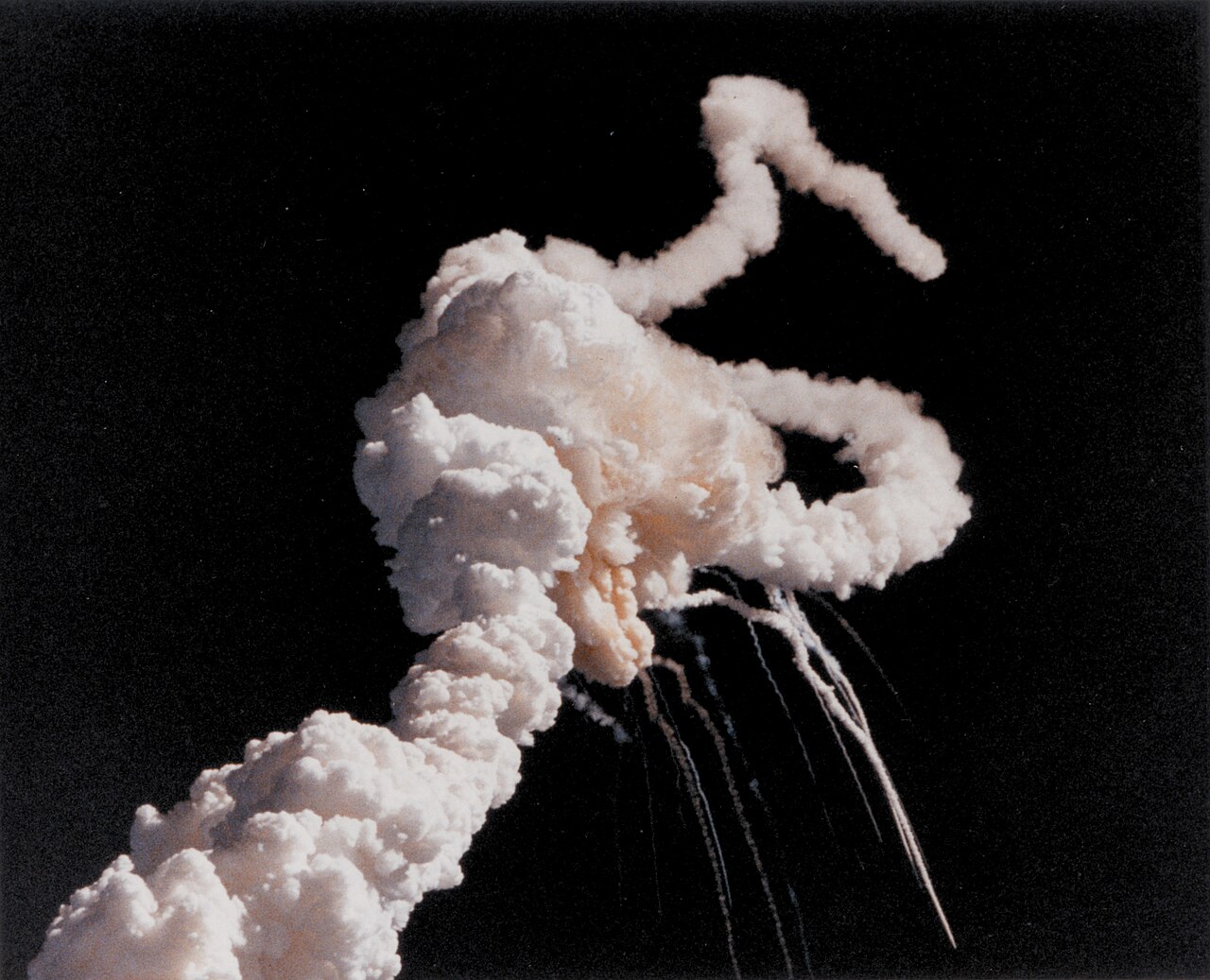
The useful historical question is not why Challenger failed in 1986 or why Columbia failed in 2003 in isolation. The sharper question is why a system that already lived through one catastrophic warning could still reproduce a structurally similar decision pattern seventeen years later.
Read side by side, these two accidents do not show “no learning.” They show partial learning: hardware and process controls improved, but risk interpretation under organizational pressure remained fragile.
Image note: The header image documents the Challenger explosion moment in 1986 and is used here as a historical entry point into this comparison. It should not be read as visual evidence for Columbia-specific failure mechanics in 2003, which followed a different immediate technical trigger.[9]
Two timelines, one recurring pattern
- 1986-01-28: Challenger (STS-51-L) breaks apart 73 seconds after launch after O-ring seal failure under unusually cold launch conditions.[1][2]
- 1986-06-09: Rogers Commission submits findings, including technical causes and organizational contributors (communication failure, schedule pressure, weak safety voice).[1][3]
- 1987-06: NASA implementation volume documents substantial redesign and management responses before shuttle return to flight.[4]
Then, after years of shuttle operations:
- 2003-01-16: Columbia (STS-107) launches; foam from the external tank strikes the left wing early in ascent.[5]
- 2003-02-01: Columbia is lost during re-entry, killing all seven crew members.[5]
- 2003-08: CAIB Volume I concludes that organizational causes were as central as the foam strike itself and issues 29 recommendations, including 15 tied to return-to-flight before resuming missions.[5][6]
- 2004-01 onward: NASA’s return-to-flight plans and external reviews track implementation progress, cost, and residual risk boundaries.[7][8]
The two accidents are separated by different hardware signatures, but both pass through a similar decision funnel: known anomaly → uncertain severity framing → constrained dissent path → operational continuation.
What changed after Challenger, and what did not
After Challenger, NASA did not stand still. The post-1986 implementation record shows extensive technical work and organizational restructuring efforts, including booster redesign and changes to oversight routines.[4] Interpreting this history as simple institutional inertia would be inaccurate.
What did not disappear was a deeper governance vulnerability: when uncertainty could not be cleanly resolved in real time, internal argument quality still depended heavily on hierarchy, framing language, and mission tempo.
Rogers Commission chapters on history, safety silence, and system pressure already described this exposure in 1986.[1][3] CAIB, in 2003, effectively found a similar weakness in a new technical context.[5]
Why Columbia was not a “new problem”
CAIB’s core contribution is often reduced to “foam strike risk was underestimated.” That is true but incomplete. The stronger claim is that the organization had already normalized recurring anomalies into an accepted operating envelope, then treated unresolved uncertainty as manageable by precedent rather than by disconfirming evidence.
In practical terms, Columbia repeated three governance moves that historians of Challenger will recognize:
- Anomaly familiarity became an argument for tolerance.
- Decision forums privileged operational continuity under schedule logic.
- Safety and engineering dissent had limited path to force escalation.
This is why the comparative frame matters. If one reads only technical root cause, Challenger and Columbia look different. If one reads decision architecture, they look uncomfortably close.
The main historiography split: culture-first vs structure-first
Two interpretations dominate this comparison.
Interpretation A: culture-first (normalization of deviance)
This view argues that repeated exposure to near-miss anomalies slowly reclassified danger as routine. On this reading, by the time a catastrophic boundary is crossed, decision-makers no longer perceive the event category as exceptional enough to trigger full-stop behavior.
Evidence weight: strong in both Rogers and CAIB narratives where communication and risk language drift are central findings.[1][3][5]
Interpretation B: structure-first (incentives, schedule, and governance wiring)
This view argues that even with sincere individuals, systems with high fixed-cost operations and rigid launch cadence will systematically compress uncertainty handling, especially when authority to halt operations is diffuse or contested.
Evidence weight: also strong, especially in chapters and post-accident reviews on management channels, independent technical authority, and return-to-flight governance design.[4][5][7][8]
What would change the balance between the two?
The debate shifts if new archival evidence showed one of these conditions:
- decision records where dissenting technical teams had full escalation access and were still overruled with high-quality contrary evidence,
- or, conversely, proof that schedule and institutional constraints were minimal in key meetings.
Absent that, the best-supported position is mixed: culture and structure interacted, but structure repeatedly set the boundary within which culture could fail safely or fail catastrophically.
Comparative lesson: visible reform is not the same as resilient decision quality
A high-risk program can implement major technical reforms and still remain vulnerable if it does not harden how uncertainty is adjudicated under time pressure. Challenger-to-Columbia shows that institutional memory is not self-executing. It decays unless encoded into authority design, escalation rights, and operational stop rules that remain effective when missions are expensive and cadence pressure rises.
That is the practical historical takeaway. The relevant unit of analysis is not “did reform happen,” but “which failure channel reform actually closed.”
Sources
- Rogers Commission report (NASA History), Chapter VI: An Accident Rooted in History
- Rogers Commission report (NASA History), Chapter IV: The Cause of the Accident
- Rogers Commission report (NASA History), Chapter VIII: Pressures on the System
- NASA implementation report (June 1987), Implementation of the Recommendations
- Columbia Accident Investigation Board (CAIB), Volume I (NASA NTRS PDF, 2003)
- CAIB Volume II bibliographic record (appendix/technical documentation context)
- NASA, Implementation Plan for Space Shuttle Return to Flight and Beyond (Rev. Jan 2004)
- U.S. GAO (GovInfo mirror), Space Shuttle: Costs for Hubble Servicing Mission and Implementation of Safety Recommendations Not Yet Definitive (GAO-05-34, 2004)
- Wikimedia Commons image source (Challenger explosion photograph)