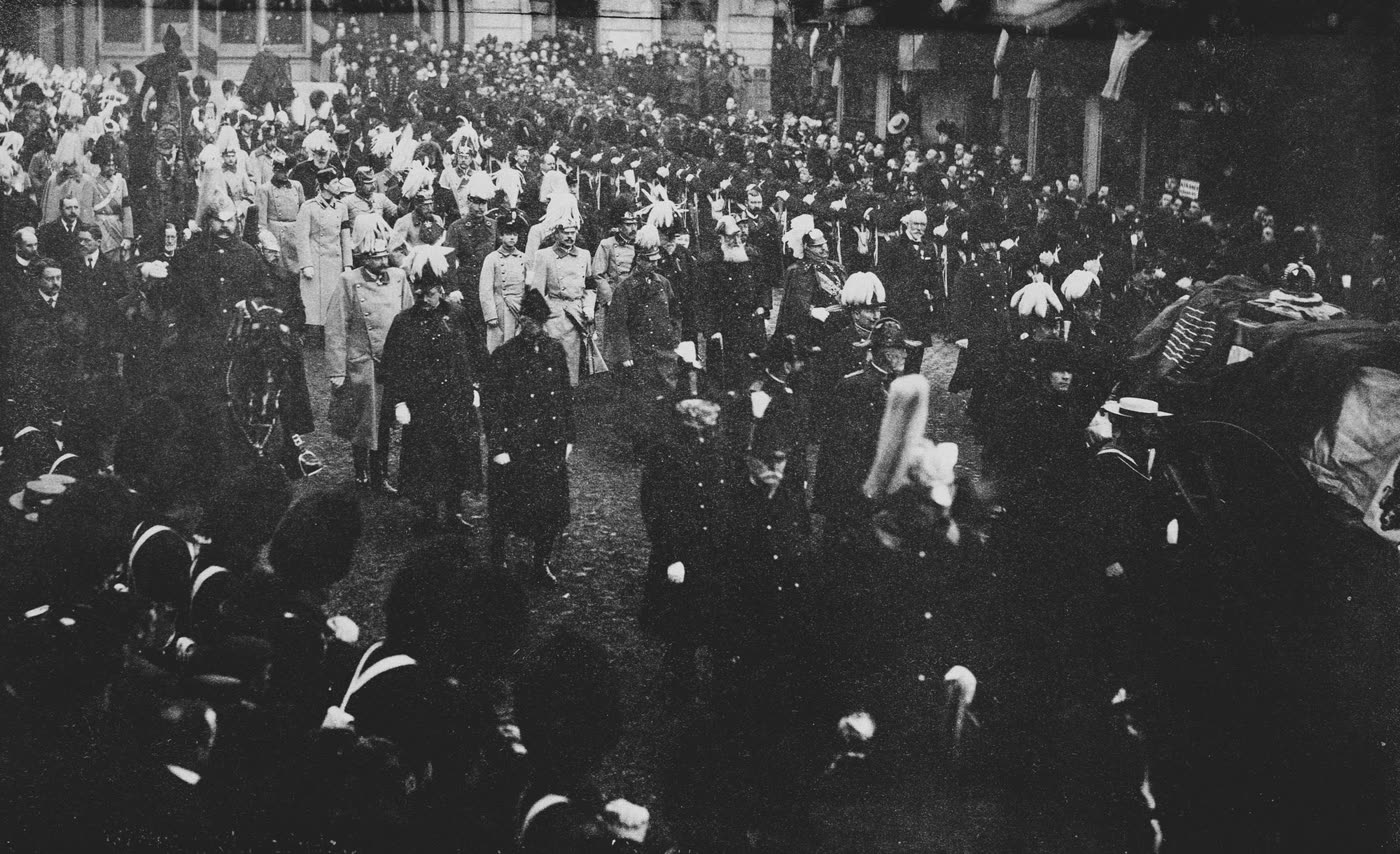

Queen Victoria's funeral sits at a hinge between two kinds of public monarchy. One was old: procession, military escort, ships, railway timings, household offices, mourning dress, and the choreography of rank. The other was newly hard to avoid: moving cameras, news films, mass spectatorship, and a public that could replay the event after the coffin had passed. The British Pathe footage embedded below matters because it catches that hinge in motion.[1]
Victoria died at Osborne House on January 22, 1901, after a reign of nearly sixty-four years, and her state funeral followed on February 2.[4] The death itself was shocking partly because duration had become political atmosphere. Many Britons had never known another sovereign. The court was not simply burying a person; it was ending the Victorian frame through which empire, domestic respectability, constitutional monarchy, and family symbolism had been narrated for decades.
The funeral therefore had to do several jobs at once. It had to satisfy Victoria's own instructions, which pushed against some older expectations: no public lying in state, a military character, white rather than conventional black, and a route that moved the body from Osborne by water and rail before the Windsor ceremony.[4] It had to place Edward VII visibly into succession. It had to gather Europe's dynastic network at a moment when royal family ties still crossed the continent densely. And it had to convert private death into public continuity without letting confusion show too much.
That last part was harder than the procession makes it look. HistoryExtra's account of the final days emphasizes how poorly prepared the household and government were, despite the apparent solidity of royal ritual: officials found precedents stale, offices disputed authority, the undertaker even arrived without the coffin, and the military organization had to be pulled together at speed.[4] The film does not show that backstage disorder. It shows the surface that disorder had to produce: slow movement, military bearing, carriages, mourners, waiting streets, and an image of state competence.
Image context: the lead image is a real archival photograph from Wikimedia Commons, sourced there to the Royal Collection and identified as Queen Victoria's funeral procession at Windsor in February 1901.[6] It is deliberately a procession image rather than a portrait, because the article's subject is not only Victoria's death. It is the way public monarchy became visible as route, order, uniforms, vehicles, spectators, and camera-readable sequence.
The Archival Video
The embedded video is British Pathe's YouTube upload "Queen Victoria's Funeral (1901)". Pathe's title and channel identify it as archive footage of the funeral procession, while the related BFI Replay entry helps clarify the wider moving-image context: Victoria's funeral was filmed by multiple companies working in 1901, yet only fragments of some versions survive.[1][2] That provenance matters. We are not watching a complete transparent record of the day. We are watching one surviving public-facing film artifact from an event that early cinema understood as historic even as it was happening.
What The Camera Makes Visible
The first thing the footage preserves is pace.[1] A royal funeral procession is built to resist haste. Its authority comes from the idea that every horse, carriage, file of soldiers, and turn in the route has been placed in a legible order. Watching it as moving image makes that order feel physical. The camera does not only show who was present. It shows the time it takes for a state to move a dead sovereign through public space.
That slow tempo is important because the funeral had been organized under pressure. The public did not see offices disagreeing or officials improvising. It saw a line that moved. The historical value of the film is therefore not that it exposes chaos; it shows the ceremonial answer to chaos. In the frame, continuity is made by sequence. One group passes, then another. Mourning becomes a managed flow.
The second thing the footage shows is how military Victoria's farewell was meant to be.[1][4] The queen wanted a funeral suited to a soldier's daughter and head of the army, and the visible result is not a purely clerical ceremony. Soldiers, mounted figures, bands, and formal escort turn death into national service language. The coffin's journey is not merely devotional. It belongs to a state that understood monarchy through command, empire, and uniformed loyalty.
That military emphasis also shaped one of the funeral's most durable traditions. Accounts of the Windsor sequence describe the gun-carriage horses failing to move and naval guards taking up the ropes instead; later royal state funerals retained the image of sailors drawing the gun carriage.[2][4] The Pathe video and BFI's related description point toward this same world of carriage, horses, troops, and naval presence even where the surviving footage is fragmentary.[1][2] The larger lesson is that tradition can be born from disruption, then remembered as if it had always been intentional.
The third thing the camera preserves is monarchy as a family system with international consequences. Victoria's descendants and relatives connected Britain to Germany, Russia, Denmark, Greece, Romania, and other royal houses. By 1901, that family map still looked like a stabilizing European network; within a generation, some of those same dynastic relationships would be strained by war, revolution, and national crisis. The funeral footage does not explain that future. It simply shows the older order assembled in public before the twentieth century broke it apart.
Why The Film Is More Than Pageantry
It is tempting to read the clip as pageantry, full stop: a famous queen, a solemn street, a historical procession. That is too thin. The footage also marks a change in how state ceremonies entered memory. Earlier royal funerals could be described in gazettes, sermons, engravings, newspapers, and personal accounts. Victoria's funeral entered a world in which cinema could carry movement itself into public afterlife.[2]
The Library of Congress blog on Irish Gazette announcements helps make the older documentary order visible. It describes official gazette material that specified mourning rules, dress expectations, naval arrangements, procession order, and even ship positions for the funeral ceremonies.[3] That kind of text made protocol governable. It fixed who should do what, when, and in what order. Film did something different. It did not replace protocol; it made protocol watchable.
That difference matters because monarchy depends on being seen correctly. A coronation, funeral, jubilee, opening of Parliament, or state procession is not simply an event with spectators attached. Spectatorship is part of the event's function. The public must see continuity where a vulnerable human fact has occurred: the sovereign has died, yet the crown continues. In 1901, the camera became another spectator with unusual power. It could repeat the sight.
Matthias Range's study of British royal and state funerals frames these ceremonies as long-running systems of music, liturgy, and ceremonial practice rather than isolated spectacles.[5] Victoria's funeral belongs to that long sequence, but the film pushes it into a new register. It lets the ceremony survive not only as service order, official notice, newspaper report, or family memory, but as motion. The visible order becomes the archive.
The Surface And The Backstage
The best way to read the footage is to keep two layers together. On the surface, it is controlled and solemn. Behind it were friction, haste, incomplete precedents, and competing authorities.[4] That combination does not make the ceremony false. It makes it historically sharper. Public ritual often works by forcing fragile institutions to produce steadiness under pressure.
Queen Victoria's death created exactly that problem. The monarchy had to change sovereigns, end an era, obey a dead queen's preferences, manage public mourning, absorb international royalty, and move a body across water, rail, London streets, Windsor streets, chapel, and mausoleum. Every stage had to look inevitable once it occurred. The camera's austere view helps us see how much labor inevitability requires.
The archival film also teaches restraint. It does not give interior feeling. It cannot tell us what Edward VII thought, what mourners feared, or what officials were fixing out of frame. Its force is external: posture, pace, crowd, carriage, line. That is exactly why it is useful. Royal power at a funeral is external by design. It asks bodies to carry meaning in public forms.
The funeral's afterlife is therefore double. It closed the Victorian reign, but it also helped open the camera age of royal ceremony. Later generations would encounter monarchy through cinema newsreels, radio, television, and livestreams. Victoria's funeral belongs near the beginning of that story. The state still spoke in horses, uniforms, naval order, and printed protocol. The camera was already learning how to remember it.[1][2][3]
Sources
- British Pathe, "Queen Victoria's Funeral (1901)" - YouTube archival-footage upload used for the embedded video.
- BFI Replay, "Funeral of Queen Victoria (1901)" - film record and provenance note on surviving funeral footage and early filming companies.
- Library of Congress, "The Irish Gazette Announcements of Queen Victoria's Death and Funeral" - official-gazette context on funeral protocol, fleet positions, and mourning instructions.
- HistoryExtra, Stewart Richards, "The final days and death of Queen Victoria" - death chronology, funeral-preparation problems, and Victoria's funeral instructions.
- Matthias Range, British Royal and State Funerals: Music and Ceremonial Since Elizabeth I (Boydell & Brewer, 2016) - bibliographic page for the long ceremonial and musical history of British royal and state funerals.
- Wikimedia Commons, "File:Queen Victoria's funeral procession.jpg" - source page for the real archival funeral-procession photograph used as the article image.