The Metre Convention of 1875 is easy to remember as a diplomatic milestone for the metric system. That is true, but too flat. Its deeper historical work was mechanical. It turned measurement from a national promise into an international operating system: a bureau near Paris, guarded prototypes, a committee, a conference, shared funding, periodic comparison, and a way for local standards to point back to a common reference.[1][2][3]
The problem was not that people lacked units before 1875. They had too many of them, and even when countries adopted metric language, practical trust still had to be built. A metre in one laboratory had to mean the same thing as a metre in another. A kilogram used in trade, customs, chemistry, geodesy, minting, engineering, or law had to remain traceable beyond local authority. The convention's achievement was to make that traceability institutional.
That is why the treaty belongs in the same nineteenth-century family as other new international bodies. BIPM's own history places the Metre Convention beside the International Telecommunication Union of 1865 and the Universal Postal Union of 1874: not as a sentimental universalist gesture, but as a new form of cooperation for systems that had to cross borders repeatedly.[1] Mail, telegraphy, and measurement all exposed the same historical pressure. Modern exchange needed standards that no single state could credibly maintain alone.
The old metric idea needed a custody system
The French revolutionary metric project had already supplied a powerful ideal: rational units that could travel beyond local custom. But an ideal unit and a working unit are different things. By the late nineteenth century, precision work depended on material standards, comparison instruments, skilled observers, and agreed procedures. A state could declare a metric unit; it could not, by declaration alone, make every other state's copy remain equivalent over decades.
The treaty's opening articles answer that weakness by creating the International Bureau of Weights and Measures, or BIPM, as a permanent institution.[1][2] Article 2 required the French government to facilitate a building for the bureau. The annexed regulations then became startlingly concrete: the bureau was to include a vault for prototypes, rooms for comparators and balances, a laboratory, a library, an archive room, work rooms, and lodgings for attendants.[2] That list matters. The convention made measurement into architecture.
This was not ornamental bureaucracy. Units become portable only when comparison becomes repeatable. The bureau gave the metric system a place where copies, instruments, reports, archives, and staff could converge. A metre or kilogram did not have to rely on patriotic confidence. It could be brought into a chain of custody.
The treaty separated possession from ordinary use
Article 6 of the convention defined the bureau's duties in a way that reads like a workflow. It would compare and verify new prototypes of the metre and kilogram; keep custody of the international prototypes; periodically compare national standards with the international prototypes and test copies; compare metric prototypes with non-metric standards used for scientific purposes; standardize geodetic measuring bars; and verify precision standards at the request of governments, scientific societies, manufacturers, or scientists.[2]
That sequence is the mechanism. First, create or receive prototypes. Then compare them. Then hold back the international reference from casual handling. Then send national standards into periodic relation with it. Then extend the comparison service outward to geodesy, science, and industry.
The custody rules were equally important. Article 8 put the international prototypes of the metre and kilogram, along with test copies, in the bureau and restricted access to the international committee.[2] The regulations went further: the place of deposit could be opened only with three keys, held separately by the director of the archives of France, the committee chair, and the bureau director. The director could enter only under a committee resolution and in the presence of two committee members.[2] That sounds theatrical until one sees the logic. The most important object was not supposed to be convenient. It was supposed to be authoritative because ordinary work used secondary standards, while the primary reference remained protected.
Committees made trust transferable
The Metre Convention did not merely lock objects in a vault. It built a hierarchy of decision-making around them. NIST summarizes the treaty's institutional structure as three connected bodies: the General Conference on Weights and Measures, or CGPM; the International Committee for Weights and Measures, or CIPM; and the International Bureau of Weights and Measures.[3] The conference gave states a diplomatic forum. The committee supervised scientific and administrative work. The bureau performed the comparisons and kept custody.
That distribution solved a political problem. If the bureau had been only a French laboratory, other governments might have treated it as French authority in scientific dress. If the convention had been only a conference, it would have produced resolutions without hands. If the prototypes had been only artifacts, they would have been mute. The treaty tied all three together: states funded and governed; a committee supervised; a bureau measured.
The contribution rule made the system more than symbolic. Article 9 required the expense of constructing and equipping the bureau, its annual maintenance, and committee expenses to be paid by the contracting states, with contributions computed by population.[2] The annex capped initial building and apparatus costs at 400,000 francs and estimated annual operating costs for the first period, when prototypes were being constructed and compared.[2] Precision, in this treaty, was not a moral wish. It had a budget.
The prototypes made abstraction usable
The treaty's most visible legacy was the artifact standard. NIST notes that on May 20, 1875, 17 countries signed the Treaty of the Meter to establish international prototypes for mass and length and to create the organizations that would oversee them.[3] BIPM's history of the kilogram explains what followed: in 1889, the first CGPM sanctioned the international prototype kilogram, a platinum-iridium artifact, and declared it the unit of mass. About 40 similar prototypes were made and assigned to member states or to BIPM after calibration against the international prototype.[4]
The point was not that a metal cylinder is philosophically elegant. It was that a carefully made artifact could anchor a distributed world of copies. The former International Prototype of the Kilogram, BIPM says, was a cylinder about 39 mm in diameter and height, made of 90 percent platinum and 10 percent iridium, and conserved at BIPM after being sanctioned in 1889.[5] Its smallness is historically revealing. A global mass system rested, for more than a century, on an object that could fit in a hand but could not be treated like an ordinary object.
The system's strength and weakness were the same. Artifact standards were tangible, comparable, and administratively usable. But they were still artifacts. BIPM's kilogram history records that by the second verification of national prototypes in 1946, average masses were diverging from the international prototype; the third verification from 1989 to 1991 confirmed divergence, with a median difference of about 25 micrograms for the original prototypes.[4] The convention had made drift visible because it had created the comparison machinery needed to detect it.
The later SI did not abolish the convention's logic
The kilogram's 2019 redefinition can be misread as a defeat for the 1875 system. BIPM states that the former international prototype defined the SI unit of mass until the revised definition took effect on May 20, 2019.[5] Its historical kilogram page explains the next step: the 26th CGPM in 2018 adopted a new definition based on a fixed value of the Planck constant, chosen to assure long-term stability and serve modern science.[4]
That shift ended the kilogram's dependence on a single artifact, but it did not end the treaty's institutional pattern. If anything, it proved the pattern's durability. The same conference system, committee structure, bureau expertise, and international reporting culture that once protected prototypes also managed the move from artifact to constant. The object changed. The operating system survived.
This is the most useful way to read the Metre Convention. It did not solve measurement once. It made measurement revisable without becoming arbitrary. It created a forum where states could agree that a unit must remain stable enough for trade and law, precise enough for science, and flexible enough to improve when better methods appeared.
What the machine did
The causal chain is simple but powerful. First, modern states and laboratories needed units that could cross borders. Second, shared units required more than national declarations; they required traceable standards. Third, traceability required custody, comparison, instruments, records, and staff. Fourth, those technical routines needed diplomatic legitimacy and funding. The Metre Convention connected all four.
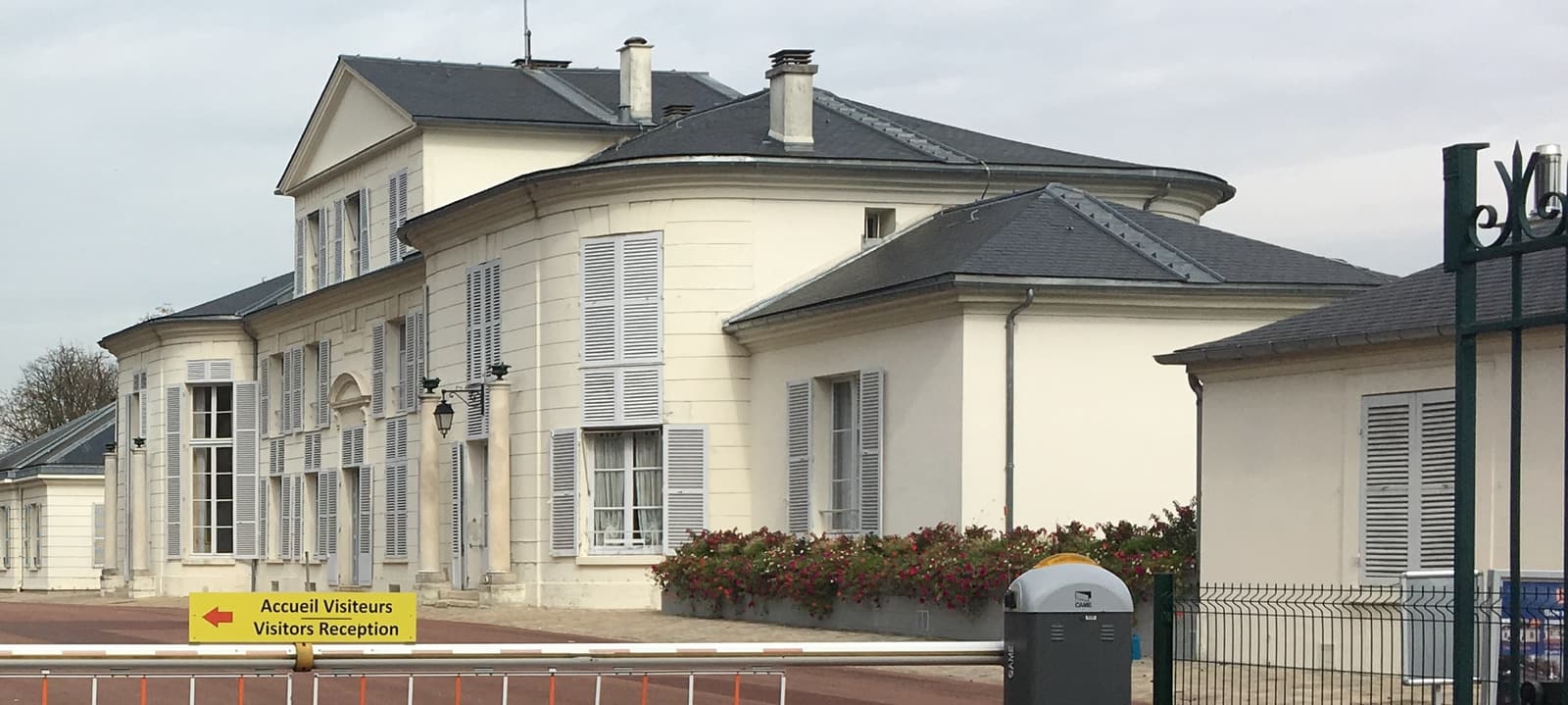
The Pavillon de Breteuil is therefore more than a picturesque headquarters. It is the visible answer to a nineteenth-century problem: how to make a measure belong to everyone without letting anyone casually own or alter it. A unit became trustworthy because a building, a vault, a committee, a conference, and a comparison routine stood behind it.
That may sound less dramatic than a revolution, an expedition, or a battle. Yet it changed the daily texture of modern life. Every cross-border shipment, laboratory calibration, engineering tolerance, pharmaceutical mass, satellite component, electrical measurement, and standards certificate depends on the idea that units can be shared without being vague. The Metre Convention made that idea durable by giving it machinery.
Sources
- BIPM, "The Metre Convention" - official overview of the 20 May 1875 treaty, its 1921 amendment, the creation of BIPM, and the convention's place among nineteenth-century international organizations.
- US Metric Association, "Metric Convention of 1875" - English treaty text and regulations, including bureau duties, prototype custody, funding rules, building requirements, and three-key access provisions.
- National Institute of Standards and Technology, "Kilogram: Focus on History" - NIST history of the 1875 treaty, the 17 signatory countries, and the CGPM, CIPM, and BIPM structure.
- BIPM, "Historical perspective: Unit of mass, kilogram" - BIPM account of the 1889 kilogram prototype, national prototypes, periodic verification, divergence, and the 2018 Planck-constant redefinition.
- BIPM, "International Prototype of the Kilogram (IPK)" - official page on the former IPK artifact, its composition, dimensions, conservation at BIPM, and replacement by the revised kilogram definition on 20 May 2019.
- Wikimedia Commons, "File:BIPM (cropped).jpg" - photographic source page for the Pavillon de Breteuil image used as this article's cover.