The Pullman Strike is often remembered as a big labor clash with a familiar cast: Eugene V. Debs, George Pullman, angry railroad workers, an injunction, federal troops, and the eventual birth of Labor Day as a federal holiday.[1][2][3] All of that is true, but it can make the episode look bigger and blurrier than it was. The strike did not become a national constitutional confrontation merely because labor and capital happened to collide in a bad economy. It became national because a very specific local grievance was connected to a very specific network.
That network was rail transportation in the summer of 1894.[1][2][3][4] Pullman workers were not employed in an isolated factory town with a self-contained market. They built cars that moved through the broader railroad system, and the American Railway Union chose a tactic that exploited that system's interdependence. Once Pullman cars were boycotted on trains that also carried interstate traffic and U.S. mail, the dispute could be reframed by the federal government as an obstruction of commerce and postal service rather than only as a labor fight.[2][4]
That is the core mechanism worth understanding. First came the company-town grievance. Then came a boycott strategy matched to the architecture of rail traffic. Then came the federal claim that the boycott was interfering with interstate commerce and the mail. Once that reframing succeeded, the strike no longer turned on whether Pullman's workers had been treated fairly. It turned on whether the national government would allow organized labor to interrupt the circulation systems on which it said the public depended.[1][2][3][4]
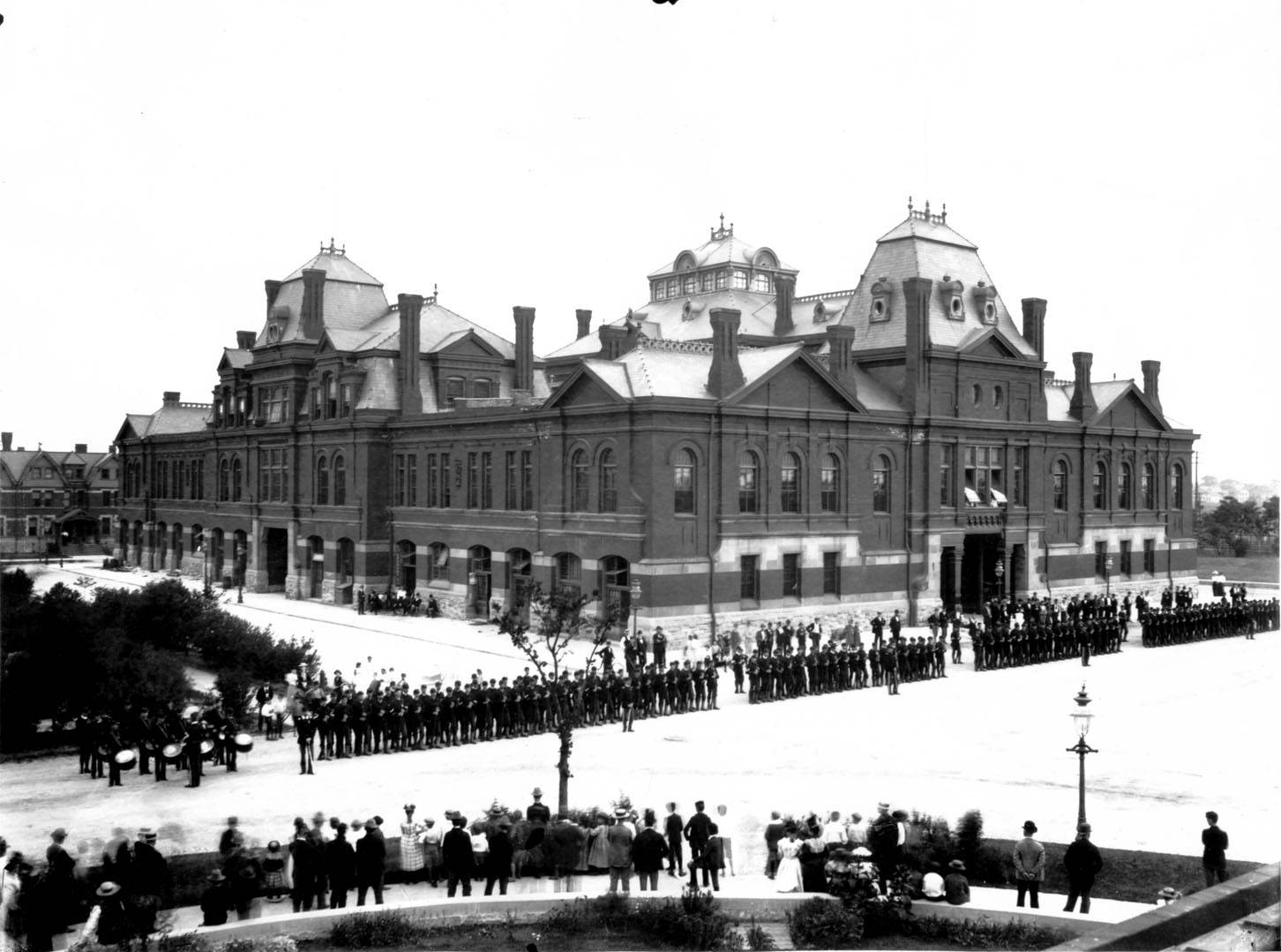
The archival image used here belongs to that mechanism. It shows strikers gathered outside the Arcade Building in Pullman while the Illinois National Guard is visible at the scene, photographed from the Florence Hotel by Pullman Company staff.[5] The image is not yet the national rail map or the Supreme Court case. It is the hinge between them: a local conflict that has already drawn armed public authority into the town.
The local trigger was not low wages alone, but low wages inside a controlled town
The first step in the chain was the depression that began in 1893.[1][3] Orders fell, the railroad industry contracted, and Pullman cut wages. That alone would have been serious enough. What turned the cut into a more combustible grievance was that the company did not lower rents and related charges in the town it controlled.[1][3] Contemporary and later institutional accounts agree on the central point: a sharp drop in pay met a company-town cost structure that did not ease with it, leaving many workers in genuine distress.[1][3]
The town made that decision feel less like an ordinary market shock and more like a trap. Pullman had built housing, deducted rents through company channels, and governed the environment through a paternal system that promised order and uplift while limiting worker autonomy.[2][3] In the good years, that model could be advertised as enlightened industrial planning. In a depression, the same structure made workers feel that the company controlled both sides of the household equation. It was employer and landlord at once.[2][3]
This is why the strike began as a legitimacy crisis inside Pullman before it became a transport crisis outside it. When workers tried to present grievances and press for negotiation, arbitration failed, managers refused meaningful accommodation, and the walkout began on May 11, 1894.[1][2] The first stage of the dispute was still local. But the town's design had already done part of the work of radicalizing it. Pullman's system had concentrated power tightly enough that a pay cut could not be separated from housing, status, and daily discipline.[2][3]
The boycott scaled because Pullman cars were attached to everybody else's trains
The second step was strategic. The American Railway Union did not need to own the rails or shut down every train by force. It only needed to exploit the way Pullman cars were distributed through the existing network. A detailed historical account of Pullman notes that after workers appealed for support, the ARU gave notice on June 20 that beginning June 26 its members would no longer work trains carrying Pullman cars.[2]
That choice mattered because Pullman cars were not marginal equipment. They were integrated into ordinary railroad operations. A boycott aimed at those cars therefore radiated outward across many carriers.[1][2][3] The National Park Service's foundation document says the action grew from a local walkout into one of the largest labor actions in American history, affecting about 250,000 workers in 27 states at its peak and disrupting rail traffic across much of the nation.[3]
This is the point where the causal chain becomes clearer than the slogan "general strike." The ARU's leverage did not come from abstract class solidarity alone. It came from coupling. A Pullman car could be one part of a train assembled for broader interstate movement. Refusing to handle that one part of the consist could stall the larger machine. The boycott therefore translated the workers' local complaint into a system-wide coordination problem.[2][3]
In that sense, the most important infrastructure in the story is not a single building in Pullman. It is the operating fact that the railroad network was interdependent. The boycott succeeded to the extent that it weaponized interoperability. What looked like sympathy for Pullman workers became, in practice, an attack on the connected routines of carriers that depended on mixed consists, shared schedules, and predictable handling rules.[2][3]
The mail turned labor leverage into a federal claim
The third step was jurisdictional. Federal officials did not have to accept the strike on labor's terms. They could recode it as an issue of public obligation. That is exactly what happened once the boycott touched the mails and interstate commerce.[3][4]
The National Park Service states the key fact directly: the strike disrupted federal mail delivery.[3] In re Debs then shows how the government described the situation in court. The complaint filed on July 2, 1894 alleged that the railroads involved were carrying interstate passengers, freight, and U.S. mail, and that the boycott prevented them from performing those duties.[4] The opinion also records the government's argument that Pullman sleeping cars were, of necessity, carried on trains that included mail cars, which meant interference with Pullman service could be represented as interference with postal service and interstate traffic together.[4]
That overlap gave the federal state a far stronger legal narrative than "a private company is under pressure from its workers." The case became: the nation has constitutional responsibilities over interstate commerce and the transmission of the mails; those highways are being obstructed; therefore the government may seek judicial and executive relief.[4] In the logic of the opinion, the issue was not simply who was right in the original wage dispute. It was whether the United States would permit organized actors to block national circulation systems that Congress had placed under federal care.[4]
Once framed that way, the strike's terrain changed decisively. Labor's tactical intelligence had exposed a choke point. The government answered by claiming ownership of the chokepoint in constitutional terms.
The injunction and troops changed the contest from negotiation to suppression
After that reframing, the remaining steps followed quickly. In early July 1894, the federal government obtained a broad injunction against boycott activity and sent troops into Chicago and elsewhere.[2][3][4] That same historical account describes the injunction as broad enough to shut down the boycott in practice and notes that soldiers joined local authorities in getting trains moving again.[2] The federal legal remedy and federal coercive capacity were now working together.
This is why the strike ended as a defeat even though Pullman himself drew wide criticism. The boycott had been powerful because it exploited a network. The injunction and troop deployment were powerful because they reclaimed that network for the state.[2][3][4] Once workers risked contempt, arrest, and military suppression for continuing the interruption, the original leverage began to collapse. By mid-July, the boycott and the union had been broken.[2]
The political system also moved to manage the fallout. Congress passed the Labor Day legislation on June 27, and President Cleveland signed it on June 28, 1894, while the conflict was still escalating.[1][3] That did not solve the strike. It did show that the administration understood the unrest as more than a local industrial dispute. Conciliation at the symbolic level and suppression at the operational level proceeded side by side.[1][3]
Why this mechanism mattered after 1894
The longer afterlife of Pullman lies in what the episode taught different institutions. For labor, it showed both the power and fragility of network leverage. A boycott could scale nationally with astonishing speed if it hit the right operational dependency.[2][3] For the federal government, it established a template for using injunctions and commerce-and-mail reasoning against labor disruptions that threatened major circulation systems.[4]
The strike also damaged the moral standing of Pullman's paternal model. Later historical accounts of Pullman note that the federal strike commission sharply criticized the company's paternalism and its refusal to arbitrate.[2][3] The National Park Service adds the legal sequel inside Illinois: after the strike, the state challenged Pullman's ownership of the town, and the Illinois Supreme Court eventually ordered the company to divest its non-industrial property there.[3] The town had been advertised as a private solution to industrial disorder. After 1894, it looked instead like evidence that private order could generate public crisis.
That is why the Pullman Strike still matters. The essential question was not whether workers suffered, though they did, or whether the boycott was disruptive, though it was. The deeper issue was how a local dispute became a contest over who controlled the nation's connective tissue. Wages and rents lit the fuse. Coupled cars transmitted the shock. The mail gave Washington its doctrine. After that, the strike no longer belonged only to Pullman.[1][2][3][4]
Sources
- National Park Service, "George M. Pullman" - overview of the 1894 wage cuts, unchanged rents, mail disruption, troop intervention, and Labor Day's immediate political context.
- SAH Archipedia, "Pullman" - historical account of the company town, the 1894 wage-and-rent crisis, the June boycott, troop intervention, and the later criticism of Pullman's paternal model.
- National Park Service, Pullman National Monument Foundation Document - institutional account of the Panic of 1893 wage cuts, nationwide spread, mail disruption, Labor Day legislation, and Illinois's later suit against the company town.
- Legal Information Institute, In re Debs, 158 U.S. 564 (1895) - Supreme Court opinion describing the federal complaint over obstruction of interstate commerce and the mails.
- Wikimedia Commons, "File:Pullman strikers outside Arcade Building.jpg" - archival image page identifying the 1894 scene in Pullman, Chicago, and the Illinois National Guard presence.