
The opening day of the Blitz is often remembered as the moment London proved it could endure bombing.[2][3][6] That memory is not wrong, but it arrives after the most important shift has already happened. On 7 September 1940, the Luftwaffe's attack on the London docks turned the war over Britain into a war inside the city. What had been, through most of August and early September, a struggle over airfields, radar, and fighter attrition became something else: smoke over the Thames, burning warehouses, blocked streets, hoses under pressure, shelter discipline, and a public suddenly living inside the target.[2][4][5]
That is why the archival footage below still matters. It does not show London only as a victim or as a symbol of resilience.[1] It shows a city being forced into emergency procedure. Searchlights sweep, anti-aircraft batteries fire, flames take hold in built-up streets, survivors pick through rubble, and civilians settle into Underground shelter life while the camera insists that all these activities belong to the same event.[1][2] The war has moved from a map to a metabolism.
The first day of the Blitz should therefore be read less as a preface to Churchillian legend than as a change in the war's operating surface.[2][3][5] The docklands were not chosen by accident. Port infrastructure, fuel, storage, rail links, and adjacent working-class neighborhoods made East London both economically vital and physically vulnerable. Once that zone ignited, London stopped being merely the defended capital and became an urban system trying to remain usable while parts of it burned.
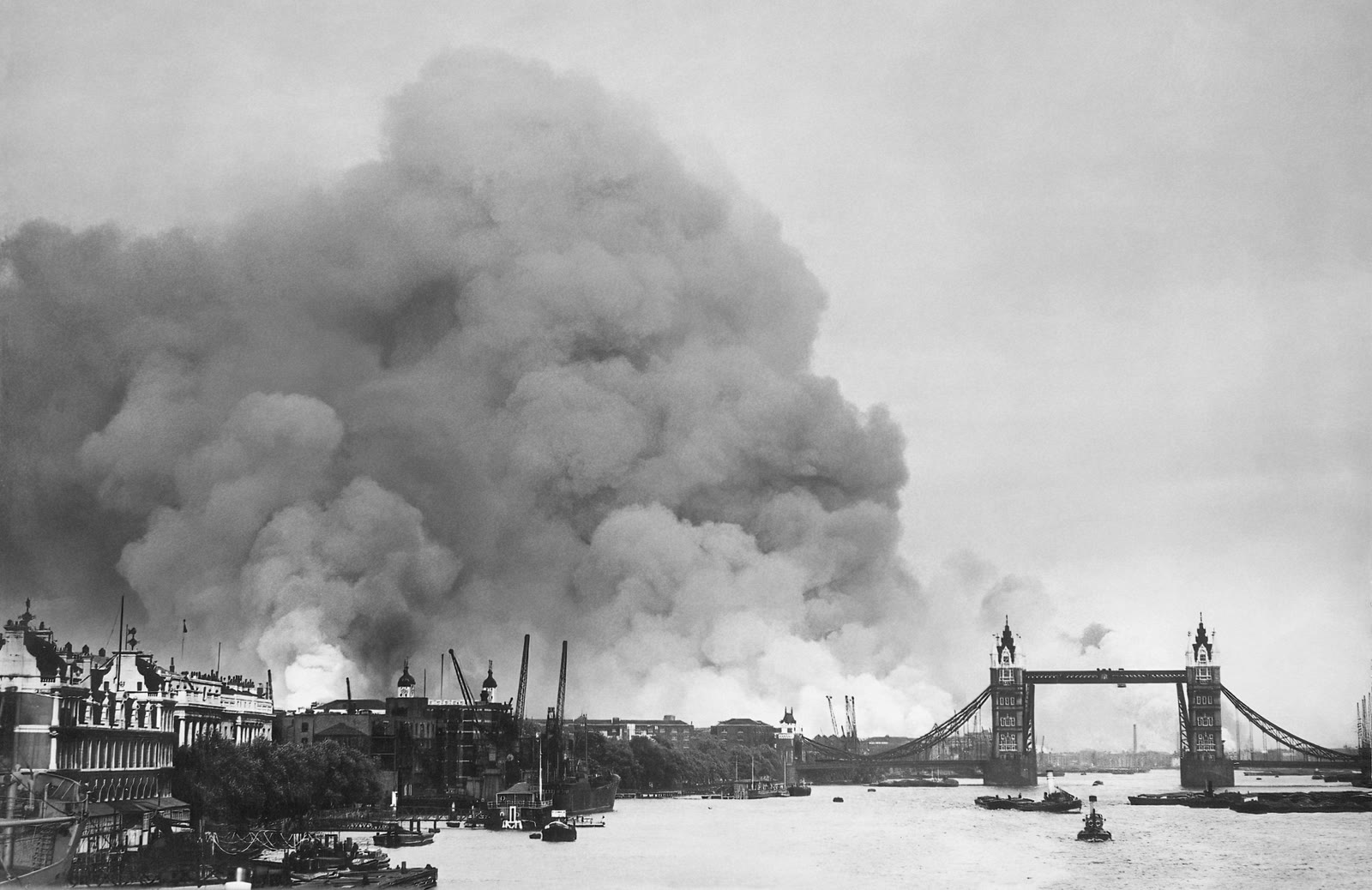
Image context: the cover uses the archival photograph commonly known as London Blitz 791940, showing smoke rising from the London docks behind Tower Bridge on 7 September 1940.[6][7] It fits this article because the piece is about visible transition. The image captures the exact moment when a famous city silhouette remains intact in the foreground while the economic body behind it has already entered fire, smoke, and emergency.
Historical context: 7 September 1940 marked the turn from airfield pressure to urban bombardment
The background to the first day of the Blitz lies in the Battle of Britain's changing phases.[4][5] The RAF Museum's phase outline places 7 September to 2 October 1940 in a distinct fourth phase defined by large-scale day and night attacks against London, and it explicitly identifies this shift as the start of what came to be called the Blitz on the capital and other cities, a campaign that lasted until May 1941.[4] That matters because it prevents the event from looking like one more raid in a continuous blur. A threshold was crossed.
The National Archives' education overview makes the opening move concrete. On 7 September 1940, it notes, 300 German bombers raided the London docks, and bombing continued until May 1941.[2] The same page explains why this mattered beyond military targeting. Once attacks moved toward docks, factories, and railways, bombs also fell into streets and houses because those targets were embedded in towns and cities.[2] Urban warfare did not require every bomb to miss. The structure of the city made industrial attack and civilian exposure inseparable.
The RAF Museum's 1940 timeline sharpens the scale of that afternoon. It records that almost 1,000 Luftwaffe aircraft were dispatched against London, that twenty squadrons of RAF Fighter Command engaged them, and that the codeword Cromwell was released because invasion was judged to be a real possibility.[5] In other words, the first day of the Blitz combined strategic fear with immediate urban consequence. London was not simply under attack; it was being tested as a port city, a capital, and a mass civilian environment at the same time.
The longer social meaning became visible very quickly. The U.S. National Archives' Prologue essay, written around the famous docklands smoke photograph, argues that the Blitz brought World War II to England's home front and emphasizes the intensity of the opening stretch: 57 consecutive days and nights of bombing, with tens of thousands of civilians eventually killed across Britain.[6] That does not mean every later raid was identical to the first one. It means the first day established the basic condition under which London would now have to function.
Video provenance
The embedded video is British Pathé's "London Blitz (1941)," uploaded to YouTube from archival material described by the channel as unused or unissued footage of London's blitz conditions.[1] That provenance matters for an archival spotlight. This is not a retrospective documentary explaining the Blitz from a safe distance. It is short, rough evidence built from wartime visual habits: searchlights, anti-aircraft fire, burning buildings, rubble, shelters, and a voice determined to translate destruction into public steadiness.
Close reading: the footage shows London turning into a managed fire zone
The first thing to notice in the clip is that the city is not shown as passive landscape.[1] Even before the eye settles on particular buildings, the frame fills with instruments of detection and response. Searchlights rake the sky. Anti-aircraft guns fire repeatedly. Hoses arc into burning structures. This matters because the footage is not only representing attack; it is representing process. London appears as a place trying to convert bombardment into sequence: detect, track, fire back, contain, shelter, clear.
The second thing to notice is the relation between height and ground.[1][6][7] The famous smoke view over the Thames and the Pathé footage share the same historical logic. From above or at distance, the city looks almost diagrammatic: bridges, river, smoke columns, zones of fire. But once the camera drops to street level, the abstractions dissolve into brick, hose lines, shattered fronts, and civilians picking carefully through debris. The Blitz becomes legible not as one catastrophic instant but as a forced oscillation between skyline and pavement.
This is where the docklands matter. The RAF Museum's description of "Black Saturday" beginning with the London Docks helps explain why the opening day looked the way it did.[3] Docks are storage, fuel, warehousing, transit, labor, and adjacency. Strike them and the result is not a clean military event. It is prolonged combustion inside a dense urban economy. The smoke behind Tower Bridge in the lead image is therefore more than scenery. It is the visible sign that the city's logistical organs have been hit hard enough to alter the atmosphere of the whole capital.[6][7]
The shelter scenes are just as important as the fires.[1] British Pathé includes civilians bedding down in Underground stations, including scenes identified in the description as Aldwych.[1] That choice gives the footage its real historical depth. The Blitz was not only what happened when bombs fell. It was also what happened when ordinary movement had to be rerouted below ground and when night ceased to belong to domestic privacy. Shelter life, however improvised, was part of the city's new operating system.
There is also a tension in the voice and editing that makes the footage especially revealing.[1] The images show fatigue, wreckage, and obvious vulnerability, while the spoken line of feeling presses toward composure and endurance. That gap is itself historical evidence. Wartime London was not held together by morale as a mood alone. It was held together by morale being attached to visible labor: fire crews, rescue work, anti-aircraft discipline, shelter order, and the continued use of streets that had already been damaged. The film's insistence that England can take it has weight precisely because the camera keeps showing how much taking it actually involved.
Legacy: why the first day still matters now
The opening day of the Blitz matters because it changed the scale at which modern war had to be understood.[2][3][4] Air power was no longer only a question of fighters, bombers, and command decisions over the Channel. It had become a question of whether a city could continue to circulate people, water, fire crews, transport, and information after its docks were set alight. The first day revealed that civil defense was not auxiliary. It was central.
That is why the smoke photograph and the short Pathé reel still hold in 2026.[1][6][7] Together they preserve a transition. London remains recognizably itself, yet the terms of ordinary urban life have already been rewritten by bombardment. The Blitz later became a national memory of endurance, and there are reasons for that. But on 7 September 1940, before legend settled in, what appeared first was a city entering emergency operation in plain view.
Sources
- British Pathé, London Blitz (1941) - archival footage of anti-aircraft fire, burning buildings, rubble, and Underground shelter scenes in wartime London.
- The National Archives (UK), "German air attacks" - overview noting the 7 September 1940 raid by 300 German bombers on the London docks and the continuation of bombing until May 1941.
- RAF Museum, "The Blitz" - institutional overview identifying 7 September 1940, "Black Saturday," and the opening attacks on the London Docks.
- RAF Museum, "Introduction to the Phases of the Battle of Britain" - periodization placing 7 September to 2 October 1940 in the phase of large-scale day and night attacks against London.
- RAF Museum, "1940" - military aviation timeline noting the 7 September 1940 assault on London, the scale of the Luftwaffe attack, and the Cromwell alert.
- U.S. National Archives, "The London Blitz" - official blog essay explaining the docklands smoke photograph and describing the Blitz as the war's arrival on England's home front.
- Wikimedia Commons, "File:London Blitz 791940.jpg" - source page for the archival image of smoke rising from the London docks behind Tower Bridge on 7 September 1940.