Kent State is usually remembered through its ending: the Ohio National Guard turning, firing, and leaving four students dead in thirteen seconds on May 4, 1970.[2][3] That ending is historically real, but by itself it flattens the event into a spontaneous explosion of violence. The stronger unit is longer and more administrative. The shootings make more sense when read as a four-day chain in which a federal war decision, a city emergency, a burned ROTC building, a campus occupation, and a failed dispersal on difficult ground all fed one another until the Guard's retreat over Blanket Hill ended in rifle fire.[1][2][3]
That is why Kent State still resists clean moral compression. It was neither a neat battlefield nor a simple classroom walkout. The event sat at the crossing of several authorities that were not solving the same problem. President Richard Nixon was defending the Cambodia operation as a necessary extension of the Vietnam War.[1] Kent's mayor was treating downtown disorder as a local emergency.[2][3] Governor James Rhodes sent the National Guard into a college town on the assumption that local forces might lose control.[3] University officials banned rallies while classes were also supposed to continue.[2][3] By noon on May 4, a crowd had gathered inside all of those overlapping commands, and none of them fit the terrain well.
The famous images of Kent State can make the day look frozen: a scream, a body, a line of armed men. The chronology shows the opposite. Everything moved. Protest spilled from campus to town on May 1; security power moved back from town to campus on May 2; Guard occupation hardened on May 3; then a march meant to disperse the crowd on May 4 pushed soldiers down into a fenced practice field and pulled them back up toward the crest of Blanket Hill under rock-throwing, shouting, and failing command control.[2][3]
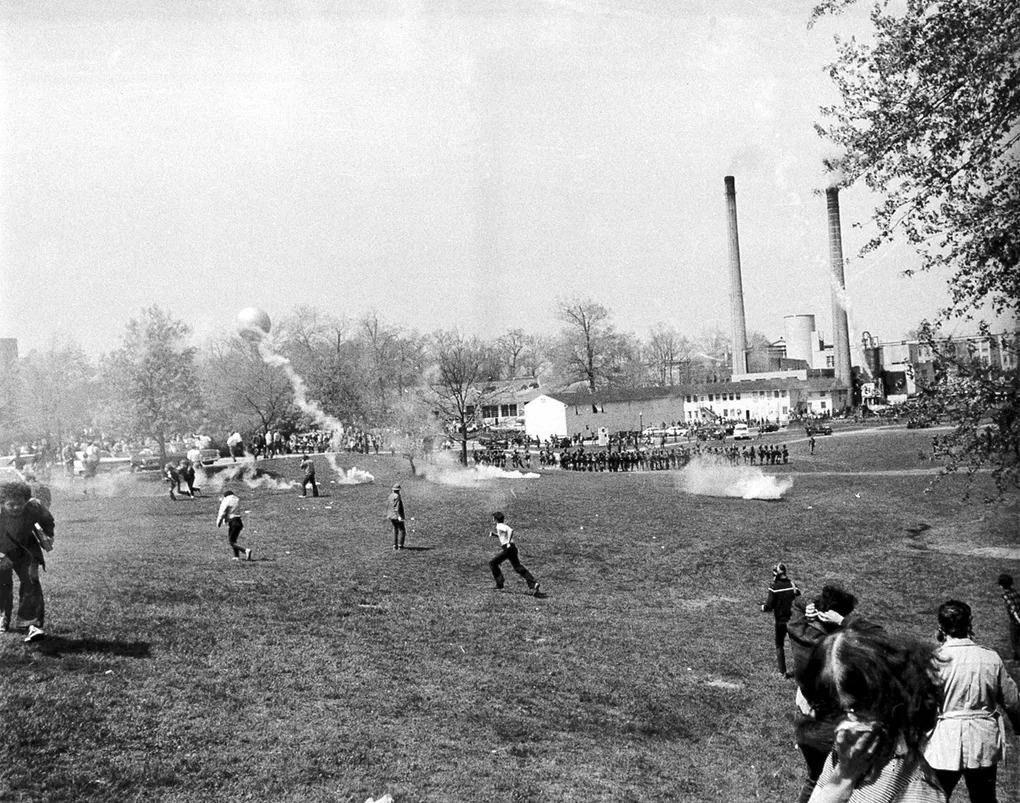
Image context: the cover uses Larry Stoddard's archival photograph of tear gas and students on the Kent State campus on May 4, 1970.[5] It fits this reconstruction because the key historical issue is motion through a stressed landscape. Before the iconic aftermath image, there was already gas in the air, uncertain visibility, and a crowd being pushed and pulled across a slope that neither police logic nor military drill had organized well.
The chain began with Cambodia, but the first escalation was local
The immediate national trigger came on April 30, 1970, when Nixon announced that American and South Vietnamese forces were entering Communist base areas in Cambodia.[1] In the speech, he framed the move as a limited operation meant to protect remaining U.S. forces in South Vietnam and preserve the credibility of withdrawal on American terms.[1] To many antiwar students, the speech read differently. Instead of winding the war down, the administration appeared to be widening it. Kent State's noon rally on May 1 followed directly from that interpretation.[2][3]
Kent's own chronology is important here because it prevents hindsight from turning the weekend into a single uninterrupted antiwar demonstration.[2] On May 1, students buried a copy of the Constitution to symbolize its "murder" and called for a second rally at noon on Monday, May 4.[2][3] By evening, however, the scene had shifted. Warm weather, drinking, anger over Cambodia, and the ordinary permeability between campus and downtown Kent produced a crowd that moved toward the town center, broke some windows, and confronted local police.[2][3] Mayor Leroy Satrom declared a state of emergency, closed the bars, and sought state assistance.[3]
That first turn matters because it changed the category of the problem. A protest against a presidential war decision became, inside Kent, a question of crowd control and municipal order.[2][3] Once the town had been tear-gassed and the bars had been closed early, local officials were no longer looking at campus dissent as a speech problem. They were looking at it as a disorder problem. That administrative shift did not cause the later gunfire by itself, but it established the lens through which later decisions would be made.
The ROTC fire made Guard deployment look like prevention instead of overreaction
On Saturday, May 2, the atmosphere did not simply cool.[2][3] Students helped clean downtown, but rumors of radical violence circulated widely, and university officials distributed notice of an injunction against damage to campus buildings.[2] Then, shortly after 8:00 p.m., more than a thousand people gathered around the Army ROTC building, and a few succeeded in setting it on fire.[2] Fire hoses were cut or punctured, firefighters withdrew, and by midnight the National Guard had cleared the campus and forced many students into dormitories.[2]
This was the hinge of the reconstruction. If May 1 turned antiwar protest into a local emergency, May 2 turned emergency into militarized prevention. After the ROTC building burned, sending the Guard no longer looked to officials like a speculative response to rumors. It looked like a response to a visible failure of control.[2][3] That did not mean the Guard had a coherent mission once it arrived. It meant that the political cost of not sending it had suddenly become much higher than the political cost of occupation.
Lewis and Hensley's account makes the sequence especially clear.[3] Satrom had already feared that local forces would be inadequate, but the mayor's fear was now reinforced by a building fire that could be shown, photographed, and narrated as proof of escalating campus violence.[3] In practice, this meant that by the time students returned to the antiwar question on Monday, they were doing so inside a campus whose governing logic had been altered by a security deployment. The Guard had not arrived to adjudicate arguments about Cambodia. It had arrived because authorities believed that campus protest could tip quickly into property destruction and wider urban disorder.[2][3]
Sunday produced occupation without a shared command language
The chronology for May 3 is quieter on the surface and more dangerous underneath.[2] Kent State's library chronology describes a deceptively calm city and campus occupied by National Guardsmen, but also notes conflicting perceptions and misunderstandings among state, local, and university officials.[2] That sentence deserves more attention than it usually gets. By Sunday, the crisis no longer belonged to one institution. The university wanted classes to resume. Officials also wanted assemblies controlled. Sightseers arrived. Demonstrators tested the limits of the occupation. The Guard itself was now present as both symbol and instrument.[2]
Near dusk, a crowd gathered again on the Commons by the Victory Bell.[2] At 9:00 p.m., the Ohio Riot Act was read and tear gas was fired.[2] When demonstrators reassembled later at East Main and Lincoln, traffic was blocked, expectations of official dialogue went unmet, tempers rose further, and at 11:00 p.m. the Riot Act was read again, followed by more tear gas and injuries on both sides.[2] These encounters were smaller than the next day's shootings, but they mattered because they hardened mutual expectations. Demonstrators learned that authorities would answer assembly with dispersal. The Guard learned that dispersal could fail, repeat, and return.
By Monday morning, the campus was therefore entering the noon rally with two incompatible assumptions already in place.[2][3] Many demonstrators were determined to hold the protest despite the ban. The National Guard was determined to disperse any assembly.[2] That is a worse setup than a simple disagreement, because it gives both sides an action they feel obliged to carry out in public view. Once two thousand people gathered near the Commons by noon on May 4, the event had already become a test of enforcement as much as a test of speech.[2]
The noon rally became a tactical loop the Guard could not control
The strongest Kent State sources agree on the outline of the shooting sequence.[2][3] Shortly after noon on May 4, an order to disperse was met by chants, curses, and some rock-throwing.[2] Tear gas canisters were fired, but wind reduced their effect.[2] The Guard then advanced with fixed bayonets across the Commons, driving demonstrators up the slope by Taylor Hall, over Blanket Hill, and down toward the Prentice Hall parking lot and the adjoining practice football field.[2][3]
This is the moment where topography enters the history as more than scenery. The practice field was fenced on three sides.[2][3] The Guard had pushed demonstrators off the Commons, but in doing so it had also moved itself into a confined area where the crowd had not actually disappeared and where soldiers no longer held a clean dispersal geometry.[2][3] Lewis and Hensley note that yelling and rock-throwing intensified while the Guard remained there for about ten minutes; some Guardsmen huddled, some knelt, and some pointed weapons, though no shots were fired at that stage.[3] What had looked like a forward-clearing motion became a stalled position under pressure.
When the Guard began retracing its line of march, the confrontation changed character but did not end.[2][3] Some demonstrators followed within about twenty yards; many others remained much farther back.[2] At the crest of Blanket Hill, twenty-eight guardsmen turned and fired 61 to 67 shots in about 13 seconds.[2][3] Four students were killed: Jeffrey Miller, Allison Krause, William Schroeder, and Sandra Scheuer. Nine more were wounded.[2][3] The distances matter because they break the later myth that everyone shot was immediately on top of the Guard. Lewis and Hensley note that the dead were roughly 270, 330, and 390 feet away, while the closest wounded student stood about 60 feet from the firing line.[3]
That spread helps explain why Kent State entered American memory as both a protest tragedy and a state-violence scandal. This was not a close-quarters struggle in which every casualty stood inside one compressed scrum. Some victims were far enough away that the shooting exceeded any narrow idea of immediate self-protection.[3] At the same time, the record also rejects a simpler legend in which the crowd had done literally nothing provocative at all. Lewis and Hensley explicitly argue that some provocation existed, while also insisting that common textbook summaries remain inaccurate about fleeing students, shots in the back, and who was merely passing to class.[3] The event reconstruction is stronger when both facts stay visible: a tense and hostile confrontation did exist, and the Guard nevertheless fired into a crowd at distances that made the response historically indefensible.
Why thirteen seconds took four days to build
Once the chronology is laid out, Kent State looks less like an inexplicable snap and more like a compressed failure of role, terrain, and authority.[1][2][3] The federal government widened the war into Cambodia and thereby recharged antiwar protest at precisely the moment when many Americans thought de-escalation had begun.[1][3] Local officials in Kent interpreted the first night's disorder through the lens of urban emergency and called for outside force.[2][3] The ROTC fire supplied the visual proof that justified Guard occupation.[2] Then the Guard, trained for control and deterrence rather than for nuanced campus mediation, confronted a Monday rally on ground that made orderly dispersal difficult.[2][3]
That sequence does not excuse the firing. It explains why the line between crowd control and lethal force became so fragile. A Guard unit marching downhill with bayonets, into a fenced field, and back uphill again was not managing a static perimeter. It was moving through a spiral of frustration, exposure, and lost initiative. Demonstrators, meanwhile, were not encountering an ordinary dean's office prohibition. They were confronting armed men who had already spent two nights using tear gas, reading the Riot Act, and occupying the campus.[2] By the time the soldiers turned at the top of Blanket Hill, the event had been narrowed into a question no one on the scene was equipped to answer well: how does an armed state back out of a failed dispersal without using the weapons it brought to enforce the dispersal?
Why the site still matters
The university library chronology records what followed immediately: disbelief, first aid, anger, and then the rapid closing of the university itself.[2] But the longer afterlife is visible in how the ground was later marked. Kent State's May 4 Visitors Center notes that the shooting site entered the National Register of Historic Places in 2010 and was designated a National Historic Landmark in 2016.[4] The same site tour points visitors to markers for the dead and wounded, the bullet hole in Solar Totem #1, and the preserved spaces that keep the geography of the shooting legible.[4]
That memorialization is historically appropriate because Kent State was always a geography problem as well as a political one.[2][4] The Commons, Taylor Hall, Blanket Hill, the practice field, and the Prentice Hall parking lot were not interchangeable backdrops. They were the route through which a foreign-policy decision entered a campus, became a municipal emergency, then became a military occupation, and finally became gunfire. The event still matters because it shows how quickly the state can lose proportionality once several authorities share force without sharing the same definition of success.[1][2][3][4]
The best way to remember Kent State, then, is not as a mystery solved by one iconic photograph or one moral sentence. It is as a reconstruction with dates, slopes, institutions, and escalating mistakes still attached. April 30 made the war wider.[1] May 1 made the campus angry.[2][3] May 2 made security logic dominant.[2][3] May 3 made occupation normal.[2] May 4 made the cost permanent.[2][3]
Sources
- Richard Nixon, "Address to the Nation on the Cambodian Sanctuary Operation" - the April 30, 1970 speech that framed the Cambodia move as a limited war measure and triggered the protest context at Kent State.
- Kent State University Libraries, "May 4 Chronology" - institutional chronology of the events from May 1 through May 4, including the downtown unrest, ROTC fire, Guard movement, and 13-second shooting sequence.
- Jerry M. Lewis and Thomas R. Hensley, "The May 4 Shootings at Kent State University: The Search for Historical Accuracy" - Kent State history resource clarifying the Guard deployment, the Monday rally, firing distances, casualties, and common factual errors in later retellings.
- Kent State May 4 Visitors Center, "National Historic Landmark Site Tour" - official site-history page covering the preservation of the shooting ground, memorial markers, and 2010/2016 landmark designations.
- Wikimedia Commons, "File:Kent State shootings.jpg" - archival photograph by Larry Stoddard showing tear gas and students on the Kent State campus on May 4, 1970.