The stock answer to Prohibition is simple: it failed, and everyone knows it failed. The supporting images are familiar enough to arrive before the argument does. There are speakeasies, gangsters, Rum Row, hidden flasks, and finally repeal on December 5, 1933.[1][5] Yet historians and historically minded social scientists have never been able to leave the story there. The harder question is not whether Americans kept drinking under the Eighteenth Amendment and the Volstead Act. They did. The harder question is what counts as "worked" between 1920 and 1933: less alcohol, less chronic disease, less disorder, more moral discipline, stronger law, or stronger democratic consent.[1][2][3]
That is why the debate stays alive. One line of interpretation emphasizes measurable early effects. By that reading, national Prohibition was not a total fantasy. Drinking appears to have fallen sharply at the start, and some alcohol-related harms fell with it.[1][2][3] Another line of interpretation argues that this is too narrow a scorecard. A constitutional ban that required mass evasion, selective enforcement, urban corruption, smuggling flotillas, and black-market violence had already failed in a more political sense, even if some public-health indicators briefly improved.[1][4][5]
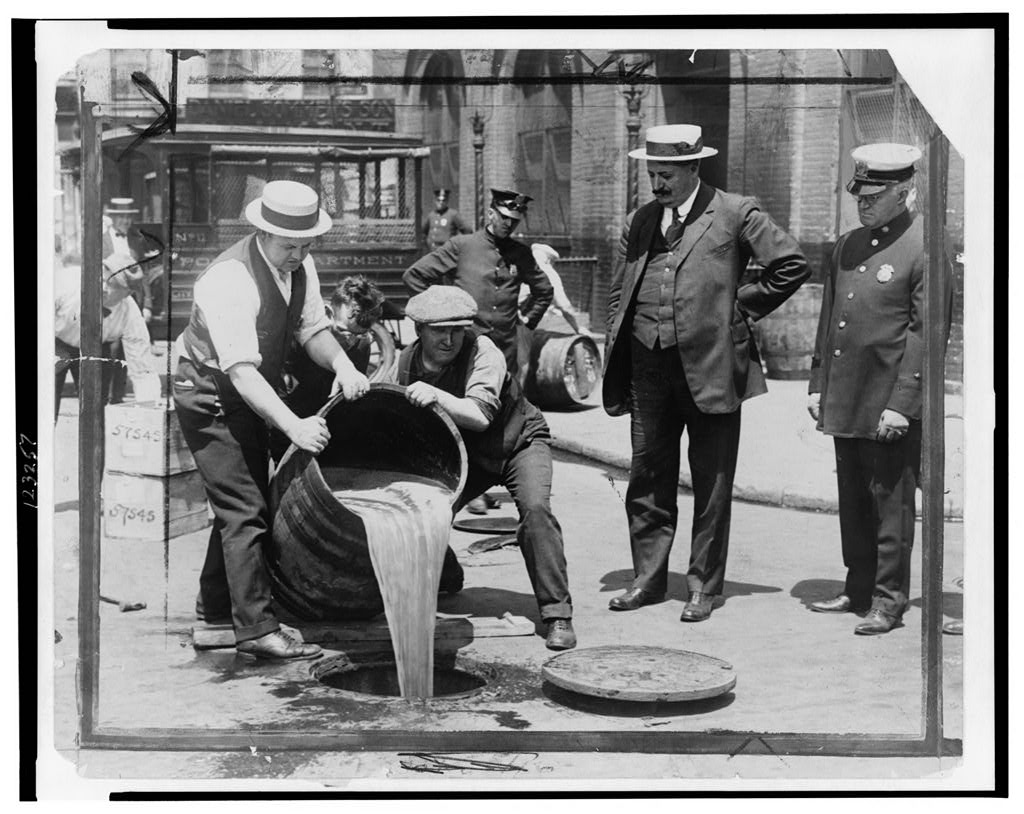
The Library of Congress photograph used here belongs to that argument. In 1921, New York City Deputy Police Commissioner John A. Leach stands by as agents pour seized liquor into a sewer.[6] It is a real enforcement image, but it also looks like performance: visible, dramatic, and local. That matters because Prohibition's central historiographical split is not between people who think the law existed and people who think it did not. It is between people who judge the regime by its early measurable suppression of alcohol use and people who judge it by the kind of state and society the regime actually produced.[1][2][4][6]
The strongest case that Prohibition did work
If the metric is alcohol consumption at the national level, the "worked" argument has real evidence behind it. The National Archives' teaching overview, drawing on contemporary statistics, states that alcohol consumption dropped by about 30 percent and that arrests for drunkenness fell in the early period.[1] Miron and Zwiebel's NBER working paper pushes the point further. Using mortality, mental-health, and crime statistics, they estimate that alcohol consumption at the beginning of Prohibition fell to roughly 30 percent of its pre-Prohibition level before later rebounding.[2] That is not a trivial effect. A law does not need perfect compliance to change behavior, and early Prohibition appears to have changed behavior substantially.[1][2]
The public-health evidence strengthens that reading. Dills and Miron, using state-level data on cirrhosis death rates, conclude that constitutional Prohibition reduced cirrhosis by about 10 to 20 percent.[3] That does not mean every claimed reform benefit was achieved, but it does mean the dry regime cannot be dismissed as pure symbolism. If heavy drinking fell enough to move cirrhosis, then Prohibition altered actual consumption patterns, not only the rhetoric of reform.[2][3]
This success interpretation also makes better sense of why the amendment passed so quickly. The National Archives summary shows that the dry coalition had deep roots before 1919: temperance organizing, the Anti-Saloon League, progressive reform, factory discipline, and moral politics all converged before the federal ban was ratified.[1] Historians who lean toward the success side do not have to claim that the nation became sober. They only have to show that the law achieved part of what its backers wanted for at least part of the period, and the early consumption and cirrhosis numbers give them that ground.[1][2][3]
The strongest case that Prohibition failed
The counterargument begins by changing the metric. Suppose success means a law that can be enforced without normalizing mass evasion, or a reform that strengthens state legitimacy rather than hollowing it out. On that measure, Prohibition looks weaker almost immediately. The same National Archives overview that reports early declines also says enforcement proved extraordinarily difficult. Illegal production and distribution became rampant, the federal government lacked the means or desire to police every border and speakeasy, and by 1925 New York City alone may have had anywhere from 30,000 to 100,000 speakeasies.[1]
Miron and Zwiebel's own consumption estimates support this failure reading as well as the success reading. Their key finding is not only the early drop but the rebound. During the next several years, consumption climbed back to roughly 60 to 70 percent of its pre-Prohibition level, and the level immediately after repeal was not dramatically different from the late-Prohibition years.[2] That makes the regime look less like a stable social transformation and more like an initial shock followed by adaptation. In other words, Americans learned the system, then routed around it.[2]
The black-market argument is stronger still when violence enters the frame. Miron's later NBER paper on prohibition and violence argues that black markets use violence to settle commercial disputes and finds that increases in prohibition enforcement are associated with increases in the homicide rate.[4] A historian does not have to accept every element of that causal model to see the broader point. Once a mass consumer good is pushed into illegality, questions of price, territory, discipline, and distribution do not disappear. They migrate into criminal organization and corrupt brokerage.[4][5]
Lawson's National Archives reconstruction of New York's Prohibition economy makes that institutional failure concrete. New York never truly dried up. Rum Row shifted outward from 3 miles to 12 miles off the coast after treaty changes in 1924; smugglers used tugs, barges, speedboats, radios, and seaplanes; urban demand remained huge; and repeal pressure grew from the same city that the state could not suppress.[5] This is not just colorful atmosphere. It is evidence that enforcement capacity and public consent had come apart. The state could raid lunchrooms, sink a shipment, or dump liquor into a sewer, but it could not make the national ban feel ordinary.[1][5][6]
Where the real historiographical split sits
The disagreement, then, is not really over facts like the date of ratification, the existence of gangsters, or the reality of early consumption decline. It is over weighting and duration. How much should the historian value short-run reductions in drinking and cirrhosis if those gains rested on an enforcement regime that large parts of the public evaded, mocked, or openly refused to fund?[1][2][3] Conversely, how much should the historian let speakeasies and organized crime dominate the story if the law did, for some years, reduce measurable alcohol intake and some health harms?[2][3][4]
The sharpest answer is that both sides are capturing a real part of the record, but at different scales. The success argument is strongest at the level of aggregate consumption and some health outcomes in the early years after 1920.[1][2][3] The failure argument is strongest at the level of political durability, everyday compliance, and the social costs of criminalizing a mass market.[1][4][5] Put differently, Prohibition may have succeeded as a temporary suppressor of drinking while failing as a durable constitutional settlement.
That formulation also explains why repeal in 1933 did not require anyone to prove that temperance concerns had been invented. It required a broad judgment that national constitutional prohibition had overshot what the American state could administer and what the public would treat as legitimate law.[1] A narrower regime of taxation, licensing, and local regulation could survive where an absolute national ban could not. In this sense, repeal was not a declaration that alcohol was harmless. It was a declaration that the chosen constitutional instrument had proved too blunt for the society it aimed to discipline.[1][5]
The better answer to the old question
So did Prohibition work? The cleanest historical answer is: it worked briefly on some of its own terms and failed on the larger political terms required to sustain itself. It reduced drinking sharply enough at first to move national indicators and cirrhosis.[1][2][3] It also helped generate a black-market order, selective enforcement, and visible violence large enough to discredit the idea that sobriety could be secured by one national constitutional ban.[1][4][5]
That answer is less satisfying than a slogan, but it fits the evidence better. Prohibition's real afterlife lies in forcing historians to separate policy effect from policy durability. A law can achieve a measurable short-run goal and still fail because the apparatus required to keep it alive corrodes the legitimacy it depends on. The sewer photograph catches that paradox exactly. The state is present. The law is real. The question is whether the scene records command or merely one moment in a very large national workaround.[6]
Sources
- National Archives, "The Volstead Act" - overview of passage, early decline in drinking, speakeasy scale, and enforcement problems.
- Jeffrey A. Miron and Jeffrey Zwiebel, "Alcohol Consumption During Prohibition," NBER Working Paper 3675 - estimates of sharp early decline followed by partial rebound.
- Angela K. Dills and Jeffrey K. Miron, "Alcohol Prohibition and Cirrhosis," NBER Working Paper 9681 - state-level evidence on cirrhosis under constitutional prohibition.
- Jeffrey A. Miron, "Violence and the U.S. Prohibition of Drugs and Alcohol," NBER Working Paper 6950 - black-market enforcement and homicide argument.
- Ellen NicKenzie Lawson, "Smugglers, Bootleggers, Scofflaws: How Liquor Got into New York City during Prohibition," Prologue (National Archives) - Rum Row, urban demand, and repeal pressure.
- Library of Congress, "(New York City Deputy Police Commissioner John A. Leach, right, watching agents pour liquor into sewer following a raid during the height of prohibition)" - 1921 photograph record used for the article image.