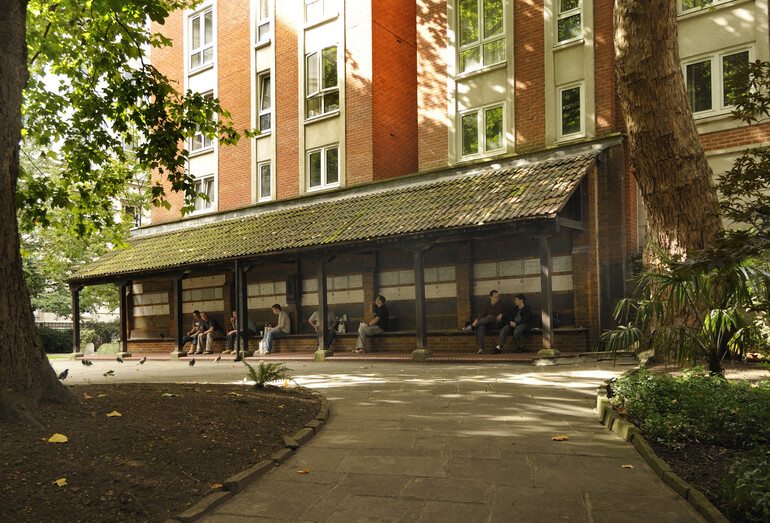
The empty spaces at London's Postman's Park seem to offer an invitation: another name could go here. Beneath a timber shelter, ceramic tablets give people a few lines in which to be remembered. The City of London's 2018 conservation survey counted 54 tablets commemorating 62 people, surrounded by the remains of a much older landscape of churchyards.[2] Their subject is courage exercised at close quarters: somebody sees another person in danger and intervenes.
Yet room on a wall does not necessarily mean room for another memorial. By 2021, renewed requests for plaques were meeting a settled objection: additions would damage the historical character of the monument.[5] A project created to rescue people from oblivion had itself become something that needed preserving. How did leaving the wall unfinished become a way of caring for it?
A jubilee project in four tablets
On 5 September 1887, the painter George Frederic Watts proposed a memorial in a letter to The Times titled “Another Jubilee Suggestion.” Queen Victoria's jubilee offered an occasion to honour people whose acts might otherwise disappear from public memory. Securing money and a site took another thirteen years.[1]
When the monument opened in 1900, Ernest George's timber loggia sheltered just four memorial tablets in a scheme intended for 120. William De Morgan made the early ceramics. After Watts died in 1904, Mary Watts continued the undertaking; when De Morgan left ceramics, Royal Doulton supplied further work. Additions became intermittent, and the project stopped in 1931 with 53 tablets.[1]
The gap between four and 120 matters. A visitor at the opening encountered the beginning of a collection. There was an implied future in the bare surface: more stories, more names, further acts of recognition. The same surface would eventually acquire another meaning, as evidence of the limits of the people and institutions that built it.
A life compressed into an ending
The memorial's research project explains that Watts amassed newspaper cuttings about rescues. Transcriptions became a catalogue from which cases were selected; after his death, Mary and a committee at St Botolph's church chose further subjects. No explicit selection procedure has been identified. The project also stresses Watts's instructional purpose: an act of courage was supposed to suggest the character of the person who performed it.[3]
That process gave the wall an editorial history. A death first had to become news, enter a collection, and then receive approval for a tablet. The resulting names cannot be treated as a census of everyone who deserved remembrance. Newspaper attention was part of the route into the monument.
Consider Samuel Rabbeth, a young doctor commemorated on a tablet installed in 1902. The Royal College of Surgeons recounts his attempt to help a child with diphtheria: after a tracheotomy failed to restore adequate breathing, he used his mouth to clear the tube. He subsequently contracted the disease. Both doctor and child died.[4]
His inclusion makes the memorial's measure of heroism particularly clear. The rescue did not have to succeed. What received recognition was the decision to accept danger for another person. Read slowly, the tablet asks the visitor to stay with an unsuccessful act of care, without supplying the comfort of a life saved.
There is also a limit to what a tablet can establish. The memorial's research project warns that early newspaper reports sometimes supplied details later corrected in subsequent reporting or at an inquest. Those first versions could become permanent inscriptions.[3] Ceramic gives a sentence durability; it cannot give the sentence an independent guarantee of accuracy. The wall preserves both human actions and the way those actions were first made legible to strangers.
One new name reopened the question
On 11 June 2009, a tablet for Leigh Pitt broke the long pause. Its inscription identifies him as a reprographic operator who saved a boy from a canal at Thamesmead and died on 7 June 2007. London Remembers records the installation date separately from the death date and attributes the new memorial to the Diocese of London.[7]
Pitt's plaque made the founding idea tangible in the present. Here was a recent workplace identity, a named place, an attempted rescue with a terrible cost. The familiar form could still accommodate a contemporary life. To someone looking at the unfilled spaces, it could suggest that the interruption had ended.
The institutions responsible for the monument took a different course. The Friends of the Watts Memorial records a 2010 policy, adopted by the church council, City, diocesan Chancellor and advisory committee, with Watts Gallery's agreement, against further memorials. They cited the creators' personal influence, the availability of modern posthumous honours, and the historical value of the plaques' language and design.[6]
This was a change in what the wall was being asked to preserve. The original enterprise had selected people for commemoration. The later policy protected the particular selection, wording and material form inherited from that enterprise. Empty places could now belong to the historic object as much as occupied ones.
The dates require care. A City report of 7 December 2021 traced the Chancellor's objection to further plaques back to 2009, when the City and English Heritage supported his view. The Friends dates the shared policy to 2010.[5][6] The sources date the objection and the shared policy separately; neither supports treating Pitt's installation as the start of an unrestricted new programme.
The park could carry what the wall could not
The practical test returned during the pandemic. The 2021 City report recorded requests for additions, including one from Barts Health NHS Trust to remember staff who had died during Covid-19. Officers proposed alternatives: engraved paving stones and a redesigned sundial using an existing plinth. These were proposals requiring consultation and consent, rather than completed memorials.[5]
The Friends' published position likewise supports a wider Garden of Commemoration, with small modern memorials in flower beds. It endorses the restriction on additions to the historic wall while making an exception in its own position for tablets belonging to Watts's original scheme.[6] Preservation and continuing remembrance therefore need not occupy the same piece of masonry.
This offers a more generous reading of the gaps. They record a project that depended on particular makers, patrons, newspaper reports and moral expectations. Filling every space would make the wall look more complete while obscuring where that historical undertaking ended. New commemorations elsewhere could acknowledge later lives on terms their own communities can explain.
Postman's Park holds two responsibilities together: keeping the old inscriptions available to scrutiny, and allowing the impulse behind them to remain active. The wall's unfinished appearance makes that distinction visible. There is still room to remember; deciding where to put a name is itself part of remembrance.
Sources
- Watts Gallery, “The Memorial to Heroic Self Sacrifice” (25 July 2018) — the 1887 proposal, construction, makers, additions, and the photograph used here.
- City of London, Postman's Park Conservation Area: Character Summary and Management Strategy (adopted 29 May 2018), pp. 23 and 31 — the memorial's physical character, tablet count, and former churchyards.
- Everyday Heroes of Postman's Park, “The Watts Memorial to Heroic Self-Sacrifice,” historical overview and research FAQ — selection from newspaper reports, moral instruction, and inscription accuracy.
- Susan Isaac, “Memorial to the common people: Postman's Park, London,” Royal College of Surgeons of England (6 April 2018) — Samuel Rabbeth's attempted rescue and commemoration.
- City of London, “Postman's Park Memorials Proposal” (7 December 2021), paragraphs 1–6 — requests for new plaques, the Chancellor's 2009 position, and proposed alternatives.
- Friends of the Watts Memorial, published policy on proposals for new tablets — the 2010 agreement, its preservation rationale, and support for commemoration elsewhere in the park.
- London Remembers, “PP – 2B – Pitt” — transcription of Leigh Pitt's tablet and its erection date, 11 June 2009.