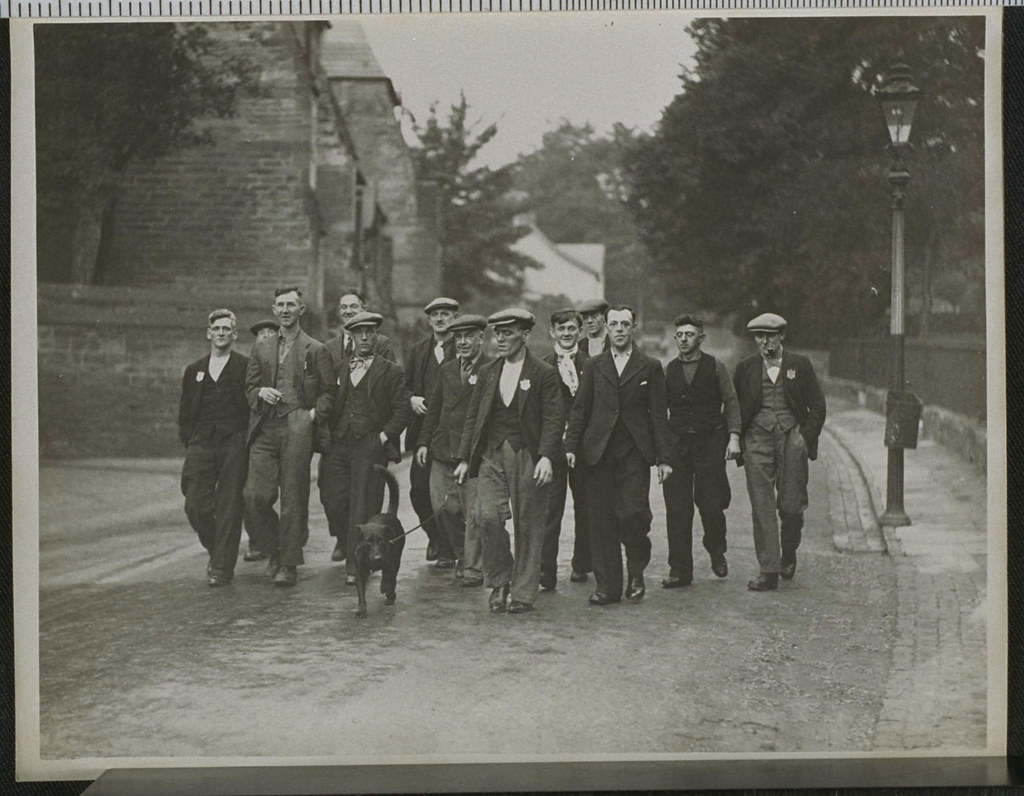
The men had walked to London to ask for work. Back in Parliament, their MP had to explain why walking there should not make them unavailable for it. On 12 November 1936, Ellen Wilkinson challenged the refusal of unemployment assistance to Jarrow marchers. They had remained in contact with the employment exchanges, she said, and could return if a job appeared. Minister of Labour Ernest Brown answered that participation in the march prevented the board from accepting them as available.[1]
The disagreement survives in a few hundred words of Hansard. Read beside the petition, police itinerary and subsequent appeal announcement, it reveals something the familiar photograph of marching men cannot: a protest about the disappearance of employment had become a dispute about the conduct of unemployed people.
The town was asking for an industry
The paper trail begins before the walking. On 26 September 1936, employment-exchange manager J. Robinson described preparations for roughly 200 men to leave the industrial town of Jarrow on the Tyne. The mayor and council were organizing the march, with councillor David Riley chiefly responsible. Wilkinson intended to accompany them. Robinson recorded plans for accommodation, public meetings and a field kitchen, while warning that some information came from newspapers and conversations. This was an official report of preparations, with its uncertainties still attached.[2]
The itinerary scheduled departure on 5 October and arrival at London's Marble Arch on 31 October. The men would carry a petition asking the government to help restore industry to Jarrow.[3]
On 4 November, Wilkinson presented the town's petition. Her statement contrasted the former employment of 8,000 people with just 100 men on a temporary scheme. She described a closed shipyard and steelworks that had been refused permission to reopen. These were the petitioners' claims as carried into the parliamentary record, not a complete industrial census.[4]
The wording located the remedy in the town: “work should be provided for the town.” The appeal was for productive life to return to a place whose skilled labor remained there. A second petition, presented by Sir Nicholas Grattan-Doyle and signed by 68,502 people from Tyneside and nearby areas, reinforced that demand for government assistance. Jarrow's case was being put both by its own representative and by a wider body of supporters.[4]
That distinction matters when the benefit argument arrives. The petition asked what could make employment exist. The assistance decision asked whether particular people met the conditions for receiving money while it did not.
A journey the authorities could follow
A police document preserved at The National Archives makes the march look remarkably traceable. It identifies the borough as organizer, names Riley as marshal, records banners at the front and rear, and even gives the registration of the accompanying grey bus: P.T. 4917. A dated itinerary follows, running through towns including Darlington, Leeds, Sheffield and Leicester before reaching Marble Arch. Rest days are marked; anticipated nights under canvas are specified.[3]
This is an advance arrangements sheet, not proof that every stop happened exactly as planned. Nor does it establish that an employer could summon any marcher immediately. Its narrower value is that the journey had an organization, a timetable and a vehicle. The police were recording a moving group with an expected whereabouts, rather than an unexplained disappearance.[3]
The museum photograph supplies another kind of evidence: people occupying a road, making a shared journey visible. Its catalog identifies Jarrow marchers travelling toward London in October 1936, but leaves the photographer unknown. It cannot tell us who later applied for assistance, whose case reached a tribunal, or what each man had arranged with his employment exchange. Those questions require records beyond the image.[7]
What counted as being available?
In the 12 November exchange, Wilkinson's test was practical: continued contact, readiness to return, and opportunities to meet prospective employers along the route. Brown's answer began with institutional authority. The Unemployment Assistance Board had “no power” to pay someone unavailable for work; officers and appeal tribunals decided whether an applicant met that condition. He declined to comment further while appeals were pending.[1]
The answer identifies the rule and the decision-makers, but does not explain why the arrangements Wilkinson described were insufficient. That missing step is the center of the close reading. Willingness to take a job and official recognition of availability had become separate questions.
By 19 November, the procedural position had changed. Answering for the ministry, Lieutenant-Colonel Muirhead reported that the appeals tribunal had upheld the determinations. His account specifically referred to applications made after the marchers returned home, with decisions based on their unavailability during participation in the march. The consequences of the journey therefore followed applicants back to Jarrow.[6]
Wilkinson now asked for a usable definition. What arrangements would the ministry accept? When Muirhead emphasized that an independent tribunal had considered the cases, she replied: “The Appeals Tribunal does not work in a vacuum.” Her final question sought regulations explaining availability.[6]
The exchange records an unsuccessful appeal, but supplies neither individual case files nor a full tribunal judgment. It does not establish each applicant's lost amount or the officials' private motives. Reading it as proof of an expressly ordered political punishment would go beyond what these answers disclose. The documented result is narrower and still severe: the board's classification survived review.[6]
A hearing was another contested form of access
A broader Commons debate on 11 November had already exposed disagreement over what the marchers' physical presence should accomplish. Discussing unemployed marches from several regions, Prime Minister Stanley Baldwin defended the established practice of refusing direct audiences. He invoked representative government and the precedent that an exception might create. Elected MPs, in his account, already provided the route for grievances.[5]
Wilkinson acknowledged that ministers had met Jarrow's council. Her objection was that established approaches had failed to secure a remedy. She wanted the House to hear the marchers themselves. The dispute concerned whether direct testimony could add something that formal representation had not delivered.[5]
Taken together, these records show the limits of arriving. The petition reached Parliament, but its carriers could not determine the terms on which institutions recognized their presence. On the road they made industrial unemployment visible. In the assistance system, the same journey became evidence against their availability. Wilkinson's unanswered demand was precise: explain what a person seeking work must actually do to count as ready for it.
Sources
- UK Parliament, Hansard, “Jarrow Marchers,” 12 November 1936, vol. 317, cols. 1024–1025 — Wilkinson's account of employment contacts and Brown's explanation of the assistance decision.
- The National Archives, “Jarrow Crusade,” MEPO 2/3097 — employment-exchange manager J. Robinson's report of 26 September 1936 on organizers, preparations and the limits of his information.
- The National Archives, “Jarrow March 1936,” MEPO 2/3907 — police arrangements sheet and transcript of the itinerary.
- UK Parliament, Hansard, “Petitions (Jarrow),” 4 November 1936, vol. 317, col. 75 — presentation of the town's petition and the wider Tyneside petition.
- UK Parliament, Hansard, “Unemployed Marchers' Petition,” 11 November 1936, vol. 317, cols. 957–1011 — especially Baldwin's defense of representative procedure and Wilkinson's appeal for a direct hearing.
- UK Parliament, Hansard, “Jarrow Marchers,” 19 November 1936, vol. 317, cols. 1895–1896 — appeal outcome and Wilkinson's demand for a definition of availability.
- National Science and Media Museum, “Jarrow Marchers en route to London,” October 1936, photographer unknown — archival photograph shared through the museum's Flickr Commons account.