Domesday Book is easy to misremember as a medieval census, a list of villages, or a blunt Norman tax grab. Those descriptions each catch a piece of the object, but they miss the mechanism. The survey ordered by William I at Christmas 1085 and carried out in 1086 did something more specific: it turned a conquest into an auditable information system.[2][4][8]
That mattered because the Norman victory of 1066 had not simply changed the name at the top of government. It had redistributed land, unsettled local claims, tied military service to tenure, and left the crown needing to know what revenue and obligations could actually be demanded. The National Archives describes Domesday as a detailed survey and valuation of landed property, recording who held land, how it was used, and how possession had changed since the Conquest.[2] The causal force sits in that design. Domesday made rule more durable by making possession, obligation, and value legible in one royal record.
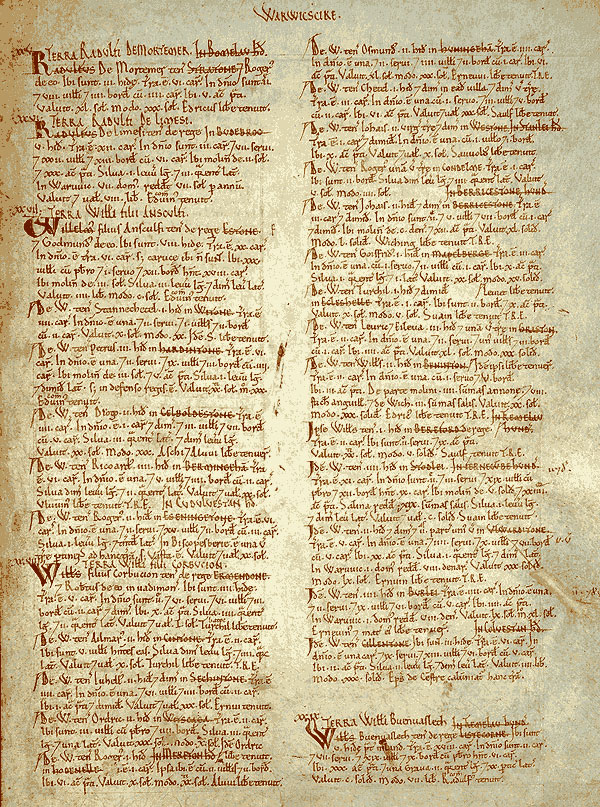
Image context: the cover image is a real archival manuscript image of a Domesday page for Warwickshire, including Birmingham. It works here because the article is about how compact written entries turned local land knowledge into a portable instrument of royal administration.[1]
The survey began with time, not only territory
The key Domesday question was not merely "who owns this place?" The stronger question was temporal: who held it in the time of King Edward, who received it after William's conquest, and what was it worth in 1086?[2][3][6] That three-part frame made the book more powerful than a snapshot.
By asking about the late Anglo-Saxon baseline, the post-conquest transfer, and the current value, the survey could compare before, after, and now inside a single entry. The National Archives education material makes this explicit: for each property, the questions were asked three times so the king could know the situation before 1066, after William had given land out, and at the time of the survey.[3] The Hull Domesday Project likewise emphasizes that many manors record valuations for 1066 and 1086, creating an unusually dense national and regional dataset across a period of enormous social and economic change.[6]
This is the first mechanism. A conqueror does not gain stable control simply by giving land to followers. He also needs a memory of the transfer. Domesday supplied that memory in a structured form. If an estate had belonged to one person before the Conquest, another after the Conquest, and a third value in 1086, the record could hold all three facts together without requiring the king to reopen the whole political history each time a dispute or assessment arose.
Sworn local testimony turned scattered knowledge into royal evidence
The second mechanism was the inquest. Domesday did not depend only on distant royal clerks guessing from the center. The National Archives research guide says the survey was carried out by commissioners holding sworn inquests in local courts, asking fixed questions of local men.[2] The Hull Domesday Project describes testimony by the men of the shire, the hundred, and sometimes the vill, and gives a conservative estimate of well over 50,000 jurymen giving or confirming evidence during the inquest.[5]
That structure mattered because land knowledge lived locally. Boundaries, tenures, livestock, plough teams, mills, meadow, woodland, and the history of who had held what were embedded in shire and hundred memory. The crown could not simply invent those details from Westminster or Winchester and expect them to function. It needed local knowledge, but it needed local knowledge under oath, in a form that could be checked, summarized, and carried upward.
This made Domesday an administrative converter. It took oral, local, and contested knowledge and turned it into written royal evidence. That did not make every entry neutral. Local witnesses had interests, Norman tenants had interests, sheriffs had interests, and the crown had the largest interest of all. But the procedure changed the kind of power available to William. A claim no longer existed only as a local memory or a lord's assertion. It could be set against sworn testimony and a written entry.
The book sorted people through land, not land through people
Domesday's social vision is narrow by design. The National Archives warns that it is not a source for finding most Norman ancestors because the individuals named are almost exclusively landholders.[2] That limitation is also its political clue. The survey was less interested in population as people than in land as obligation.
Britannica describes the commissioners compiling accounts of the estates of the king and his tenants-in-chief, the men who held directly from him.[8] Open Domesday, the modern database built from Professor John Palmer's work, presents the survey as a record of landholdings and resources in 1086, searchable by places, people, and estates.[7] The shape of the data follows the shape of power: who held from whom, where, with what resources, and at what value.
That is why modern place names can mislead. The National Archives research guide notes that modern places may cover land belonging to more than one eleventh-century manor, and where those manors had different holders they may appear in more than one Domesday entry.[2] The unit of royal concern was not the modern town as a community identity. It was the manor, the estate, the holder, and the fiscal or service relationship attached to them.
This sorting made Norman England more governable because it mapped obligations through tenure. Once land was connected to named holders and values, the crown could see more than geography. It could see a chain of responsibility. That chain mattered for geld, disputes, military expectations, and the political work of confirming who now belonged inside the post-conquest order.
Value made land comparable across a broken political landscape
The third mechanism was valuation. Domesday records resources, but value is what lets scattered resources become comparable. A manor with ploughland, meadow, woodland, mills, fisheries, villagers, bordars, and livestock was not only described; it was made assessable.[3][6]
The Hull Domesday Project's values guide stresses how unusual this is: for many manors, Domesday gives valuations for both 1066 and 1086, and sometimes an intermediate value as well.[6] That matters because conquest damaged, transferred, or reclassified land unevenly. Some places rose in value, some fell, and some were recorded as waste or reduced. A royal government that wanted revenue, settlement, and defense needed to know the difference.
Valuation also turned memory into leverage. If a manor had been worth one amount before 1066 and another in 1086, the entry could support arguments about loss, recovery, tenure, and expected render. It did not have to explain every cause. It only had to create a common accounting surface. Once values were written in a consistent royal framework, local variation could be compared rather than merely narrated.
This is why Domesday's detail felt oppressive to contemporaries. The National Archives collection page quotes the Anglo-Saxon Chronicle's complaint that no hide, virgate, ox, cow, or pig was left out of the record.[4] The complaint is not just about nosiness. It recognizes the political change. Things that had belonged to local habit, oral memory, and lordship practice were being pulled into a central account.
Domesday reduced disputes by preserving a royal version of the past
The survey also helped with conflict among Normans themselves. The National Archives education page frames William's decision partly around money and disagreement among Normans over the lands they had received.[3] This is the legal side of the mechanism. Redistribution creates winners, but it also creates boundary disputes, overlapping claims, and incentives to exaggerate holdings. Domesday did not remove those conflicts. It gave the crown a reference point from which to hear them.
That reference point explains the later name. The National Archives research guide notes that Domesday became known by a name associated with final judgment, because its record could be treated as authoritative.[2] The force of that authority did not come from a single dramatic decree. It came from the accumulation of procedure: fixed questions, sworn local testimony, county circuits, written returns, valuation, and royal custody.
The book's afterlife confirms the point. The National Archives calls Domesday the oldest government record it holds and stresses its continuing value for studying local history, landholding, and medieval administration.[2][4] Open Domesday's modern searchable interface extends that same logic for present readers: the power of the source lies in cross-reference. A person, manor, place, value, or resource can be followed across entries, making the record still behave like a machine for connecting local facts to a larger order.[7]
What the mechanism changes
Domesday worked because it joined five operations. First, it fixed the chronology around 1066 and 1086. Second, it pulled local testimony into sworn inquests. Third, it sorted claims through landholding rather than through broad population counting. Fourth, it converted resources into values. Fifth, it preserved the result as a royal reference that could outlast the immediate politics of conquest.[2][3][5][6][8]
That makes Domesday less a medieval curiosity than a lesson in state formation. William's regime did not only conquer territory. It made territory auditable. The book's dense Latin entries show a government learning to bind memory, land, and value together. Once those things were bound, the crown could ask sharper questions: who held this, by what chain, what was it worth, what had changed since King Edward, and what could now be demanded?
Domesday's harshness lies there. It did not need to be a modern census to alter political life. It only needed to make the land answerable to a written royal memory.
Sources
- Wikimedia Commons, "Domesday book--w.jpg" - source page for the manuscript image used as the article cover.
- The National Archives, "Domesday Book" research guide - overview of the survey, chronology, landholding scope, sworn inquests, and research limits.
- The National Archives, "Domesday Book" education resource - fixed survey questions, three time points, and William's administrative purpose.
- The National Archives, "Domesday" collection page - public-record context, Christmas 1085 commission, tax and defense framing, and Anglo-Saxon Chronicle detail.
- Hull Domesday Project, "Juries" - local testimony, shire and hundred witnesses, and conservative juror estimate for the inquest.
- Hull Domesday Project, "Values" - valuation terminology, 1066 and 1086 comparison, and cautions about interpreting manor values.
- Open Domesday, "About" - database scope, Professor John Palmer's data, and modern access to Domesday places, people, and estates.
- Encyclopaedia Britannica, "Domesday Book" - survey context, commissioners, tenants-in-chief, and historical significance.