The Petition of Right is often reduced to a short civics list: no taxation without Parliament, no imprisonment without cause, no quartering of soldiers, no martial law in peacetime.[2][4] Those principles are real, but the document becomes sharper when read as a sequence rather than a slogan. In 1628, Parliament did not send Charles I four unrelated complaints. It built a single indictment in which forced finance, arbitrary detention, household billeting, and emergency jurisdiction all appeared as parts of one governing habit.[1][2]
That habit had been visible for several years. Charles came to the throne in March 1625. After clashes with Parliament over supply, he raised money through a Forced Loan in 1626, then imprisoned refusers and kept collecting customs by prerogative.[2][4] By the time Parliament presented the Petition on 28 May 1628, received the king's first answer on 2 June, and secured full assent on 7 June 1628, the issue was larger than one tax quarrel.[2][3] The real question was whether the crown could cite necessity and then move around the ordinary forms of law.
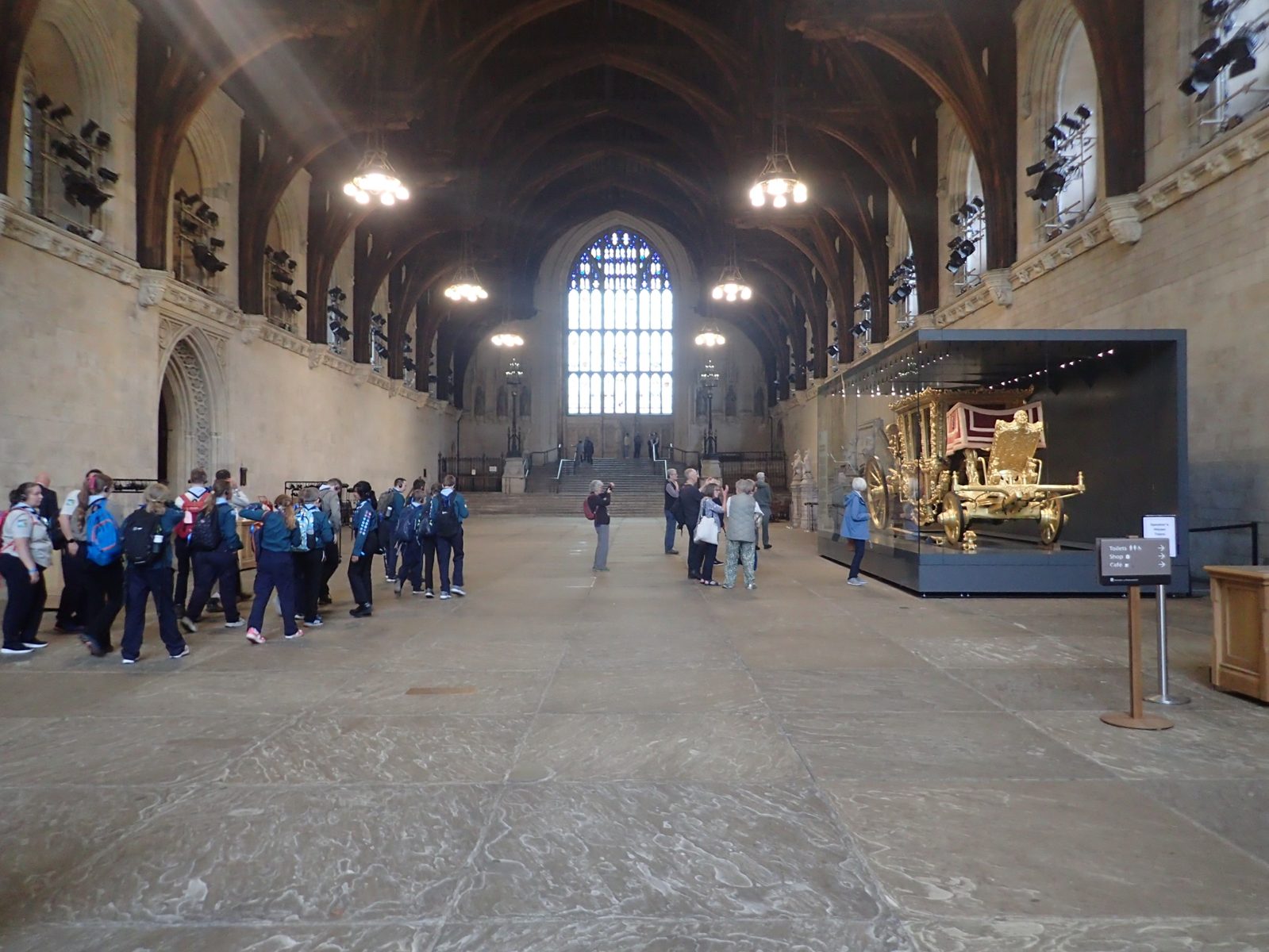
Image context: the cover uses a real photograph of Westminster Hall rather than a document scan or later royal portrait.[5] That choice keeps the piece inside the institutions where law, finance, and royal authority met in public. The article is still a close reading of a text, but the photograph gives that text a room: Parliament's argument was made as part of a constitutional confrontation rooted in Westminster's legal and political space.
The document starts with money, because money drove the rest
The Petition opens with taxation language and older statutes against compelled contributions.[1] It reminds the king that subjects should not be forced into any tax, aid, or loan without common consent in Parliament.[1] Then it pivots immediately to contemporary abuse: commissions had gone out into the counties, people had been required to lend money, and refusers had been pressed, bound over, or otherwise harassed.[1]
That ordering matters. Parliament is not merely saying that one fiscal measure was unpopular. It is saying that extra-parliamentary finance created a chain of coercion. Once a loan is treated as a command rather than a negotiated grant, refusal becomes disobedience, and disobedience invites custody.[1][2][4] The text therefore places the Forced Loan first because it was the engine that made the rest of the crisis legible.
The prayer at the end confirms the point. Parliament asks that no one be compelled to make any "gift, loan, benevolence, tax, or such like charge" without "common consent by act of parliament."[1] That phrasing is compact, but it is not narrow. It sweeps together several methods by which the crown could rename extraction and still demand payment. The Petition is trying to close the renaming trick itself.[1]
Imprisonment is the second step in the same pattern
After money, the Petition turns to detention.[1] It cites the Great Charter and later statutes, then states the contemporary abuse plainly: subjects had been imprisoned, brought up on habeas corpus, and returned to prison with no cause certified beyond the king's special command.[1] This is the crucial hinge in the document. Parliament is no longer arguing only that the king took money wrongly. It is arguing that he also disabled the normal legal route by which the subject could test that wrong in court.[1][2]
Here the text becomes almost procedural in its anger. It does not complain in vague emotional language. It names the missing thing: cause.[1] A person may be arrested under law, but the legal order has to say why. When the Petition later asks that no freeman be "imprisoned or detained," it means no imprisonment by unexplained command, no detention that substitutes royal will for an answerable charge.[1]
This is why the document still reads as more radical than its ceremonious tone suggests. Parliament is not yet claiming that the monarchy is illegitimate. It is claiming that prerogative cannot erase the requirement that power state its grounds.[1][2] That is a narrower claim than revolution and, in a constitutional sense, a more dangerous one.
Billeting and martial law extend the same logic into the household and the courtroom
The next two grievances are sometimes treated as side issues, but the Petition places them exactly where they belong.[1] First come "great companies of soldiers and mariners" dispersed through the counties, with inhabitants compelled to receive them into their houses against custom.[1] Then come commissions authorizing proceedings by martial law within the land.[1]
Read together, these clauses show that the document is tracing a movement of wartime necessity inward.[1][2] Billeting pushes the cost and disorder of war into private households. Martial-law commissions push military jurisdiction into civil space. In both cases, the crown is represented as acting as though emergency can travel wherever the king says it must.[1] Parliament's answer is not sentimental domesticity. It is jurisdictional boundary-making.
That is also why the four famous principles belong together. Forced loans concern how the crown raises means. Imprisonment without stated cause concerns how it handles refusal. Billeting concerns how military burden is distributed. Martial-law commissions concern what kind of court order governs the resulting disorder.[1][2][4] The Petition's architecture turns them into a single constitutional theory: when ordinary law exists, the king may not replace it with command, even under pressure.
The document asks for old law, but the pressure of the request is new
The Petition repeatedly insists that these are the subject's inherited "rights and liberties" under the existing laws and statutes of the realm.[1] That insistence is tactical and substantive at the same time. Tactically, Parliament speaks the language of restoration because open claims of novelty would have been easier for Charles to reject as innovation. Substantively, the document really does root itself in older authorities, above all Magna Carta and the Edward III statutes it cites at length.[1][4]
Yet the pressure generated by this restoring language is new. Parliament is asking the king to accept that some familiar instruments of government can no longer be defended as occasional expedients.[1][2] The issue is not whether Charles may ever govern energetically. The issue is whether he may govern by stepping around the legal forms that are supposed to justify action in the first place. The Petition therefore looks backward in citation and forward in consequence.
The later history proves that the settlement was incomplete. The UK Parliament's historical note stresses that Charles made sure the Petition was enrolled in a way that left doubts about its force as law, and he soon ignored its principles, especially over customs revenue.[2] The Parliamentary Archives record the sequence cleanly: presentation in late May, answer in early June, assent under pressure, then no durable trust.[3] By 1629, the quarrel over tonnage and poundage was already reopening the same wound.[2]
Why the Petition still matters
The Petition of Right endures because it did more than list liberties. It diagnosed a method of rule.[1][2][4] Parliament identified a recurring pattern in which the crown treated need as self-justifying: money first, then detention, then the lodging of troops, then exceptional jurisdiction. The answer it offered was equally patterned: statute, cause, consent, ordinary law.[1]
That is why the document still reads clearly in 2026. Its deepest claim is not that government must be weak. Its claim is that power must travel through named procedures if it wants obedience that can still be called lawful. Once that point is understood, the Petition of Right stops looking like a prelude made important only by what came later. It becomes a precise constitutional argument in its own right, made at the moment when Parliament decided that emergency command had become a system.[1][2][4]
Sources
- Constitution Society, "The Petition of Right 1628" - full transcription of the petition's sequence on forced loans, imprisonment, billeting, martial-law commissions, and the final prayer for redress.
- UK Parliament, "Charles I and the Petition of Right" - background on tonnage and poundage, the Forced Loan, the 1628 assent sequence, and Charles I's later evasions.
- Parliamentary Archives, "Public Act, 3 Charles I, c. 1: Petition of Right" - archival record describing the manuscript act, its delivery on 28 May 1628, and the king's answer on 2 June 1628.
- Encyclopaedia Britannica, "Petition of Right" - concise overview of the four principles, the forced-loan dispute, and the document's later constitutional standing.
- Wikimedia Commons, "File:In Westminster Hall - geograph.org.uk - 7600204.jpg" - real-world photograph of Westminster Hall used as the article cover, grounding the Petition in the institutional space of Westminster rather than in a document scan.