Pauli Murray is often remembered as a sequence of remarkable firsts: lawyer, civil-rights activist, writer, priest, feminist precursor.[1][2][3] Those facts are all true, and on their own they blur the shape of Murray's historical function. The sharper way to read this life is as a bridge. Again and again, Murray took experiences that institutions preferred to keep separate and forced them into one argument. A university rejection became a federal question. A bus arrest became evidence that ordinary travel could expose constitutional hypocrisy. Exclusion at law school became the phrase "Jane Crow." A reference book on segregation statutes became movement infrastructure. A civil-rights law written mainly in racial terms became a platform for attacking sex discrimination as part of the same problem.[1][2][3][5][7]
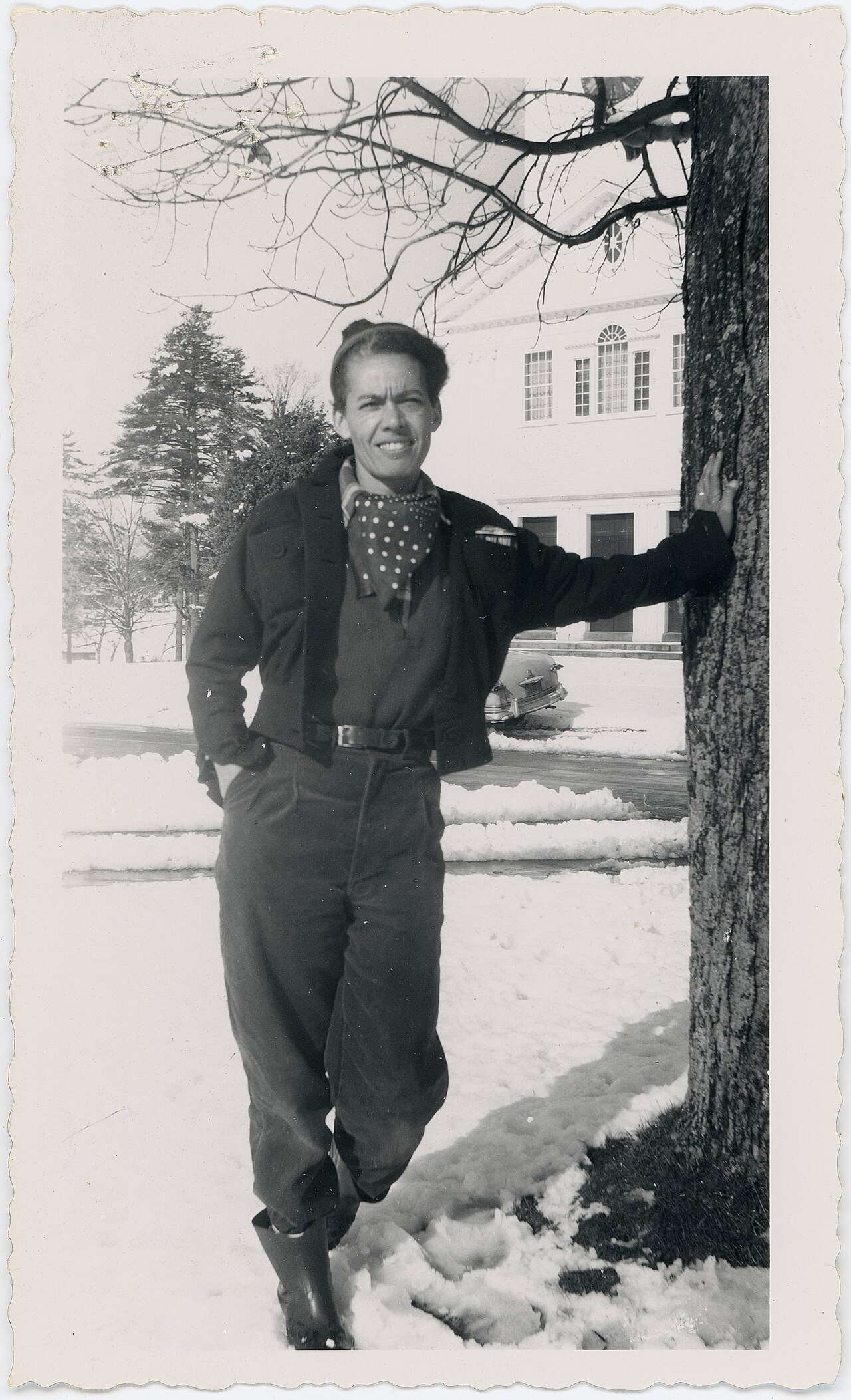
The cover image helps make that continuity visible. It is an archival portrait of Murray from about 1955, a photograph Murray sent to Eleanor Roosevelt in December 1955.[1][6] That matters because Murray's historical importance lies less in one isolated public scene than in the long thread joining argument, correspondence, research, and institutional pressure. The portrait comes from the middle of that thread, after the first great civil-rights compilations and before the Title VII and NOW years. It belongs with this article because Murray's life works best when read as one continuous method.[1][6]
Timeline anchors
- 1938: Murray applied to the University of North Carolina, was rejected because the school did not admit Black applicants, and wrote to Franklin Roosevelt while copying Eleanor Roosevelt.[1][2]
- 1940: Murray was arrested in Virginia for refusing to comply with segregated bus seating.[1][2]
- 1941-1944: at Howard Law School, Murray was the only woman in the class, experienced what Murray named "Jane Crow," and graduated first in the class.[2][7]
- 1950: States' Laws on Race and Color appeared as a 776-page segregation-law reference work circulated to colleges, universities, and law offices.[2][4]
- 1964-1966: Murray pushed the sex provision in Title VII toward serious enforcement, coauthored "Jane Crow and the Law" in 1965, and helped shape the vision that became the National Organization for Women in 1966.[3][5][7]
The 1938 UNC letter turned personal exclusion into a national argument
The bridge begins with a refusal to keep injury local. In 1938, after Murray applied to graduate study at the University of North Carolina, Chapel Hill, the application was rejected because UNC did not admit African American students.[1][2] Murray responded by writing directly to Franklin Roosevelt after he had praised UNC as a "great liberal institution," and Murray copied Eleanor Roosevelt on the letter.[2] This was more than a protest note. It was an early demonstration of Murray's operating habit: take a supposedly ordinary act of exclusion and force it into the language of democracy, hypocrisy, and federal responsibility.[1][2]
That episode matters because it set the pattern for the decades that followed. The Roosevelt correspondence did not overturn UNC's decision. It did something harder and more durable. It created a relationship with Eleanor Roosevelt and moved Murray's thinking toward a wider public scale.[1][2] A local admissions barrier became an argument about what liberalism meant if Black Americans were still being screened out of citizenship's institutions. Murray was already doing what would define the later career: refusing the neat border between personal humiliation and structural politics.[1][2]
The lead image fits here as well. A portrait sent to Eleanor Roosevelt in 1955 implies a relationship that outlasted one complaint and one answer.[1][6] That continuity matters because Murray's politics were not built on one flash of symbolic defiance. They were built on sustained contact, repeated persuasion, and a willingness to keep translating experience into public language even when institutions responded slowly.[1]
The 1940 bus arrest and Howard Law made "Jane Crow" into a method
The next bridge ran through transportation and legal education. In 1940, fifteen years before Rosa Parks, Murray was arrested in Virginia for refusing to obey Jim Crow bus seating rules during a trip home to Durham.[1][2] The event is often cited because it is an early civil-rights milestone. Its deeper importance lies in what Murray learned from it. Segregation was not only a Southern abstraction or a courthouse principle. It appeared in the mundane choreography of movement: where a rider sat, how a conductor enforced the rule, and how quickly public order could become racial discipline.[1][2]
At Howard Law School, the same lesson took a second form. Murray entered in 1941 on a recommendation linked to Thurgood Marshall, became the only woman in the class, and encountered contempt from faculty and classmates who treated female legal ambition as a category error.[2][7] Murray's answer was the phrase that still matters most: Jane Crow.[2][7] The term did not mean that race and sex were identical experiences. It meant that the legal and social logic used to naturalize racial hierarchy had a cousin in the rules, customs, and expectations used to subordinate women.[2][3][7]
That insight is why Howard belongs at the center of Murray's biography. The point is not simply that Murray suffered two forms of discrimination. Many people did. Murray's distinctive contribution was analytical. The life at Howard produced a transferable comparison. If Jim Crow could be attacked as a structure rather than as a pile of insults, then the same legal imagination could be turned toward sex discrimination.[2][7] Murray was not leaving civil-rights politics for women's politics later on. The bridge had already been built inside the law-school years.
The 1943 lunch-counter sit-ins Murray helped lead at Howard strengthen that reading.[1] They show that the emerging legal theory was never detached from direct action. Murray kept moving between the street, the classroom, and the page. That movement is one reason the life resists tidy categorization. Research, protest, and jurisprudence were never separate compartments.[1][2]
The 1950 segregation-law book turned research into movement infrastructure
The most under-read middle chapter of Murray's life is the least cinematic one. After law school, Murray was commissioned to produce what began as a modest pamphlet on the effect of segregation laws. The result was States' Laws on Race and Color, published in 1950.[2][4] The Smithsonian describes the book as a 776-page volume disseminated to colleges, universities, and law offices, while the University of Georgia Press summary makes clear just how exhaustive it was: legislation from forty-eight states, the District of Columbia, and ordinances from twenty-four major cities, plus federal materials and legal context.[2][4]
This is where biography turns into infrastructure. Murray did not simply denounce segregation in principle. Murray built a working map of it. That mattered because movements need searchable systems as much as they need slogans. Lawyers, organizers, and students could point to statutes, compare jurisdictions, and see segregation as a coordinated machinery rather than as a set of isolated local habits.[2][4] The Smithsonian notes that Thurgood Marshall later called the book "the bible" of the civil-rights movement and that it is often cited as groundwork for the arguments used in Brown v. Board of Education.[2]
The historical significance of the book lies precisely in its dryness. It turned outrage into reference. It made discriminatory law legible at scale. Murray's gift here was not theatricality but compression. A continent-sized problem became a volume one could carry, cite, and argue from.[2][4] That is the bridge again: lived grievance crossing over into legal method.
Title VII and NOW show that Murray never treated sex equality as a separate afterthought
The last stretch of this microhistory matters because it corrects a common mistake. Murray's later work for women's equality is sometimes told as a second career, as though race had come first and sex later. The sources point the other way. The National Park Service describes Murray as a bridge figure whose efforts were critical to retaining "sex" in Title VII and whose vision of a civil-rights association for women became the National Organization for Women.[3] The National Archives page on the Civil Rights Act supplies the institutional setting: sex was added to Title VII in 1964, but enforcement remained weak and uneven, especially because early executive action omitted sex from the core enforcement order.[5]
Murray's intervention in this moment drew directly on the older Jane Crow insight. The NOW history page notes that in 1965 Murray coauthored, with Mary Eastwood, "Jane Crow and the Law: Sex Discrimination and Title VII," turning the old law-school analogy into an explicit federal argument.[7] The article's importance was not rhetorical flair. It gave lawyers and advocates a way to reason from civil-rights precedent toward women's equality claims. If arbitrary hierarchy had already been exposed in racial law, then sex discrimination could not be dismissed as a private custom or a natural difference beyond constitutional concern.[3][5][7]
By 1966, that logic had reached organizational form. The National Archives records how the newly formed NOW quickly pressed the Johnson administration to make the sex provision in federal employment law real rather than decorative.[5] Read beside the National Park Service account of Murray's role, the point becomes clear: Murray helped build the conceptual bridge and then helped supply the traffic across it.[3][5] The move from the UNC letter to NOW was not a zigzag. It was one continuous campaign to show that democracy could not survive by protecting one class of citizens while leaving another category of subordination intact.[1][2][3][5][7]
Why the bridge matters more than the list of firsts
The strongest reading of Pauli Murray, then, is not heroic accumulation. It is connective design. Murray kept finding the seam between categories that American institutions wanted to keep apart: Black rights and women's rights, private injury and public law, protest and paperwork, moral language and enforceable policy.[1][2][3][4][5][7] That is why the life still feels modern. Murray did not wait for later theorists to explain that structures overlap. Murray kept demonstrating it in action.
The 1955 portrait is a fitting final image for that reason.[1][6] It is calm, formal, and midstream. It does not depict arrest, courtroom drama, or organizational founding. Instead, it catches a figure already carrying several worlds at once. That is the historical achievement. Pauli Murray's bridge called "Jane Crow" let civil-rights law travel farther than the categories of its own moment were supposed to allow.
Sources
- National Park Service, "Pauli Murray" - on the 1938 UNC letter, the Eleanor Roosevelt correspondence, the 1940 bus arrest, and the 1943 Howard sit-ins.
- Smithsonian National Museum of African American History and Culture, "Jane Crow & the Story of Pauli Murray" - on Howard Law, the term "Jane Crow," States' Laws on Race and Color, and the book's civil-rights afterlife.
- National Park Service, "Pauli Murray Family Home" - on Murray as a bridge figure, the importance of Title VII, and the path toward NOW.
- University of Georgia Press, States' Laws on Race and Color - publication page describing the scale and contents of Murray's 1950 segregation-law compilation.
- National Archives, "Women's Rights and the Civil Rights Act of 1964" - on the sex amendment to Title VII, the early enforcement gap, and NOW's pressure on the Johnson administration.
- Wikimedia Commons, "File:Pauli Murray approx. 1955.jpg" - source page for the archival portrait used as the article image.
- National Organization for Women, "Finding Pauli Murray" - on the 1965 article "Jane Crow and the Law: Sex Discrimination and Title VII" and Murray's legal-feminist role.