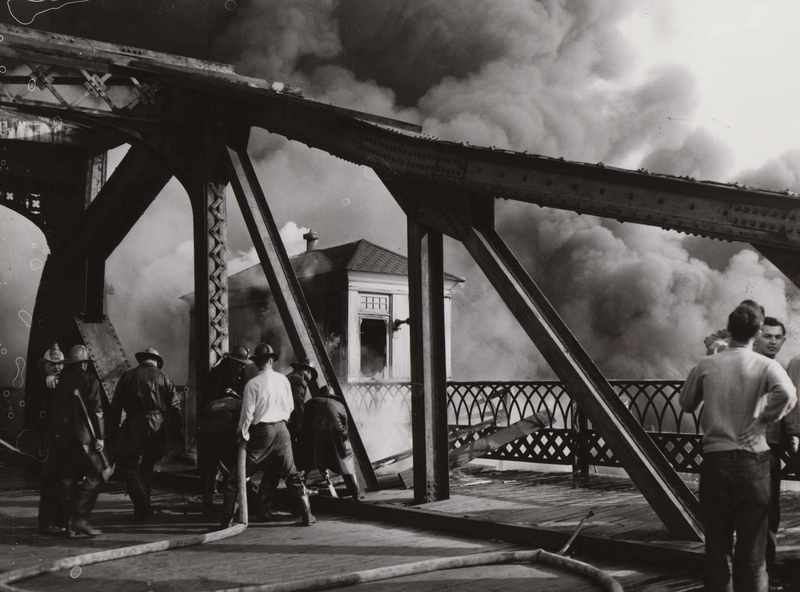
The Cuyahoga River survives in American memory as the river that burned, and many people picture that memory with one dramatic photograph: flames roaring up beside a ship while firefighters battle smoke from a bridge.[2][4] The usual implication is simple. In 1969, pollution became so outrageous that the river caught fire in full public view, the country recoiled, and the modern environmental era began. Evidence supports only part of that story. On June 22, 1969, the lower Cuyahoga really did catch fire.[1][2][3] But the blaze was small, brief, and apparently unphotographed.[1][2] The famous picture usually attached to the event comes from a much larger fire in November 1952.[2][4]
That does not make the 1969 fire unimportant. It makes it historically sharper. The real lesson is not that one apocalyptic inferno suddenly shocked the nation into ecological conscience. The harder lesson is that a relatively modest fire landed at exactly the right political moment. Cleveland had already begun to change course, Mayor Carl Stokes knew how to stage public attention, and national media were newly ready to turn local pollution into a civic indictment.[1][2][3] The Cuyahoga became famous not because the 1969 blaze was the river's worst fire, but because it became the right symbol at the right time.
Timeline anchors
- 1868: EPA's Clean Water Act teaching history identifies this as the first recorded Cuyahoga River fire in the modern sequence.[3]
- November 1952: the river's largest fire causes more than $1 million in damage to boats and a riverfront office building.[3][4]
- 1968: Cleveland voters approve a $100 million bond issue for sewer construction and water-treatment upgrades, showing local cleanup politics had already started before the famous fire.[1][2]
- June 22, 1969: debris and oil near the Republic Steel mill ignite, damaging two railroad bridges; the fire lasts less than half an hour.[1][2]
- June 23, 1969: Mayor Carl Stokes leads reporters on a pollution tour of the river the day after the fire.[1]
- August 1, 1969: Time gives the story national traction, calling the Cuyahoga the river that "oozes rather than flows."[1][3]
- 1970-1972: the first Earth Day, creation of EPA, and the Clean Water Act help lock the river fire into national environmental memory.[1][3]
These markers matter because they separate scale from consequence. The biggest blaze was not the one that became iconic. The iconic blaze was the one that arrived when public meaning had become easier to ignite.
1. The standard picture of the 1969 fire is visually wrong
The easiest myth to correct is the image itself. Cleveland Historical says it plainly: the striking river-fire photograph that ended up in Time was actually from the 1952 fire, and no picture of the 1969 river fire is known to exist.[2] The source page for the image used here identifies it as firefighters trying to extinguish the 1952 Cuyahoga River fire at Jefferson and West 3rd Streets, photographed by James Thomas and preserved in the Cleveland Memory Project.[4]
That correction is more than a caption dispute. It changes how the event is imagined. The widely recycled 1952 image shows a large industrial fire with towering smoke, a bridge crowded by responders, and a scale that makes the river itself look consumed.[4] If a reader silently imports that image into June 1969, the chronology starts to lie. The fire that entered environmental history was not visually enormous in that way. It had to borrow its picture from an earlier and more destructive episode.[2][4]
This is why the Cuyahoga belongs so naturally in myth-vs-evidence mode. The myth is not that the river never burned. It did. The myth is that the most famous mental picture corresponds directly to the event that became nationally symbolic. It does not. The symbol and the photograph were welded together after the fact.[2][4]
2. What actually happened on June 22, 1969 was real, but comparatively small
Evidence does not minimize the 1969 fire into fiction. The National Park Service states that debris trapped by railroad bridges near Republic Steel piled up, oil on the water increased flammability, and a flare from a passing train likely provided the spark.[1] The result was a fire that lasted less than a half hour and caused minor damage to the railroad bridges.[1] Cleveland Historical adds a more local measure: roughly $100,000 in damage to two railroad bridges, with little immediate local or national attention.[2]
That scale matters because it shifts the question from "how could a river burn?" to "why did this particular burn matter so much?" Clevelanders were not shocked by the basic fact of combustion. NPS notes that the river had burned more than ten times over the previous century, and EPA's Clean Water Act history counts at least 13 fires in the larger sequence.[1][3] In a heavily industrial river treated as infrastructure rather than as a living system, fire did not automatically register as metaphysical scandal.[1]
The fire was therefore both ordinary and revealing. Ordinary, because industrial debris and oil slicks had made earlier fires possible. Revealing, because by 1969 more Americans were ready to treat such a scene not as the cost of business but as evidence of a broken relationship between city, industry, and water.[1][2][3]
3. The event landed after public opinion had already started to move
Another useful correction is chronological. The usual compressed story makes the river fire look like a single match struck into total political darkness. NPS and Cleveland Historical both show that the ground had already been prepared.[1][2] Cleveland residents had approved a $100 million cleanup bond issue in 1968.[1][2] The federal Water Pollution Control Act of 1965 was already on the books.[1] Cleveland Historical also notes that deindustrialization had begun to reduce some pollution pressures even before the famous fire, meaning the river of 1969 was still badly polluted but already entering a new political phase.[2]
That is why NPS draws an important distinction between fact and symbol. The agency says myth enters when people describe the 1969 fire as the primary cause of the environmental movement's major milestones.[1] Evidence points to a wider sequence instead: local cleanup politics, the Santa Barbara oil spill, the emerging environmental beat in journalism, and a national audience increasingly ready to see pollution as a public crisis rather than a local nuisance.[1]
This does not shrink the Cuyahoga's importance. It places it correctly. The fire worked because it arrived inside an atmosphere that had already become combustible in political and cultural terms.
4. Carl Stokes and the media turned a local incident into a national symbol
The most important day may have been June 23, 1969, not June 22. NPS says that the morning after the fire, Mayor Carl Stokes led the local press on a pollution tour of the river, with environmental reporter Betty Klaric covering it for the Cleveland Press.[1] Cleveland Historical adds that Stokes later testified before Congress, with his brother Louis Stokes, to urge stronger federal involvement in pollution control.[2]
That sequence matters because symbols do not make themselves. The fire alone was a local infrastructure accident on a polluted river. Stokes helped convert it into a claim about public responsibility. Then Time amplified the claim nationally on August 1, 1969, using its now-famous language about a river that "oozes rather than flows" and drawing broader attention to Cleveland's condition.[1][3] Once national outlets took up the story, the Cuyahoga stopped belonging only to Cleveland. It became a portable image of what industrial America had allowed its waters to become.[1][2]
The irony is sharp. The image that traveled farthest was not the image of the actual 1969 blaze, because there was no known photograph of that blaze.[2] Public memory had to be built from an older picture, a newer political message, and a country newly willing to join them.
5. The fire became famous because it was the right symbol, not because it was the biggest disaster
EPA's teaching history offers the cleanest summary of why the Cuyahoga endured: the 1969 fire mobilized public concern and helped spur the wider surge of water-pollution politics that fed into EPA, the Great Lakes Water Quality Agreement, and the Clean Water Act.[3] NPS is more careful and, for that reason, more persuasive. It says the story is complex, that other changes were already in motion, and that the river fire should be celebrated above all for its symbolism.[1]
That word is the key. The Cuyahoga fire became historical not because it was the river's worst combustion event, and not because it alone caused a legislative revolution. It became historical because it condensed several truths into one memorable object. The river had burned before. Pollution really was severe. National opinion was already shifting. And one city had leaders ready to stage the problem in public view.[1][2][3]
So the best evidence-based answer is paradoxical. The famous 1969 Cuyahoga River fire is both overstated and deserved. It is overstated if one imagines an unmatched inferno directly photographed and instantly followed by federal salvation. It is deserved if one understands it as the moment when a small fire, an older image, a mayor's media strategy, and a changing political climate fused into the symbol that the environmental era remembered.[1][2][3][4]
Sources
- National Park Service, "The 1969 Cuyahoga River Fire" - on the small scale of the June 22, 1969 blaze, the next-day Stokes press tour, the Time coverage, and the difference between fact and symbolism.
- Cleveland Historical, "Cuyahoga River Fire: The Blaze That Started a National Discussion" - on the $100,000 damage estimate, the lack of a known 1969 fire photograph, the reused 1952 image, the 1968 cleanup bond, and Carl Stokes's advocacy.
- US EPA, "Introduction to the Clean Water Act" - on the longer sequence of at least 13 fires, the scale of the 1952 fire, Time's description of the river, and the 1969 fire's role in mobilizing water-pollution politics.
- Cleveland Historical, "1952 Fire" - source page for the archival James Thomas photograph used as this article's image.