Among the demands of the People's Charter was a salary: £500 a year for an MP. Published in 1838, the programme also proposed abolishing the property qualification for entering Parliament. Put those two demands together and a practical question emerges. If voters chose a man who worked for his living, what would he live on while representing them?[1]
William Lovett and Francis Place drafted the Charter for the London Working Men's Association after the 1832 Reform Act had left working people largely outside the parliamentary electorate. Its six demands concerned male suffrage, secret voting, equal constituencies, annual elections, payment of MPs and the removal of MPs' property qualification.[2] Read as a package, they ask what would make political choice usable for people without wealth.
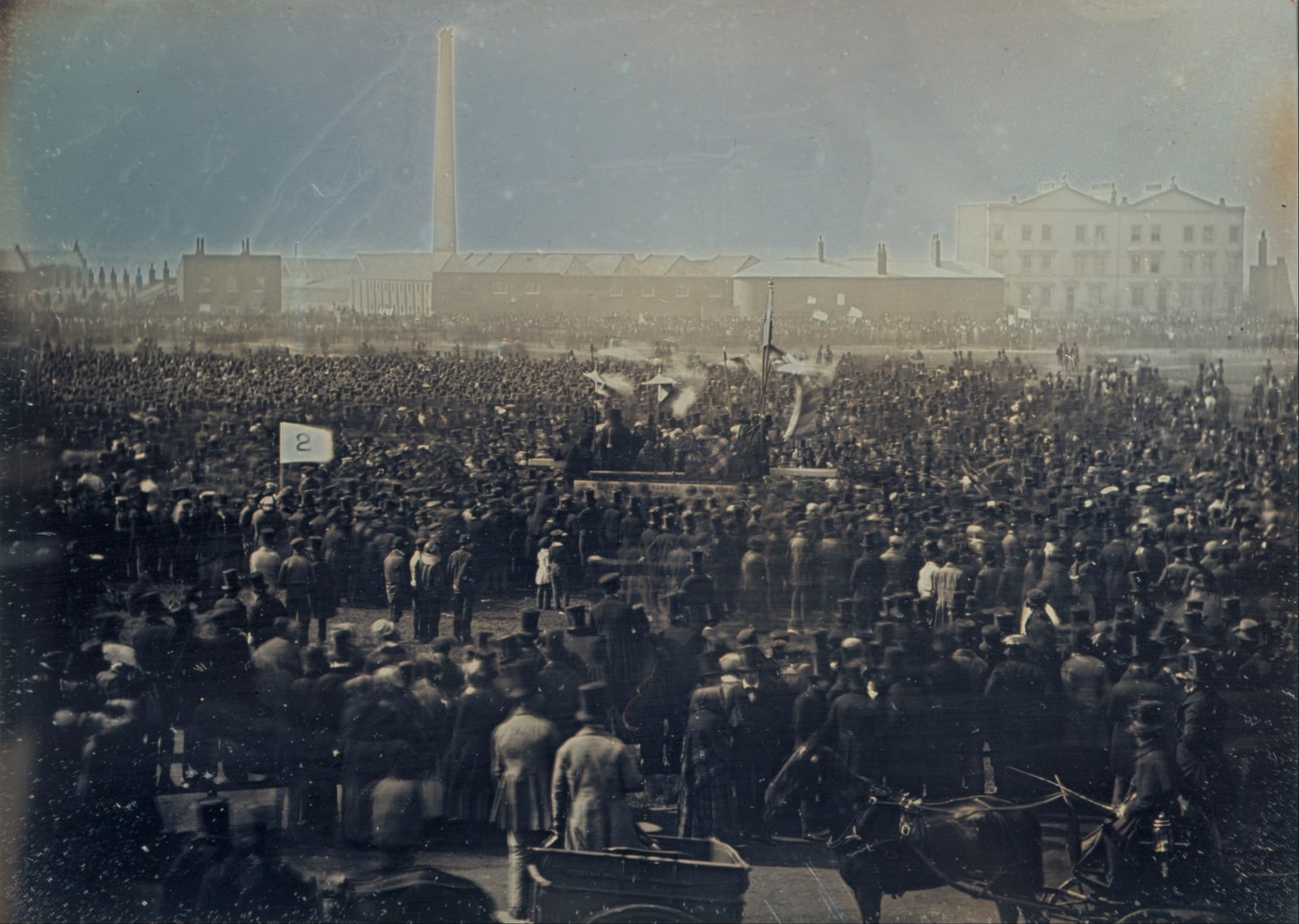
Opening the door to Parliament cost money
Removing a property qualification changed who could legally become an MP. Payment addressed the separate question of who could sustain the job. A person might satisfy every formal condition for election and still lack the income needed to serve.
The Charter's proposed salary makes that distinction tangible. London Museum's surviving copy records both the £500 payment and the abolition of the property test.[1] The combination would allow electors to look beyond men whose private means already supported a parliamentary career. That is the practical implication of the paired provisions, rather than evidence that every successful candidate would have been financially independent of every patron.
A later movement document makes the connection explicit. The People's Charter Union's address of 17 April 1848, preserved in Home Office records, describes payment as necessary once the property qualification disappears. It also insists that the electors' choice should determine eligibility.[5] Wealth should cease to be an additional, unelected selector of representatives.
The voter needed somewhere to be unseen
The original Charter was drafted as the outline of an Act, with instructions for election officials. Its voting procedure sent an elector through a certificate check, then gave him a ball to put into an aperture opposite his chosen candidate's name. The polling place had to shield that choice from observation.[4]
This was a physical arrangement for independence. A right to vote could be compromised if someone with power over the voter could watch its exercise. The 1848 Union address accordingly explained the ballot as protection against bribery and intimidation.[5]
Privacy did not mean leaving the election unobserved. The Charter provided for candidates' agents to witness the examination and sealing of ballot boxes and the counting after polling closed.[4] The distinction is revealing: the voter's decision required concealment; the officials' handling of votes required scrutiny. Trust depended on giving different people different things to see.
Responsibility had a deadline
Annual elections supplied another form of control. The Union's 1848 address explained them as a way to keep members responsible to their constituents.[5] A representative could be chosen freely and supported by a salary, yet still become distant from those who elected him. Frequent elections would repeatedly renew—or withdraw—his authority.
The proposal joined access to accountability. Paid office was not presented as an entitlement held indefinitely by its occupant. Electors would have regular opportunities to replace him. The salary made service possible; the short term made continued service conditional.
Equal representation addressed the distribution of that power. The Charter proposed 300 constituencies of approximately equal population.[1][4] Expanding the electorate alone would leave another question unresolved: how much parliamentary weight did a vote carry where its holder happened to live? The six demands reach from the voter's circumstances to the shape of the institution receiving his vote.
Who counted as “the people”?
The programme's language of political equality had a consequential boundary. Its franchise was male. Historian Malcolm Chase, writing for Parliament, notes that the authors decided against including women because they feared the demand would not be taken seriously.[6]
Women nevertheless did the work of Chartism. Chase identifies May Pares, a south-east London organiser who collected petition signatures and accompanied the 1842 petition to Westminster. Where signatures were recorded separately, women's participation was substantial.[6] A woman could help assemble the public claim for representation while remaining outside the electorate that claim proposed.
This complicates any reading of the Charter as a complete declaration of equal citizenship. The campaign's participating public was wider than its intended voting public. Pares's organising makes the difference concrete: political capacity was already being exercised by someone whom the proposed franchise would exclude.
A programme outlived its petitions
Parliament rejected the Chartist petitions presented in 1839, 1842 and 1848.[2] The Charter therefore describes a proposed system, not the rules under which the photographed crowd subsequently voted. Its detailed provisions record what campaigners wanted institutions to become.
Later reforms arrived separately. The secret ballot entered parliamentary elections in 1872; the 1885 redistribution reshaped constituencies; and the 1918 franchise reform enfranchised men over twenty-one and many women over thirty. Equal voting terms for women followed in 1928.[7] That sequence took decades and extended beyond the Charter's own definition of the electorate. Annual parliamentary elections remained unfulfilled.[2]
The document's enduring interest lies in how closely its demands attended to ordinary constraints. Someone needed an income to serve. Someone needed privacy to choose. Someone needed a way to dismiss a representative who had ceased to listen. Reading the provisions together reveals a conception of political freedom that had to survive the journey from a declared right into a polling room and a working life.
Sources
- London Museum, “The people's charter,” 1838 collection object — provenance, six demands, 300 constituencies and proposed £500 annual payment for MPs.
- UK Parliament, “The Chartist movement” — authorship and political context, the three rejected petitions and the unfulfilled demand for annual elections.
- William Edward Kilburn, “View of the Great Chartist Meeting on Kennington Common,” 1848, Royal Collection RCIN 2932484 — daguerreotype reproduced through Google Art Project and Wikimedia Commons; image provenance.
- London Working Men's Association, The People's Charter, 1838 — primary text, especially “Arrangements For Elections,” clauses IV–VI and XIII–XIV; transcription on the John Collins historical research site.
- The National Archives, “What was Chartism?”, source 1 — primary text of the People's Charter Union address, 17 April 1848, catalogue reference HO 45/2410A; explanations of the ballot, annual elections and payment of MPs.
- Malcolm Chase, “The Chartist petition of 1842,” UK Parliament Petitions Committee, 1 March 2016 — women's participation, May Pares and the Charter's male-only franchise.
- UK Parliament, “Key dates” — the Ballot Act, redistribution and the franchise changes of 1918 and 1928.