A hotel lift spends much of its life waiting. Its passengers expect it to move whenever they need it. In 1888, London's Hotel Metropole had seventeen hydraulic lifts: machinery that needed to be ready even when it was standing still.[1]
London's answer was to sell readiness through a pipe. A public hydraulic supply began operating in 1883.[2] Owners could buy a few moments of lifting power without maintaining an entire steam plant to provide them.
The steam engine moved away from the customer
Hydraulic power could sound like energy harvested from a river. This system consumed energy to put water under pressure. A report of the Institute of Marine Engineers' visit to Grosvenor Road on 18 July 1914 describes steam pumping engines supplying the mains. The water carried their work to machinery elsewhere.[4]
The report distinguishes production from delivery: the station's pumps discharged at 800 pounds per square inch, while the service offered customers 700. Its nearly 178 miles of mains supplied cranes, passenger lifts, presses, capstans and even vacuum cleaners.[4] The same buried supply could serve very different motions above ground.
The attraction lay in separating those motions from the machinery producing the pressure. Each customer could draw on a shared pumping station. Maintaining a steam plant became the supplier's responsibility, while users needed machinery suited to the pressure it delivered.
A lifted weight made power wait
Between the pumps and changing demand stood the accumulator: a cylinder containing a vertical piston, or ram, loaded with a heavy weight. Pumping water into the cylinder raised the load. As customers drew water, the weight descended, pushing water into the system. Its weight relative to the ram's area determined the pressure.[2]
In his 1911 Encyclopædia Britannica contribution, company engineer Edward Bayzand Ellington explained the benefit. Accumulators could cover brief demand surges and give operators time to start additional pumping units. Combining many intermittent demands also helped the supplier use its plant economically.[2]
The reserve remained finite. Once the ram descended, pumps had to raise it again. A continuously heavy demand required adequate pumping capacity; a short burst could draw on stored energy. Lifts and cranes, with their starts and pauses, suited that distinction.
The pauses made the tariff plausible
The customer's meter connected that physical arrangement to a business. In the 1888 account, water was measured after it had passed through the machine, on the exhaust side, and then discharged to the drains. Charges varied with consumption, with lower rates for more continuous use.[1]
A proprietor bought water delivered with usable pressure. Paying for consumption could cost less than keeping a private plant ready, even when the purchased power's unit price was high. The bargain depended on how often the machine worked.
A utility had to survive a broken pipe
Sharing power also meant sharing dependence on the mains. The 1888 description records circuits of pipes with stop valves at intervals, allowing sections to be isolated. It describes another diagnostic habit: checking unexpected increases in overnight pumping as a possible sign of leakage.[1]
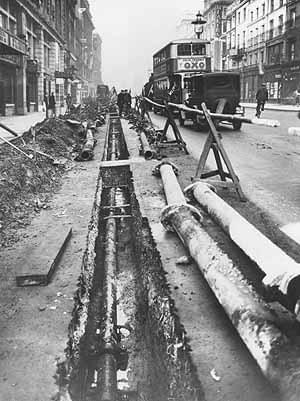
These details make the photograph of Piccadilly more than a picturesque excavation. The caption identifies replacement of older cast-iron mains with steel pipes around 1930.[3] The service required maintenance beneath an occupied city. Customers could dispense with their own steam plant only because someone else kept attending to the equipment between the station and their premises.
A pressure promise was therefore an operational obligation. Pumps, valves, meters and repair crews all belonged to the product.
Electricity arrived inside the hydraulic system
The ending was more gradual than a contest between Victorian water power and modern electricity suggests. Tower Hamlets' catalogue preserves records specifically concerning Wapping's conversion from steam to electric drive. They include electrical-equipment specifications from 1952, conversion-cost calculations from 1954–55, and correspondence with the London Electricity Board.[5] These are catalogue descriptions of surviving records, rather than operating logs consulted for this article.
Historic England's listing independently identifies electrically driven pumps from the 1950s among the station's surviving machinery.[6] Electricity could replace the means of pumping while customers continued receiving pressure water. Changing the power source at the station and replacing the machines connected to the mains were separate decisions.
Eventually the market contracted. Subterranea Britannica's account links the postwar decline to bomb damage and the departure of manufacturing businesses, alongside the spread of electric equipment.[3] Wapping, the final pumping station, closed in 1977.[5][6]
The pipes retained another kind of value. The Tower Hamlets catalogue explains that the company's rights to install and maintain its network under public highways helped attract Mercury Communications, which used the pipes as telecommunications ducts.[5] Access beneath London had become useful for carrying something else.
The hydraulic service had made brief bursts of force available by sharing the equipment that stood ready between them. After the pressure disappeared, the laboriously established route through the city still had work to do.
Sources
- “The Distribution of Hydraulic Power in London,” Scientific American Supplement, no. 648, 2 June 1888 — contemporary summary of E. B. Ellington's Institution of Civil Engineers paper; Falcon Wharf, accumulators, metering, tariffs and customers. Digitized by Project Gutenberg.
- Edward Bayzand Ellington, “Power Transmission—Hydraulic,” Encyclopædia Britannica, 11th edition, 1911 — contemporary explanation of accumulator capacity, intermittent demand, network operation and operating losses. Transcribed at Wikisource.
- Andy Emmerson, “Hydraulic Power in London,” Subterranea Britannica — Piccadilly pipe-replacement photograph and credit; account of the network's postwar decline.
- Institute of Marine Engineers, “Visit to the London Hydraulic Power Company's Pumping Station, Grosvenor Road, S.W.,” 18 July 1914, printed p. 155 — contemporary visit report describing the supply and its uses; IMarEST digital library PDF.
- Tower Hamlets Local History Library and Archives, Records of the London Hydraulic Power Company, B/LHP, catalogue pp. 1–5 — collection history, conversion records B/LHP/1/4–6, closure and subsequent telecommunications use.
- Historic England, “London Hydraulic Power Company Station With Number 37,” National Heritage List entry 1242419 — Wapping's surviving electric pumps, accumulator towers and final period of operation.