The Pentagon Papers are often remembered through the newspaper drama of June 1971: a leak, an injunction fight, a rushed Supreme Court decision, then a durable First Amendment legend. Read the record more closely, though, and the deepest historical shock appears earlier and lower down in the paperwork. It sits in the architecture of the report itself.
The National Archives page identifies the study by its formal name, Report of the Office of the Secretary of Defense Vietnam Task Force, commissioned by Robert McNamara in 1967 and delivered in a much larger form than the partial newspaper excerpts that made it famous in 1971.[1] The index volume then shows how the report organized its own evidence. Under Part V, the heading is not a neutral label like "policy" or "decision-making." It is "Justification of the War," and that section is split into "Public Statements" and "Internal Documents."[2]
That split is the sharp historical question: what made the Pentagon Papers so damaging was not only that they were secret, but that the report's own structure turned the credibility gap into an official table of contents.
Timeline anchors: when a secret study became a constitutional crisis
- June 17, 1967: McNamara orders the Vietnam Task Force study that became the Pentagon Papers.[2]
- January 15, 1969: Leslie H. Gelb sends the final report forward as 43 volumes built from document-based studies and documentary records.[2]
- June 13, 1971: the New York Times begins publishing excerpts from the leaked study, starting the prior-restraint fight described in the Supreme Court opinion.[3]
- June 29, 1971: Senator Mike Gravel reads portions into the Senate subcommittee record, opening a second publication channel noted in the later Speech or Debate case.[1][4]
- June 30, 1971: the Supreme Court decides New York Times Co. v. United States, refusing to keep the injunctions in place.[3]
- June 1972: Gravel v. United States defines how far congressional protection reached for reading and republication of the Papers.[4]
The report's own preface tells you why the leak hit so hard
The index volume begins with Gelb's transmittal memorandum, and that document matters because it explains what kind of object the Pentagon Papers were before they became a press event. Gelb says McNamara's instruction had been to produce studies that were "encyclopedic and objective," then describes the result as "not so much a documentary history, as a history based solely on documents."[2]
That wording draws an important boundary. The Papers were not a memoir, not a think-tank polemic, and not a single dissent memo. They were an internal state archive arranged into a retrospective explanation of how decisions had been made. Gelb also explains that when the task force feared a passage could be accused of being taken out of context, it included the whole paper in the documentary record sections.[2] In other words, the project tried to defend itself against the exact charge the executive branch would later face in public: selective justification.
This is why the leak landed with such force. It was not simply that embarrassing secrets escaped. It was that the U.S. government had already assembled, inside one official project, the materials with which its own public story could be compared against its internal paperwork.
Why the index matters more than one famous excerpt
Many episodes in the Pentagon Papers are remembered through isolated revelations. The index suggests a different reading. The most damaging fact was structural before it was anecdotal.
Part V, "Justification of the War," divides the evidence into two buckets.[2]
- Public Statements: what administrations said outwardly.
- Internal Documents: what administrations recorded inwardly.
That arrangement is devastating because it makes contradiction inspectable at scale. A single leaked memo can be dismissed as contextless or anomalous. A multi-volume architecture that places public rhetoric and internal record side by side is harder to contain. The table of contents itself tells the reader where to look for divergence.
This is the deeper reason the Pentagon Papers became a credibility event rather than only a secrecy event. The issue was not just disclosure of classified material. The issue was disclosure of an official framework that implicitly asked readers to compare what presidents and senior officials told the country with what the document trail showed inside government.[1][2]
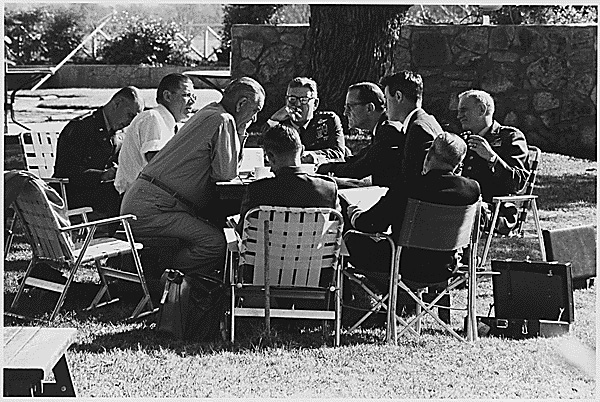
Seen this way, the archival photo of the Joint Chiefs meeting at the LBJ Ranch in December 1964 works as more than atmosphere. It represents the environment the study was built to reconstruct: closed high-level deliberation whose later public justification could be tested against contemporaneous internal paper.[1]
What the Supreme Court actually decided on June 30, 1971
The constitutional legend is real, but it is narrower than the legend sounds. The per curiam opinion in New York Times Co. v. United States states that any system of prior restraint comes to the Court with a "heavy presumption" against constitutional validity, and that the government carries a "heavy burden" if it wants such a restraint imposed.[3] The immediate holding was simple: on the rushed record before the Court, the government had not carried that burden.
That is a large First Amendment result, yet it is not the same thing as a general judicial blessing for every leak of classified information. The case did not hold that secrecy classifications were void, that leakers were immune, or that newspapers could never face later legal risk. It held something tighter and more historically specific: the executive branch had failed to justify emergency prepublication bans against these newspapers in this case on this timetable.[3]
Justice Black's concurrence captured the civic mood in more expansive language, writing that "Only a free and unrestrained press can effectively expose deception in government."[3] That sentence became the famous memory line, and for good reason. But the institutional importance of the case lies in the combination of Black's rhetoric with the per curiam's narrower mechanism. Moral language gave the case its afterlife; the failure of proof on prior restraint gave it its legal shape.
Why June 30 did not settle the whole boundary
If the June 1971 decision had simply created a total press-and-publication immunity, the story would end there. It did not. The next year's Gravel v. United States shows that the constitutional boundary remained contested once publication moved from newspapers to Congress and then toward private republication.
The Court in Gravel protected legislative activity around the Senate subcommittee episode, but it also said that private publication through Beacon Press was "in no way essential to the deliberations of the Senate" and therefore fell outside the protected core of the legislative process.[4] That distinction matters. It means the Papers escaped executive control through related but different channels:
- newspaper publication tested under prior-restraint doctrine,[3]
- congressional use tested under the Speech or Debate Clause,[4]
- private republication tested under a narrower, less protected theory.[4]
So the real constitutional history of the Pentagon Papers is layered. The executive branch lost the injunction fight. Congress gained room to use the material legislatively. But the Court still refused to say that every downstream publication act belonged inside the same protected zone.
Two interpretations, and the stronger one
Interpretation 1: the Pentagon Papers case created a broad press triumph over secrecy
This reading captures the public memory well. The Court rejected the injunctions, the newspapers kept publishing, and the phrase "Pentagon Papers" became shorthand for the press defeating the national-security state.[3]
Interpretation 2: the case was narrower in law and deeper in political damage
This reading fits the documents better. Legally, the Court decided a prior-restraint case under extraordinary time pressure.[3] Politically, the report itself did the heavier work because its own structure displayed the split between public justification and internal record.[2] The later Gravel opinion confirms how bounded the legal victory remained once the Papers moved into other publication forms.[4]
The stronger historical interpretation is the second one. The Pentagon Papers mattered so much because two things happened at once: the report exposed an official credibility fracture, and the government failed to stop the first major publication channel quickly enough to keep that fracture inside the executive branch.
What would change the assessment?
This interpretation would weaken if the report's internal architecture turned out to be editorially misleading, with "Public Statements" and "Internal Documents" functioning as neutral filing labels rather than an invitation to comparison. It would also weaken if the Court had actually announced a sweeping immunity for publication of classified material in any forum. The surviving documents point the other way. The report was organized to make comparative reading possible, and the Court's holdings stayed narrower than later legend.
That is why the Pentagon Papers still feel modern. Their enduring force lies not only in leaked content, but in the moment an internal state history became legible as a map of public-private contradiction.[1][2][3][4]
Sources
- U.S. National Archives, "The Pentagon Papers" — official overview of the task force report, the 1971 leak, and the archival image of the Joint Chiefs meeting at the LBJ Ranch on December 22, 1964.
- U.S. National Archives, Pentagon Papers: Final Report OSD Vietnam Task Force & Index — Gelb transmittal memorandum, task force scope, and the Part V split between "Public Statements" and "Internal Documents."
- U.S. Government Publishing Office, United States Reports, 403 U.S. 713, New York Times Co. v. United States (1971).
- U.S. Government Publishing Office, United States Reports, 408 U.S. 606, Gravel v. United States (1972).