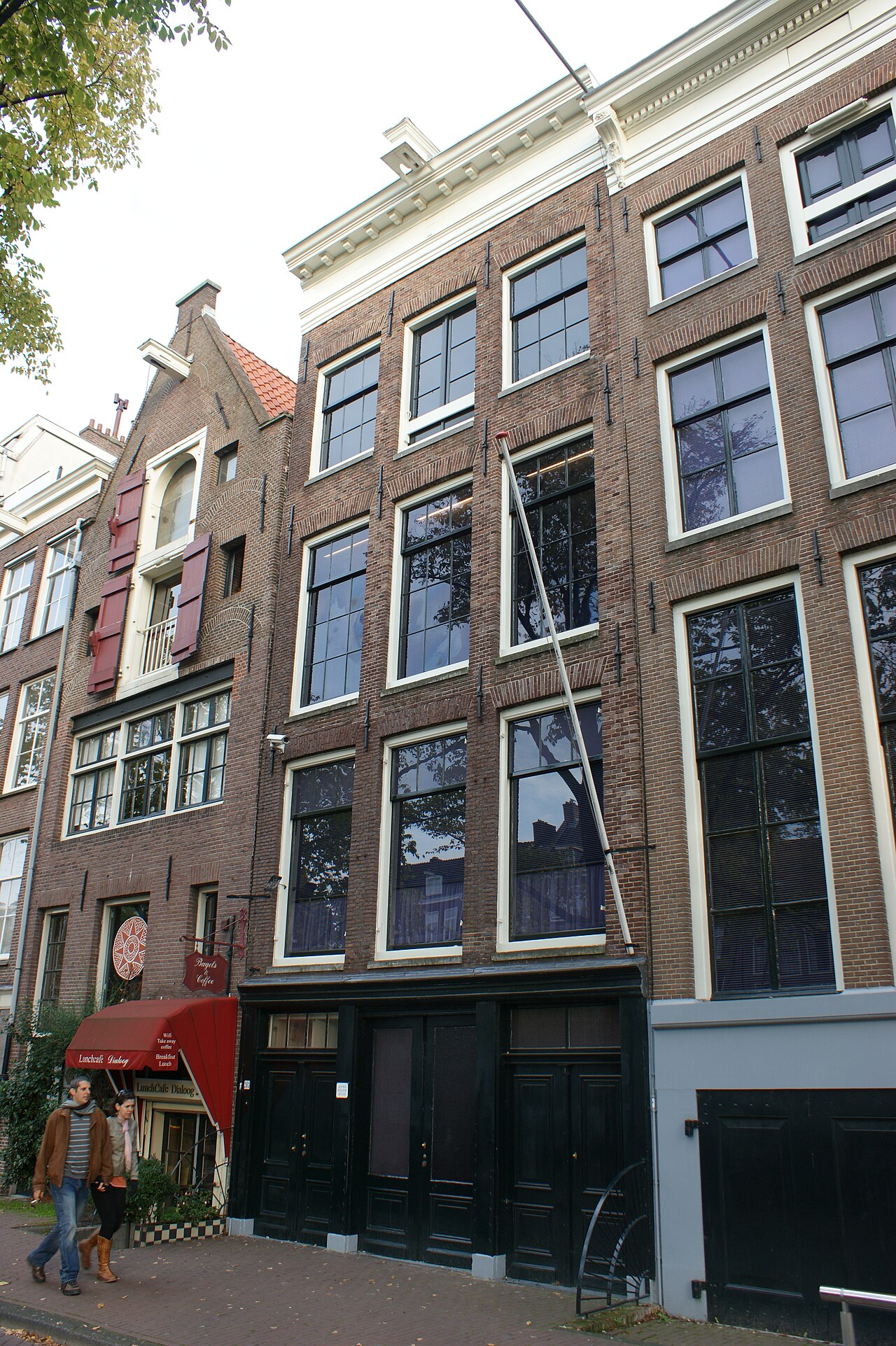
The Anne Frank House is one of the few major museums whose strongest object is absence. Visitors do not come for a richly reconstructed interior. They move through a set of rooms that were preserved in a stripped state, with only a few surviving traces left in place. That outcome was not inevitable. It came from a sequence of postwar decisions about demolition, restoration, authenticity, and public memory.[1][2]
The sharp historical question is therefore practical: how did an empty hiding place become the museum’s central argument?
First layer: after 1945, emptiness was the condition of survival
When Otto Frank returned to Amsterdam in June 1945, he was the only one of the eight people from the Secret Annex to come back from Auschwitz. He resumed work with his staff in the business premises at Prinsengracht 263, but the former hiding place remained empty.[1][2] That detail matters because the annex did not enter public memory as a room full of relics. It entered memory as a space that had been emptied by arrest, deportation, looting, and loss.
The museum’s later emotional force depends on that starting condition. The building held the diary story, but the rooms themselves carried the shock of removal.
Second layer: the house first had to be rescued from disappearance
The preservation story was precarious in the 1950s. The buildings at Prinsengracht 263 and the neighboring corner properties had deteriorated after the war. In 1950, the Berghaus textile factory wanted to buy the site and demolish the buildings for a new factory block. Otto Frank briefly secured the property through Opekta in 1953, but restoration costs exceeded what the company could carry. In 1954, he sold the building to Berghaus, and demolition once again appeared likely.[1]
The decisive turn came in 1957. A committee of prominent Amsterdam citizens formed the Anne Frank House organization to preserve the hiding place, open it to the public, and carry Anne Frank’s ideals into public life. Berghaus then donated Prinsengracht 263 to the new foundation. The neighboring properties still had to be assembled through difficult negotiations, and the financing gap was only closed with help from the municipality of Amsterdam and the University of Amsterdam in 1958.[1]
This is the first commemoration lesson of the site: memory needed an institutional shell before it could become a public ritual. Without that civic coalition, the annex would have survived only in print and testimony, not as a walkable place.
Third layer: the museum opened in 1960, but the annex was left bare on purpose
The Anne Frank House opened to the public on 3 May 1960 after restoration work between 1958 and 1960.[1][3] The crucial curatorial choice was Otto Frank’s request that the annex remain unfurnished. The museum’s own account is explicit: when he returned after the war, the annex was empty and barren, and when the museum opened, it stayed that way at his request.[2] On the bookcase conservation page, the institution adds the technical side of that story: the moveable bookcase was stabilised during the 1958-1960 renovation and then displayed to the public from opening day onward.[3]
That decision shaped the site’s moral grammar. A reconstructed room would have invited visitors to imagine domestic life. The preserved empty room pushes visitors toward a different recognition: people lived here, and everything they used was taken away. The museum did not remove interpretation from the house. It made deprivation itself legible.
Fourth layer: emptiness was never total; a few traces were treated as evidence
The annex is bare, but it is not blank. The museum preserved a narrow set of material traces that keep the space anchored to daily life in hiding.
- The original hinged bookcase still conceals the entrance, making secrecy and access part of the visitor’s physical experience.[3]
- Anne’s picture wall was preserved, including the images she pasted up to make the room more livable.[2][4]
- Pencil marks recording Anne and Margot’s height were kept on the wallpaper.[4]
- Otto Frank’s map of the Normandy coast, used to track the Allied advance after 8 June 1944, remains part of the evidentiary texture of the rooms.[4]
These traces explain why the house avoids the feel of abstract memorial architecture. The curatorial method is selective retention: remove the temptation of total reconstruction, but keep enough physical evidence that the rooms still read as inhabited historical space.
Fifth layer: renewal in 2017-2018 changed the frame around the annex, not the annex itself
The Anne Frank House did not freeze in 1960. It renewed itself for new audiences while protecting the annex’s authenticity claim. The museum’s renewal pages state the formula directly: the Secret Annex remained as it was, while everything around it was renewed in 2017 and 2018.[5] The renewed museum was presented on 22 November 2018, with a stronger chronological approach and more historical context for visitors who increasingly lacked direct family or eyewitness proximity to the war.[5][6]
The 2018 annual report shows why that mattered. The museum welcomed 1,225,976 visitors that year, and about half were under thirty.[6] By then, the institution was managing a paradox common to twentieth-century memory sites: the farther the event recedes, the more explanation the visitor needs, yet too much explanatory rebuilding can weaken the authority of the place itself.
The Anne Frank House answered that problem by preserving the annex’s stripped physical core while expanding interpretation outside it.
Two ways to read what the empty rooms now do
Interpretation 1: evidentiary absence
Under this reading, the bare annex is a forensic space. Its force comes from what was removed and what faintly remains: the hidden entrance, the wall pictures, the growth marks, the map, the floor plan of concealment.[2][3][4] The museum persuades by leaving the violence of erasure visible.
Interpretation 2: disciplined moral staging
Under this reading, the empty rooms are also a museum technology. They train visitors into a mode of attention: quieter, slower, less consumptive than a reconstruction-heavy historical house. The surrounding interpretation, especially after the 2018 renewal, turns that attentiveness into a broader historical and civic lesson about persecution, deportation, and democratic fragility.[5][6]
The strength of the site comes from the overlap of those two readings. The rooms work because they are both evidence and method.
What would change the assessment?
If archival evidence emerged showing that Otto Frank had actually favored a substantially refurnished annex and that the foundation overrode him later, the current interpretation of emptiness as founding principle would weaken. If, on the other hand, future conservation work showed that the remaining traces had to be replaced by replicas at scale, the museum would face a different problem: preserving narrative continuity while losing part of the material authority that makes the site feel singular.
For now, the historical lesson is clear. The Anne Frank House became durable not because it recreated the past in full, but because it learned how to preserve the right absences.[1][2][5]
Sources
- Anne Frank House, "How it all began" - postwar ownership changes, the 1957 foundation, and the 3 May 1960 opening.
- Anne Frank House, "Inside the museum" - the empty annex, Otto Frank's request, and the surviving picture wall.
- Anne Frank House, "The bookcase" - conservation history of the moveable bookcase and the 1958-1960 renovation.
- Anne Frank House, "The picture walls in the Secret Annex" - preserved wall images, height marks, and the Normandy map.
- Anne Frank House, "Museum renewal" - the 2017-2018 renewal and the decision to leave the Secret Annex unchanged.
- Anne Frank House, "Museum Annual report 2018" - visitor volume and the renewed chronological presentation.