The March on Washington is usually compressed into one sentence and one voice: August 28, 1963, the Lincoln Memorial, Martin Luther King Jr., "I Have a Dream." That shorthand is powerful, but it is thinner than the event itself. The march was not only a speech platform. It was a carefully staged national demonstration assembled by a coalition, structured by an official program, and watched through cameras that turned a quarter-million people into a civic image legible to the entire country.[2][3][4]
James Blue's documentary The March, restored and released by the U.S. National Archives, is one of the clearest surviving moving-image records of that transformation.[1][2] It matters because it does more than preserve the famous climax. It keeps the event's logistics, tempo, and crowd behavior in view. If the printed program shows the march as planned on paper, Blue's film shows what it looked like when the plan had to hold in real space.[3]
Historical context: the march was designed as a coalition act, not a spontaneous crowd
The formal name, the March on Washington for Jobs and Freedom, gives away the structure. The event joined civil-rights demands to labor and economic claims: desegregation of schools, protection of voting rights, a federal jobs program, a higher minimum wage, and stronger fair-employment authority.[3][4] The point was not simply to dramatize grievance. It was to present Black freedom as a national democratic and economic question at once.
That coalition required discipline. The official program lists religious leaders, union figures, student organizers, musicians, and the major civil-rights organizations in a sequence that moved the day forward without letting it fragment into rival rallies.[3] King was the culminating speaker, not the whole architecture. A crowd of that size on the National Mall could have read as disorder. The organizers worked to make it read as moral seriousness.
Blue's film catches that design at street level. Instead of treating the day as one long climax, it watches people arrive, wait, fan themselves in the heat, sing, and listen. That is one reason the footage remains historically valuable: it restores the middle distance between leadership symbolism and mass participation.
Video provenance
The embed below is the National Archives' restored upload of The March on its official YouTube channel.[1] The film was directed by James Blue, with photography by Bruce Davidson, and was revisited by the Archives for the march's sixtieth anniversary as both a historical document and a record of documentary craft.[2] What survives here is not raw television coverage. It is a shaped film that still preserves the event's bodily scale.
Close reading: what the film shows that photographs and quotations flatten
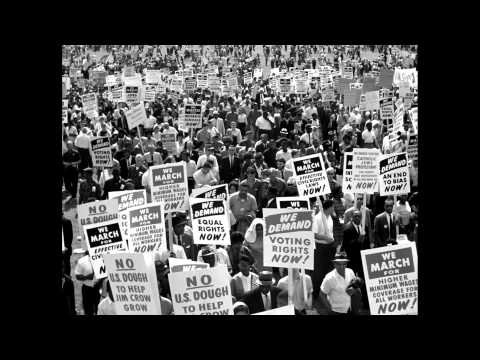
The first thing to notice is movement before rhetoric. Around the opening minutes, Blue stays with bodies in transit: buses, sidewalks, handmade signs, clusters of marchers sorting themselves into lanes. That choice re-centers the event's operational fact. A quarter-million people did not simply appear before the memorial. They had to be routed into visibility. The march became persuasive in part because it looked governed rather than chaotic.[1][3]
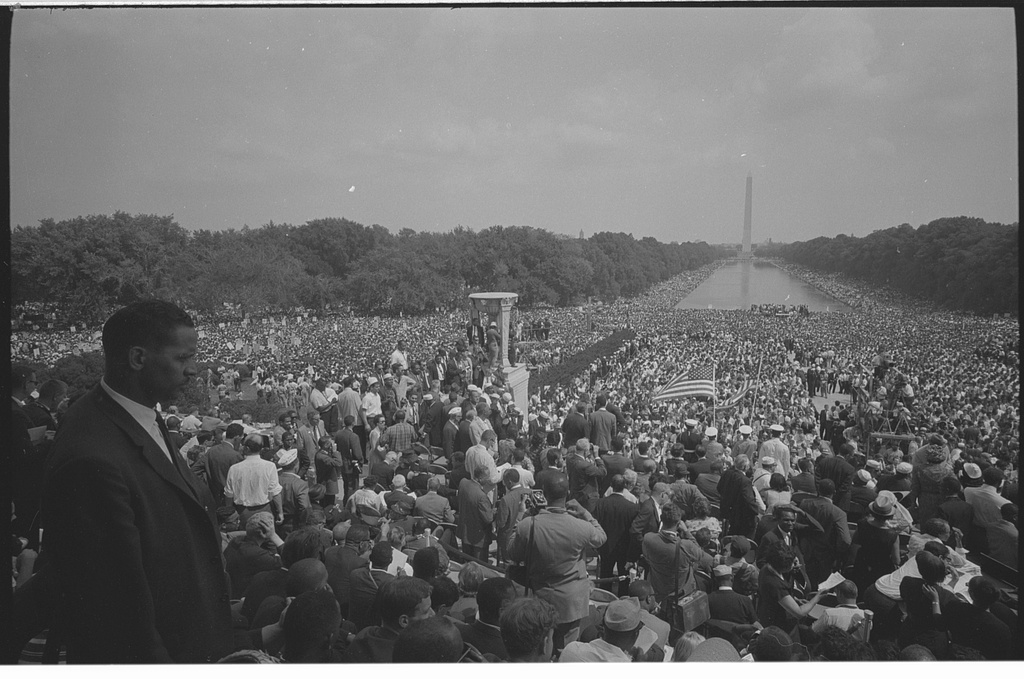
A second thing to notice is how often the camera returns to waiting. In still photography, the event often becomes pure scale: a sea of heads, the Washington Monument in the background, the Reflecting Pool packed with bodies.[5] In the film, scale is built through pauses. People lean against one another, drink water, check programs, look toward the platform, and settle into listening. This slows the event down enough for the viewer to see a political gathering becoming a temporary public order.
The soundtrack matters in the same way. The film keeps songs, applause, announcer transitions, and crowd murmur in the frame of interpretation. That sound bed makes the march feel less like a single oratorical eruption and more like a civic assembly with rhythm. By the time King's speech arrives, the audience has already been shown as a disciplined listening body. The speech lands inside that discipline rather than creating it from nothing.[1][2]
Around the middle section, Blue's framing repeatedly ties speakers to faces in the crowd rather than isolating the podium. That visual logic matters historically. It insists that leadership and audience are mutually constitutive. The movement is neither a faceless mass nor a sequence of celebrity turns. The film keeps showing the relay between platform and crowd: how authority is borrowed, received, and amplified.
The imagery also clarifies something that later memory often blurs. The march was national and interracial, but it was not socially abstract. You see clergy, union contingents, students, families, and children. You see carefully dressed participants conscious that they are being watched by the country. The result is not respectability as style alone; it is respectability as media strategy. On camera, self-presentation became part of the argument for federal action.[3][4]
What this archival footage adds to the history
The great strength of The March is that it makes order visible without draining away urgency. Written summaries can tell you the demands, the attendance, and the place the event occupies in civil-rights chronology.[3][4] A famous still image can tell you scale.[5] The film adds the transition between those facts. It shows how a coalition turned choreography into legitimacy.
That distinction matters because the march's later symbolic life has been so dominated by one excerpt from one speech. The event deserves that speech, but it also deserves to be remembered as a feat of democratic staging. The film makes you see the organizers' wager: if the country were shown enough dignity, enough order, enough collective seriousness, then inaction in Washington would appear smaller than the people gathered to confront it.
The footage also reveals the limits of retrospective simplification. The march was not only about dream language or interracial uplift. The official program and the coalition literature fixed jobs, wages, and federal enforcement directly into the day's demands.[3][4] Blue's film helps recover that wider agenda because it lingers on signs, printed matter, and the composition of the crowd instead of hurrying straight to the canonical lines.
Legacy
In historical memory, the March on Washington became an icon. In Blue's film, it is still an achievement under construction. That is why the archival record matters. The moving image preserves not just what the event meant later, but how it managed to mean anything on that hot August day: through scheduling, visual discipline, coalition sequencing, and the stubborn work of assembling a crowd large enough to alter the moral scale of American politics.[1][2][3][4]
If this footage were lost and only the speech remained, the march would survive as language. Because the film survives, it survives also as structure.
Sources
- US National Archives, The March (1963, restored), official YouTube upload of James Blue's film.
- National Archives, "60th Anniversary of the March on Washington Film Screening and Discussion" - provenance, restoration context, and Bruce Davidson's role.
- National Archives Catalog, Official Program for the March on Washington for Jobs and Freedom, 8/28/1963 - speaker order, demands, and event structure.
- The Martin Luther King, Jr. Research and Education Institute at Stanford, "March on Washington for Jobs and Freedom" - coalition context, attendance, and political demands.
- Library of Congress, "Crowd at the March on Washington" - Warren K. Leffler photograph, August 28, 1963.