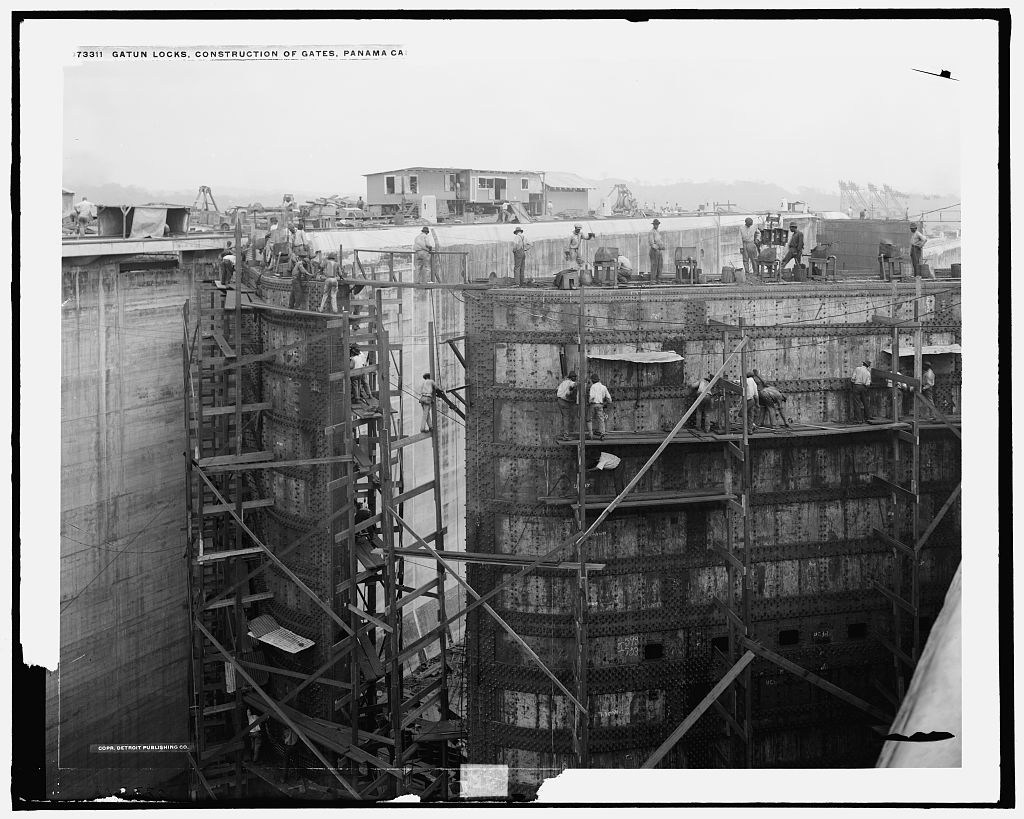
The Panama Canal is often remembered as the world's most famous ditch: engineers cut through jungle and mountain, linked two oceans, and changed global shipping forever.[2][3][5] That memory catches the scale and misses the mechanism. The canal opened in 1914 not because builders finally dug a sea-level channel where the French had failed, but because the project stopped being that kind of project. It became a system. Locks lifted ships to Gatun Lake, dams turned the Chagres River from an obstacle into stored operating water, mosquito control reduced the disease burden enough to hold a work force together, and excavation was concentrated into a narrower but still punishing problem at Culebra Cut.[1][2][3][4][5]
That distinction matters because it changes what "success" meant. The breakthrough was not raw willpower. It was a redefinition of the job after earlier assumptions proved wrong. The French sea-level vision treated Panama as if the main task were to remove enough earth.[1] The American-era lock canal succeeded when engineers and administrators accepted that the real problem had four linked parts: hydrology, disease, slope stability, and traffic design.[2][3][4] Once those parts were reorganized into one operating scheme, the canal became buildable.
Timeline anchors
- May 1879: the Paris canal congress endorses a sea-level Panama canal even though engineer Godin de Lépinay argues for a lock-and-lake design that would reduce digging and tame the Chagres flood problem.[1]
- May 4, 1904: the U.S. construction effort formally begins on the Isthmus, with William C. Gorgas among the first senior figures to set up operations.[2]
- June 1906: after intense debate, Congress approves a lock canal rather than a sea-level canal; John F. Stevens insists that controlling the Chagres River is the central engineering question.[2]
- November 11, 1905: Panama City reports the last yellow-fever case on the Isthmus after screening, fumigation, drainage, and water-supply changes.[2]
- October 4, 1907: a major Cucaracha slide crashes into Culebra Cut, underlining that excavation volumes and slope behavior remain unstable even under the revised plan.[4]
- October 10, 1913: the Gamboa dike blast floods the Cut and joins it to Gatun Lake, proving that the lock-and-lake system is physically coming together.[3]
- August 15, 1914: the canal opens with the Ancon making the first official transit under wartime-muted ceremonies.[5]
These markers show that the canal was not solved by one decision or one shovel campaign. It was solved by a sequence in which each choice reduced a different kind of impossibility.
1. The French failure began with the wrong central question
The French canal company entered Panama under the prestige of Ferdinand de Lesseps, whose success at Suez made a sea-level canal sound like the natural, modern answer.[1] At the 1879 Paris congress, de Lesseps pushed a plan that rejected locks and treated the Isthmus as a place where enough excavation would eventually flatten the route into one continuous channel.[1] That design was not chosen after a clean comparison of equally weighted alternatives. The same official history notes that Godin de Lépinay presented a lock canal centered on dams, artificial lakes, and much less digging, with a specific claim that it would control the Chagres and avoid some of the excavation burden.[1]
The importance of that rejected plan is causal, not merely anecdotal. It reveals that the decisive operating concept already existed before the famous American build. What failed in the French era was not imagination in general, but institutional commitment to the wrong image of the canal. A sea-level trench looked elegant on paper because ships would move straight through without lifting.[1] In Panama's terrain, that elegance concealed three compounding liabilities: too much unstable excavation, too little control over tropical water, and a work environment in which sickness would chew through labor before the earthworks were done.[1][2][4]
Seen this way, the French attempt was not just unlucky. It was mismatched to the site. The project treated the Isthmus as a depth problem when it was really a systems problem.
2. The American breakthrough came when the canal was redesigned around control
The U.S. effort inherited more than machinery and property rights in 1904.[2] It inherited a demonstration of what Panama punished. The key shift came when John F. Stevens forced the canal debate away from prestige and toward operating constraints. The Panama Canal Authority's history preserves his blunt formulation: "the one great problem in the construction of any canal down there is the control of the Chagres River."[2] That sentence matters because it identifies water management, not excavation romance, as the job's real center.
By 1906, that reframing had political consequences. The same account records Congress voting for a lock canal after Stevens argued that a sea-level passage would become an "impracticable futility" and a narrow trench vulnerable to endless slides.[2] The numbers from Culebra Cut explain why. The 1906 minority report estimated 53,800,000 cubic yards of excavation for a lock canal but 110,000,000 cubic yards for a 40-foot sea-level canal, and later revisions kept rising largely because slide behavior was worse than expected.[4] A canal that reduces digging by tens of millions of cubic yards is not just cheaper; it changes the exposure of the whole project to rain, slope failure, labor time, railroad spoil handling, and disease.
The canal therefore became manageable only after the route was reconceived as a controlled elevation change. Instead of insisting that ships remain at sea level, the lock plan accepted that ships could be raised, floated across an artificial inland water body, and lowered again.[3] That choice converted a geographical enemy into an engineered sequence.
3. Disease control was not a side story; it was labor-force preservation
The second indispensable mechanism was sanitary reform. The canal could not be completed if the work force kept cycling through yellow fever and malaria at French-era rates.[2][4] The U.S. history of the canal makes the institutional sequence plain. Gorgas arrived with recent Cuban experience, but early superiors doubted the mosquito theory and starved sanitation of support until Stevens backed it in 1905.[2] Once that backing came, anti-mosquito work became infrastructural: screened buildings, house-by-house fumigation, oiling of water containers and pools, drainage, vegetation clearing, and urban water-supply changes that removed breeding conditions from daily life.[2]
The result was measurable. The last yellow-fever case in Panama City was reported on November 11, 1905.[2] Malaria took longer, but the mortality burden also changed sharply: the canal history records a decline from 7.45 deaths per 1,000 employees in 1906 to 0.30 per 1,000 in 1913.[2] CDC's broader malaria history treats the Panama Canal effort as one of the early American cases in which officials made major gains against mosquito-borne disease through organized control, linking the episode to later public-health practice.[5]
The causal point is straightforward. Disease control did not make the canal easier in a symbolic sense. It extended the time horizon over which the canal could actually be built. Fewer workers dying or collapsing meant more stable crews, more predictable construction schedules, and less organizational fragility. Without that, even a correct lock design would have struggled to reach completion.
4. Gatun Lake and the locks turned topography into machinery
The lock canal only became real when its water logic replaced the trench logic. The Panama Canal Authority's engineering history states the principle succinctly: water lifts ships 85 feet above sea level to Gatun Lake, carries them across the divide, and lowers them on the far side.[3] No pumps run this basic motion; the locks operate by gravity alone, with water admitted and released through large culverts built into the walls and floors of the chambers.[3] That matters because the canal was designed not as a static passage but as a repeatable hydraulic machine.
The machine depended on geography being reorganized. Gatun Dam turned the Chagres valley into Gatun Lake, and the later flooding of the Cut joined the excavation zone to that lake-water operating system.[3][4] In late 1907, engineers even moved the planned Pacific-side locks from Sosa Hill to Miraflores for more stable foundations and better protection, a reminder that the lock design was itself adjusted to local conditions rather than imposed as pure abstraction.[3]
This is the deep reason the canal succeeded. A sea-level plan tried to eliminate terrain. The lock plan used terrain selectively. Water was stored, height differences were accepted, and the canal's most difficult segment no longer had to be the whole route. Only one section had to be cut with great violence; the rest could be flooded into function.
5. Culebra Cut remained brutal, but it was now the hardest part of a smaller problem
None of this means the lock canal made digging easy. Culebra Cut remained one of the most difficult earthmoving sites in modern history.[4] The official history calls it the canal's "special wonder" and describes repeated slides, including the Cucaracha slide of October 4, 1907, when roughly 500,000 cubic yards moved after heavy rain.[4] Later structural-break slides forced removal of millions more cubic yards, and total excavation estimates kept climbing through 1913.[4]
But the lock plan changed the meaning of those crises. Under a sea-level design, endless slope movement in the divide threatened the entire conception of the canal. Under the lock-and-lake design, slides were still costly and dangerous, yet they occurred inside a project whose overall earth-removal burden had already been reduced and whose water route had already absorbed large stretches of the crossing.[3][4] By October 10, 1913, when the Gamboa dike was blasted and the flooded Cut joined Gatun Lake, the project had effectively crossed the conceptual finish line even though cleanup and stabilization continued.[3]
The opening on August 15, 1914, with the Ancon making the first official transit, therefore marked more than the end of construction.[5] It marked the triumph of a different answer to the Panama question. The canal worked because its builders stopped demanding that Panama behave like Suez.
The best causal summary is this: the canal became possible when engineers treated it as a linked system of disease control, river control, stored elevation, and bounded excavation.[1][2][3][4][5] Digging still mattered enormously. It just stopped being the whole story.
Sources
- Autoridad del Canal de Panamá, "The French Canal Construction" - on the 1879 Paris congress, de Lesseps's sea-level commitment, and Godin de Lépinay's earlier lock-and-lake alternative.
- Autoridad del Canal de Panamá, "American canal construction" - on the 1904 U.S. takeover, Gorgas's sanitation campaign, Stevens's support, the Chagres River argument, and the 1906 lock-canal vote.
- Autoridad del Canal de Panamá, "Design Of The Locks" - on the 85-foot lift to Gatun Lake, gravity-fed lock operation, the Miraflores site change, and the October 10, 1913 flooding of the Cut.
- Autoridad del Canal de Panamá, "Culebra Cut" - on slide mechanics, excavation estimates for lock versus sea-level plans, Gatun Lake's expansion, and the recurring instability of the divide.
- Autoridad del Canal de Panamá, "End of the Construction" - on the muted August 15, 1914 opening and the Ancon's first official transit.
- Library of Congress, "Gatun locks, construction of gates, Panama Canal" - archival photograph source page for the lead image.