The line “The British are coming!” feels inseparable from Paul Revere. But as a historical claim, it bundles together three different questions that need to be separated:
- What was Revere actually trying to do on the night of April 18, 1775?
- What do the closest surviving accounts say he likely shouted, if anything?
- When did the familiar slogan become the dominant version of the ride?
Once those are split apart, the phrase starts to look less like eyewitness transcription and more like a later memory-device: vivid, portable, and only partly faithful to the evidence.
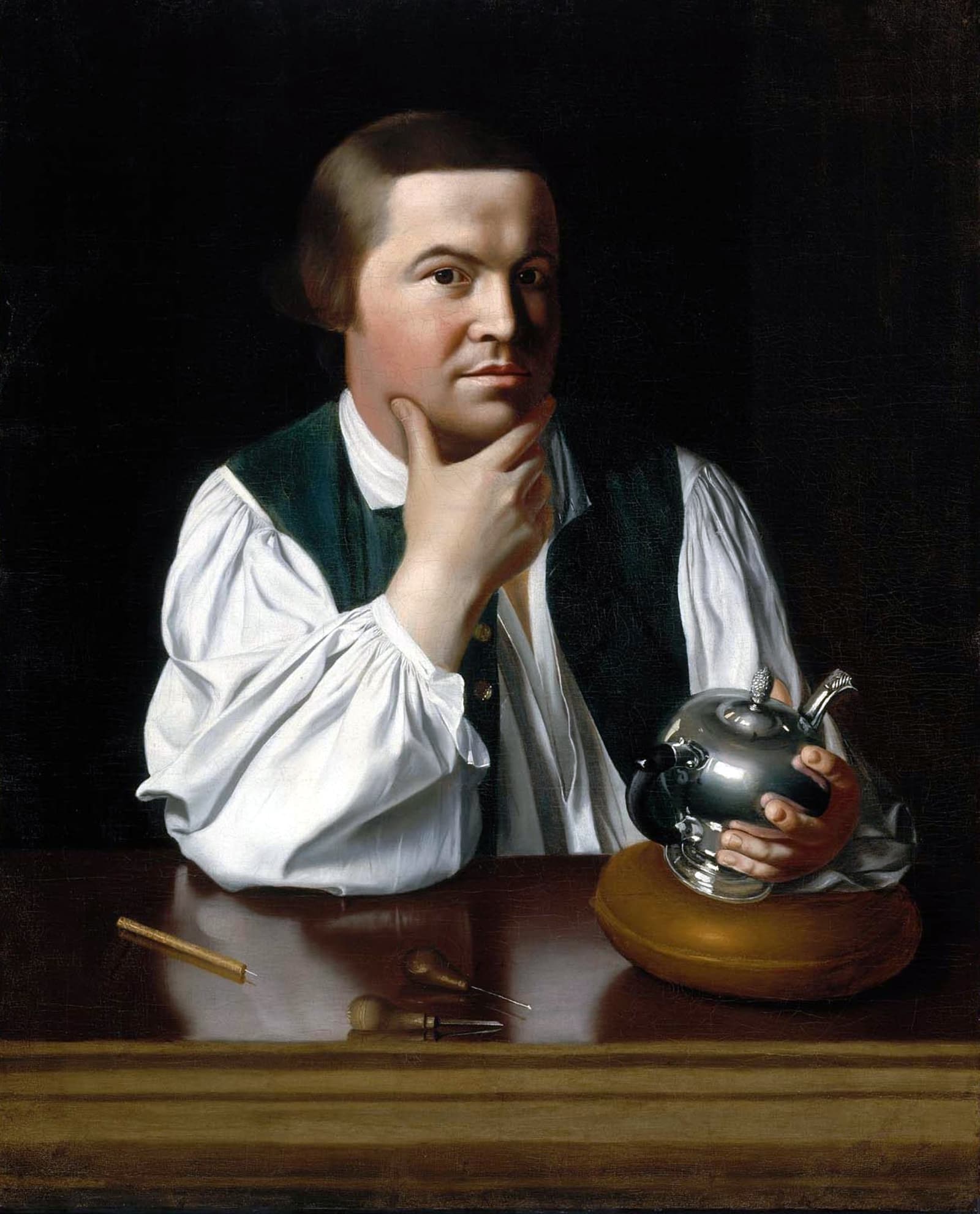
Image context: the Copley portrait matters here because the article is not just about a ride, but about how one person became the face of a much larger alarm network in American memory.
Timeline anchors: when the wording changed meaning
A few dates clarify why the slogan is unstable:
- 1775-04-18 to 1775-04-19: Revere rides out of Boston as part of a covert patriot alarm system on the eve of Lexington and Concord.[1][2][3]
- 1798: Revere’s later account to Jeremy Belknap still frames the mission as warning Hancock and Adams and spreading alarm, not as a theatrical countryside catchphrase.[3]
- 1822: a later recollection associated with Dorothy Hancock Scott introduces a version of the phrase “The British are coming!” into the record decades after the event.[3]
- 1863: Henry Wadsworth Longfellow’s Paul Revere’s Ride, published during the Civil War, gives the episode its most influential national afterlife.[4][5]
That chronology matters because the most famous wording arrives after the politics of identity have changed. In 1775 many Massachusetts colonists still considered themselves British subjects defending their rights; by the early 19th century, and especially after the War of 1812, “British” had become a much cleaner national opposite.[3]
The source ladder, in plain order
The easiest way to avoid myth drift is to rank the evidence chain instead of flattening it.
- Closest to the event: the April 1775 ride itself and the wider Lexington-Concord alarm context.[1][2][6]
- Stronger later framing: Revere's own 1798 recollection about warning Adams and Hancock and spreading alarm, without a clean slogan fixed in place.[3]
- Weaker but culturally stronger afterlife: the 1822 recollection and Longfellow's 1863 poetic condensation, which carry narrative force far beyond their documentary weight.[3][4][5]
That ladder does not settle every word choice by itself. It does show why later retellings are powerful memory objects while still being softer evidence for what was said on the road. The key QA move is to stop asking whether the slogan is emotionally true and ask instead whether it is the closest surviving language from the night itself.
What the ride required in real time
The ride was not designed as a piece of public theater. It was a security-sensitive courier mission.
Britannica and the Paul Revere House materials agree on the essentials: British regulars were moving out from Boston, patriot leaders feared action against Samuel Adams and John Hancock, and a warning system involving lantern signals, boats, horses, and multiple riders was already in motion.[1][2][6]
That operational setting cuts against the standard schoolbook image of Revere racing through the countryside shouting to anyone within earshot. If patrols were actively looking for messengers, noise was a risk, not an advantage. The Paul Revere House summary is especially explicit on this point: Revere’s mission was supposed to be secret, and he generally alerted specific houses and trusted contacts along the route rather than performing a broad public proclamation.[2][3]
So the first myth to discard is not only the exact phrase. It is the idea of the ride as one continuous dramatic speech-act.
What the closest evidence suggests he likely said
The strongest commonly cited wording is not “The British are coming,” but “the regulars are coming out.”
The Paul Revere House draws here on William Munroe’s later testimony about events in Lexington, where Revere is said to have shouted, “Noise! You’ll have noise enough before long — the regulars are coming out!”[2] Because Munroe’s testimony is itself later rather than contemporaneous, it works best as stronger contextual evidence than as a courtroom-grade verbatim transcript. Even with that caution, the phrasing fits the political language of 1775 much better than the later slogan does.
Why? Because “regulars” identified the professional soldiers of the British army without creating the conceptual confusion that “British” could create among colonists who still thought of themselves as Britons. The FAQ and “What Did Paul Revere Actually Say?” materials make this point directly: “the British are coming” would have been awkward phrasing on that night because it imposed a later national distinction onto an earlier imperial crisis.[2][3]
This does not mean every witness heard exactly the same words. It means the evidence points toward a warning framed around regulars, patrols, and local alarm, not a polished slogan built for posterity.
Where “The British are coming” seems to enter the story
The phrase did not spring fully formed from the night ride itself. It appears to harden later, through recollection and retelling.
The Paul Revere House notes that one early appearance comes from an 1822 dinner-party recollection involving Dorothy Hancock Scott, who remembered a man in Lexington crying out “The British are coming!” when he saw British bayonets.[3] Even if that recollection preserves a real memory fragment, it is already separated from the event by nearly half a century.
That gap matters. Between 1775 and 1822, the American Revolution had been fought, the United States had been consolidated, and the War of 1812 had further clarified the cultural divide between “American” and “British.” A phrase that sounded imprecise or even odd in the imperial world of 1775 sounded perfectly natural in the national world of the 1820s.[3]
So the slogan is best understood as a later language fit: not necessarily invented out of nothing, but retrospectively standardized under changed political conditions.
Longfellow is where memory beats documentation
If 1822 helped normalize the language, 1863 is where the myth became durable.
Longfellow’s Paul Revere’s Ride does not actually hinge on the exact line “The British are coming,” but it does something even more powerful: it remakes a distributed warning network into a single heroic midnight drama.[4] Revere becomes the lone audible conscience of the countryside, “through the night went his cry of alarm / To every Middlesex village and farm.”[4]
That transformation mattered because Longfellow was not merely recounting the Revolution; he was writing during the Civil War, when national cohesion and usable patriotic memory had fresh urgency.[5] The poem compressed complexity into something teachable, recitable, and morally clear. Once the ride entered classrooms and popular culture through that lens, a short slogan had a much better survival chance than the messy documentary record.
Why the network matters as much as the sentence
One reason the slogan distorts the event so efficiently is that it turns a network into a solo performance. The closer historical picture is busier: lantern signals across the Charles, a boat crossing, alerts to specific houses, and multiple riders including William Dawes and Samuel Prescott helping spread the warning beyond a single horseback line.[2][6] Once that network shrinks to “Paul Revere said one unforgettable sentence,” both the wording and the structure of the event get simplified at the same time.
It also helps sort out one famous line people often fold into the same scene. “One if by land, two if by sea” was the lantern plan, not the best evidence for Revere’s spoken warning on the road. The signal belongs to the network story; the shouted catchphrase belongs to later memory compression.[2][6]
That is also why the myth has such staying power in classrooms. A distributed alarm system is accurate, but hard to recite. One rider plus one line is inaccurate in the details, but perfect for memory.
The two strongest interpretations
Interpretation 1: the traditional phrase preserves the essential truth of the alarm
On this reading, “The British are coming” is not a stenographic quotation but a fair popular shorthand. Revere did spread warning of a British military movement, and popular memory merely simplified the wording.
Interpretation 2: the phrase is a later nationalist condensation, not the best evidence for 1775 speech
This reading better fits the source trail. The covert nature of the mission, the political language of imperial subjects, and the surviving testimony pointing to “the regulars are coming out” all suggest that the textbook phrase is mainly the product of later memory work.[2][3][4]
At the moment, Interpretation 2 is stronger.
What would change the assessment?
A newly surfaced contemporaneous deposition from April 1775 recording multiple witnesses independently quoting Revere as saying “The British are coming” would materially strengthen the traditional version. Short of that, the evidentiary balance still favors a looser, less theatrical warning vocabulary.
Why the myth lasted
The slogan survived because it solves two storytelling problems at once. It names a villain clearly, and it turns a complicated communications network into one unforgettable human moment.
That is why the phrase remains culturally useful even after its historical precision weakens. The actual ride involved multiple riders, local contacts, lantern signals, and house-to-house alarm.[2][6] The remembered ride gives you one horse, one patriot, one sentence.
As history, the second version is cleaner than the first. As memory, that cleanliness is exactly why it won.
Sources
- Encyclopaedia Britannica, “Paul Revere”
- Paul Revere House, “Revisit the Ride: What Actually Happened on the Midnight Ride?”
- Paul Revere House, “Revisit the Ride: What Did Paul Revere Actually Say?”
- Paul Revere House, “Longfellow’s Poem”
- Encyclopaedia Britannica, “Henry Wadsworth Longfellow”
- Encyclopaedia Britannica, “Battles of Lexington and Concord”
- Paul Revere House, “Frequently Asked Questions About the Midnight Ride of Paul Revere”