The Halifax Explosion is usually remembered as a single catastrophic fact: two ships collided, one of them exploded, and an entire district vanished. That summary captures scale, but it hides the sequence that made the disaster historically important. Halifax in late 1917 was not simply a city struck by bad luck. It was a wartime harbour system running hot: traffic dense, cargo risks unevenly distributed, warning channels incomplete, and emergency capacity strong in some places but thin in others.
Read as a chronicle rather than as a monument, the event becomes sharper. A routine morning movement in the Narrows turned into a 20-minute spectacle that drew crowds instead of clearing them. The blast then forced the city to improvise rescue with railway dispatchers, soldiers, municipal committees, hospitals, and outside aid almost all at once. Within weeks, catastrophe response had become something more durable: a reconstruction and compensation apparatus that would shape Halifax for decades.[1][2][3][4][5]
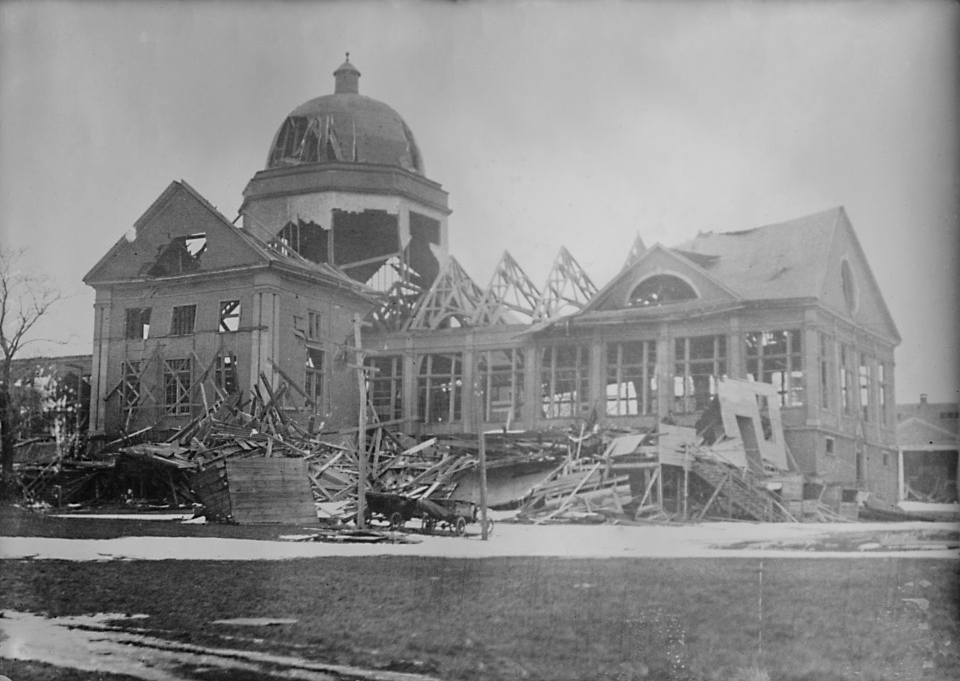
The hero image matters in that frame. The photograph of Richmond after the blast, with the Imo stranded on the far shore, is not just proof of damage. It shows the basic analytical point of the article: the explosion was not only a shipboard accident but a systems failure that radiated through docks, rail lines, homes, city government, and then into a formal relief state.
Timeline: the morning that widened into an institution
- Evening of 5 December 1917: The French munitions ship Mont-Blanc remains outside the Narrows because anti-submarine net controls delay entry; the Norwegian relief ship Imo is likewise delayed in departing.[3][4]
- About 7:30 a.m., 6 December: Mont-Blanc heads toward Bedford Basin carrying picric acid, TNT, guncotton, and benzol; Imo departs in the other direction.[1][4]
- Shortly before 8:45 a.m.: After a series of confusing whistles and evasive maneuvers in the Narrows, Imo strikes Mont-Blanc.[1][3][4]
- Roughly 8:45–9:05 a.m.: Fire spreads on Mont-Blanc; the crew abandons ship; crowds gather along the waterfront and at windows; warning spreads only unevenly.[1][2][3]
- 9:05 a.m.: Mont-Blanc explodes near Pier 6 in Richmond, destroying the north end and damaging nearly every building in Halifax and Dartmouth.[1][3][4]
- By 11:30 a.m.: Halifax municipal leaders assemble in the one usable room left in City Hall and begin documenting emergency decisions in formal minutes.[5]
- Afternoon and night of 6 December: Relief committees form; hospitals overflow; railway and military transport move people, supplies, and information.[1][2][5]
- 7 December: A snowstorm complicates outside assistance even as aid from Boston and other places continues to move toward Halifax.[1][5]
- 22 January 1918: The Dominion Government appoints the Halifax Relief Commission, shifting the disaster from emergency rescue into organized compensation, rehousing, and rehabilitation.[1]
That last date matters because it changes the way the event should be read. The explosion did not end when the smoke cleared. The historical event includes the administrative machine built to sort the dead, the injured, the homeless, and the rebuilt city.
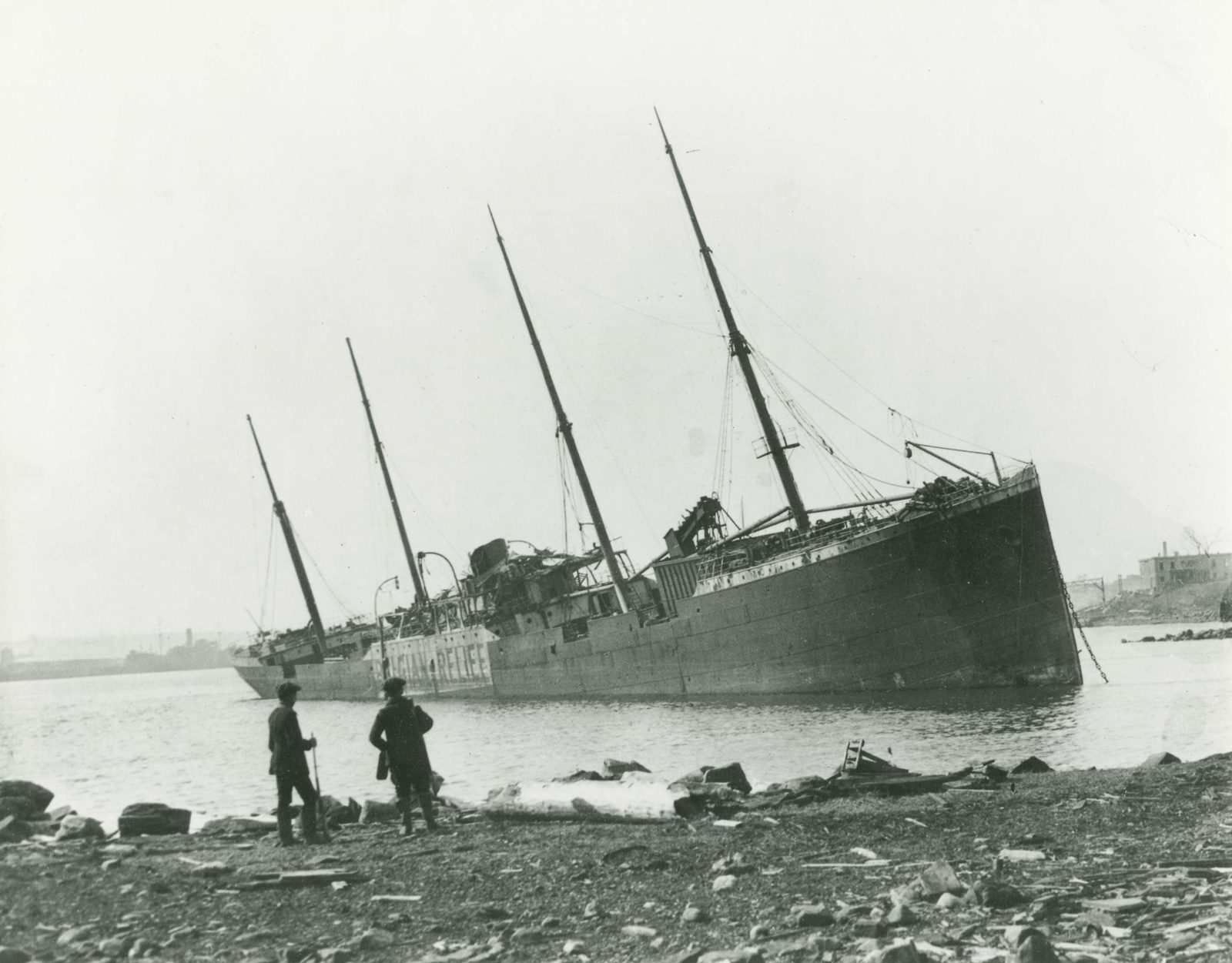
The stranded Imo photograph keeps the reader inside the physical aftermath: hull, shoreline, water, wreckage, and the scale mismatch between one damaged ship and a city forced into relief mode.[7]
Before the blast: a harbour running at wartime density
Halifax had become one of the central North Atlantic convoy hubs of wartime Canada. Shipping, troops, rail traffic, and wartime secrecy all loaded the harbour with more than commercial pressure. The Narrows had become a place where ordinary navigation rules mattered more, not less, because small judgment errors could now interact with military cargoes and congested movement windows.[1][4]
That morning both ships were operating inside those pressures. Imo was behind schedule and outbound; Mont-Blanc was inbound with an extraordinarily dangerous cargo. Maritime Museum and Canadian Encyclopedia accounts agree on the broad sequence: unusual passing behavior, contradictory whistle exchanges, last-minute attempts to reverse engines, then collision.[1][3] The contact itself was not yet the catastrophe. The catastrophe began when sparks ignited spilled benzol and the burning Mont-Blanc kept drifting instead of stopping in a controllable space.[1][3][4]
This is the first place where the chronicle changes the standard memory. The disaster was not produced by impact energy alone. It came from a chain: navigation confusion, hazardous cargo, limited public knowledge of that cargo, and the simple fact that a burning vessel still had enough time to become a public spectacle.
The 20-minute warning failure
From collision to detonation, Halifax had roughly twenty minutes. In theory that is enough time to move a crowd, halt inbound movement, and spread a warning. In practice it was not.
The reasons were structural. The harbour population did not know what Mont-Blanc carried. The ship’s crew fled and shouted warnings, but by many accounts those warnings were not understood by the watching public.[3] Fire on the water looked dramatic rather than legible. People moved toward windows, docks, and higher viewpoints to watch. Children paused on their way to school. Workmen and residents treated the burning ship as an event to witness, not a blast radius to escape.[1][3][4]
Only a narrow set of actors understood the stakes clearly. One of them was railway dispatcher Vincent Coleman in the Richmond yards. The Maritime Museum’s account notes that newspaper versions of his final telegram differ slightly, but the core message is stable: he tried to stop inbound rail movement because the munitions ship at Pier 6 was about to explode.[2] Whether he definitively halted passenger Train No. 10 remains disputed even in later reconstruction, yet the museum makes a broader point that matters more historically: the telegraph message alerted the railway system that Halifax had suffered a catastrophe, which accelerated relief traffic from outside the city.[2]
That is why Coleman should not be reduced to a single heroic anecdote. His action sits exactly at the boundary between failed local warning and successful networked response. Halifax could not clear the crowd in time, but it could still tell the wider rail system what had happened.
9:05 a.m.: blast, glass, water, and urban unmaking
At 9:05 a.m., the harbour accident became a city disaster. The Maritime Museum describes fragments embedding in buildings, whole blocks destroyed, and a pressure wave so violent that churches, schools, factories, homes, and docks vanished across the blast zone.[1] Britannica emphasizes the combined force of blast and water, including a tsunami that surged well above the high-water mark and drove destruction back into the city fabric.[4]
Numbers alone do not explain the human pattern of injury, but they do discipline it. More than 1,900 people died; about 9,000 were injured; roughly 25,000 were left without housing; 1,630 homes were destroyed and 12,000 damaged, according to the Maritime Museum summary.[1][4] One of the distinct injury signatures was eye trauma from shattered glass. That detail matters because it shows how the blast reached beyond the immediate waterfront. The city’s normal visual relationship to the harbour—people looking out from windows at work or at home—became part of the casualty mechanism.[1]
The Richmond district took the first concentrated blow, but the event was metropolitan in effect. Halifax and Dartmouth were both damaged. Hospitals were overwhelmed. Morgues and identification systems fell behind. Families spent weeks looking for bodies or trying to establish who had survived.[1][3]
Rescue by noon, administration by afternoon
Halifax did not respond with elegant prewritten doctrine. It responded with whatever organized capacity was closest to hand.
The Maritime Museum account stresses the importance of the city’s wartime human infrastructure: troops, sailors, rail workers, hospitals, ships in harbour, and municipal officials.[1] That mattered because the explosion struck a city already full of disciplined manpower and transport assets. Rescue began quickly, even though coordination was improvised. Buildings and ships were commandeered for shelter or treatment, the injured were redistributed, and relief committees were already formed by the afternoon of the disaster.[1]
The Halifax Municipal Archives adds a striking local detail: by 11:30 a.m. Deputy Mayor Henry Colwell, aldermen, citizens, and provincial officials had assembled in the only serviceable room left in City Hall, and minutes were still being taken.[5] This is the hinge point where the chronicle becomes governance history. The city was half-shattered, yet it moved almost immediately into recorded decision-making—meetings, submissions, committees, and later negotiations over costs, authority, and reconstruction.[5]
Aid then widened beyond Halifax. Boston received a plea for help the same day; Massachusetts organized medical and supply assistance that became part of the event’s long afterlife in Atlantic memory.[1][5] The next day’s snowstorm slowed movement and deepened suffering, which is precisely why the speed of the first railway and military response mattered so much.[1][2]
From catastrophe to relief state
A chronicle of the Halifax Explosion is incomplete if it stops with rescue. The longer historical significance lies in institutionalization.
On 22 January 1918, the Dominion Government appointed the Halifax Relief Commission. According to the Maritime Museum, the commission handled pensions, claims, rehousing, and victim rehabilitation, and it remained in being until 1976.[1] That duration is astonishing. A 20-minute fire and blast produced a relief body whose administrative life outlasted the war, the interwar years, the Second World War, and much of the postwar city.
This is what makes Halifax more than a disaster story. It is a case study in how modern urban catastrophe creates a second event made of files, claims, housing plans, compensation disputes, and reconstruction authority. Municipal archive material shows that local government and the Relief Commission had to negotiate not just aid delivery but control over redevelopment and who would pay for what.[5] The city did not simply rebuild itself; it was rebuilt through an argument over jurisdiction, memory, and resource allocation.
That longer arc also explains why the blast lives in multiple registers at once: as a wartime harbour accident, as a mass-casualty emergency, and as the origin point of new urban forms such as the Hydrostone district and tighter harbour regulations.[1]
What this chronicle changes in how we read Halifax
Two corrections follow from reading the explosion this way.
First, the event should not be treated as an unavoidable freak detonation. It was a sequence in which wartime congestion, dangerous cargo, inconsistent signaling, limited public warning, and then fast improvised rescue all mattered. The explosion was sudden; the catastrophe was systemic.
Second, Halifax belongs in the history of state formation at the municipal edge. The blast did not only test courage. It forced rapid conversion from spectacle to triage, from triage to committee rule, and from committee rule to a relief-and-reconstruction regime that lasted decades.
One useful way to remember the event is to hold five linked systems in mind: traffic, cargo, warning, rescue, relief. The first two explain why the collision became combustible, the third explains why twenty minutes were squandered, and the last two explain why Halifax survives in the archive as more than a blast site.
That is why the Halifax Explosion still reads as more than a local tragedy. It shows how modern cities fail through infrastructure and recover through administration, and how the second process can become almost as historically important as the first.
Sources
- Maritime Museum of the Atlantic — Halifax Explosion Infosheet (cargo, timeline, casualties, relief commission, inquiry, Hydrostone)
- Maritime Museum of the Atlantic — Vincent Coleman and the Halifax Explosion (telegraph warning, train dispute, railway relief response)
- The Canadian Encyclopedia — The Halifax Explosion of 1917 (narrative sequence, eyewitness framing, casualties, inquiry context)
- Encyclopaedia Britannica — Halifax explosion of 1917 (cargo composition, detonation timing, tsunami, casualty scale)
- Halifax Municipal Archives — Halifax Explosion | Sources (City Hall emergency meetings, relief records, Boston aid references, reconstruction governance)
- Wikimedia Commons / Library of Congress image page — Halifax Explosion Aftermath LOC 2 - restored.jpg (hero image source showing devastated Richmond and the stranded Imo)
- Wikimedia Commons image page — Halifax explosion - Imo.jpg (in-body aftermath photograph showing the stranded Imo after the blast)