The phrase “bank holiday” can make the March 1933 rescue sound like a dramatic pause that somehow cured panic by itself. That is too simple. Closing the banks bought time, but time alone does not stop a run. What stopped the run was a sequence: the closure, the sorting of banks by condition, emergency liquidity against good assets, federal willingness to stand behind the reopened institutions, and a communication strategy that made ordinary depositors understand the new rules.[1][2][3][4]
That sequence is why the episode still matters. The mechanism was not psychological reassurance floating free of policy, and it was not policy working silently in the background. The Roosevelt administration stabilized the system by making institutional triage and public trust arrive together.[1][3][5]
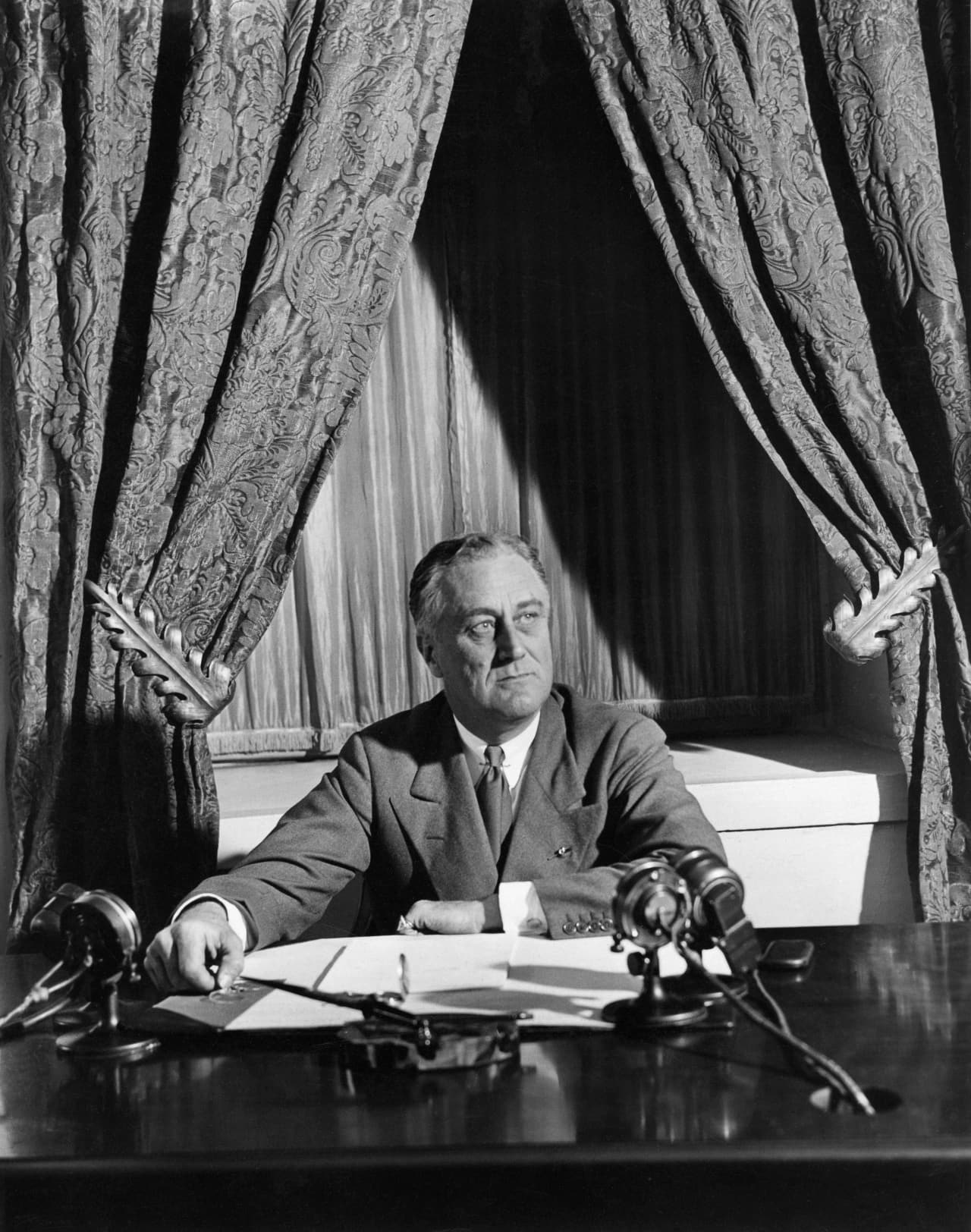
Image context: the hero image shows Roosevelt delivering his March 12, 1933 fireside chat on the banking crisis. It is used here because this article is about the moment when technical banking measures were turned into a mass public argument the average depositor could actually act on.
Timeline anchors: where the mechanism starts
- 1933-03-01: the Federal Reserve Bank of New York warns that its gold reserve has fallen below the legal requirement, a sign that convertibility pressure and withdrawals are reaching the core of the system.[1]
- 1933-03-03: failures and withdrawal restrictions spread; by Roosevelt’s inauguration weekend, banking operations are already impaired across most of the country.[1][4]
- 1933-03-06: Roosevelt proclaims a national bank holiday, suspending banking transactions nationwide.[1][4]
- 1933-03-09: Congress passes the Emergency Banking Act, giving the Treasury and Federal Reserve the legal tools to reopen, support, reorganize, or keep closed different classes of banks.[2][4]
- 1933-03-12: Roosevelt uses his first fireside chat to explain the logic of the rescue in plain language.[3][6]
- 1933-03-13 to 1933-03-15: banks reopen in stages, beginning with Federal Reserve cities, then clearing-house cities, then smaller communities whose institutions pass review.[2][3]
- 1933-03-31: the public has redeposited roughly two-thirds of the currency withdrawn during the worst recent phase of panic, according to Federal Reserve History’s summary.[2]
- 1934-01-01: the first national FDIC deposit insurance system begins, making permanent one element of the broader confidence architecture.[5]
The dates show the key point: the holiday worked only because it quickly turned from blanket stoppage into a differentiated reopening regime.
What depositors actually saw from the outside
From a household point of view, the rescue stopped looking like an invisible balance-sheet problem and started looking like a sequence of public signals:
- first, everything stopped at once, which told depositors that the old run dynamic had been interrupted nationwide rather than left to state-by-state improvisation;[1][4]
- then some banks reopened before others, which made reopening itself look like evidence of review rather than a casual return to normal;[2][4][7]
- then Roosevelt explained on national radio why reopened banks were safer than cash at home, giving depositors a usable rule for what to do next.[2][3]
That outside view matters because ordinary savers did not see capital ratios or emergency-lending memos. They saw a stop, a filter, and a presidential explanation. The mechanism succeeded partly because the visible sequence lined up with the hidden policy machinery.
The easiest way to remember the rescue is as a ladder rather than a single decree:
1) The closure mattered because it froze a system that could not meet demand at panic prices
Roosevelt’s March 12 address explained the core problem with unusual clarity. Banks did not keep all deposits in a vault; they transformed deposits into loans and securities. When frightened depositors demanded currency all at once, even sound banks could not liquidate assets fast enough “except at panic prices far below their real value.”[3]
That diagnosis is essential. The crisis was not simply that every bank had already become worthless. It was that a run forced institutions to realize assets under fire-sale conditions, turning a liquidity panic into solvency destruction. The holiday therefore did one necessary thing: it stopped immediate withdrawal pressure long enough for the government to change the rules of survival.[1][3]
Necessary, however, is not the same as sufficient. A closure without a credible reopening plan can deepen fear by confirming that the state itself does not know which banks are safe. The mechanism had to move fast to the next stage.
2) The decisive move was triage: not all banks reopened at once, and that selectivity created signal
Federal Reserve History describes the internal logic as a three-part classification. Class A banks were sound enough to reopen quickly; Class B banks required reorganization; Class C banks would not reopen.[1] Executive orders and Treasury licensing then turned that classification into an operational schedule.[4]
This was the part of the rescue that converted a nationwide stop into a screening system. Instead of asking depositors to trust the old banking landscape, the government asked them to trust a newly filtered one.
That mattered because depositors did not need a theory of monetary economics. They needed an answer to a simpler question: if my bank opens, what does that opening mean? Roosevelt’s message on March 12 and the staggered reopening of March 13–15 supplied a concrete answer: opening itself had become a federal signal of review and conditional approval.[2][3][4]
Recent NBER-backed research adds an important nuance here. The sequencing did restore deposits, but it also created stigma for banks that reopened later. Depositors interpreted early reopening as evidence of strength, and they were often directionally correct in doing so.[7] That is a limitation worth keeping in view. The holiday did not eliminate differentiation; it formalized it.
3) Triage would still have failed without liquidity: reopened banks needed a way to meet withdrawals
Even a licensed bank could have been ruined if anxious customers returned on reopening day and demanded cash faster than the institution could raise it. The Emergency Banking Act attacked that problem directly.
Federal Reserve History emphasizes two linked tools. First, the Act allowed the Federal Reserve Banks to issue additional currency on good assets.[2] Second, it expanded support for banks whose balance sheets were strained but salvageable, including conservatorship and Reconstruction Finance Corporation capital measures.[2]
Roosevelt translated the same point into nontechnical language on air: “The new law allows the twelve Federal Reserve banks to issue additional currency on good assets and thus the banks that reopen will be able to meet every legitimate call.”[3]
That sentence is the hinge of the whole mechanism. The government was not merely announcing that banks were safe. It was changing the cash-conversion capacity of the institutions being declared safe.
In other words, the reopening banks were supposed to be trusted because they now had a backstop, not because the president hoped confidence would magically reappear.
4) Liquidity needed a believable sovereign promise behind it
This is where William L. Silber’s interpretation is useful. In his New York Fed article, he argues that the Emergency Banking Act’s emergency-currency provisions, together with Roosevelt’s willingness to protect Reserve Banks against losses on emergency lending, amounted to de facto 100 percent deposit insurance for reopened banks.[5]
That phrasing is Silber’s analytical claim, not a statutory label used in March 1933. But it captures something real in the historical record. Federal Reserve History quotes Roosevelt’s March 11 assurance to New York Fed governor George Harrison that the federal government would ask Congress to indemnify Reserve Banks for losses on emergency loans.[2] If the central bank would lend freely and the sovereign would stand behind those losses, then depositors had reason to believe reopened banks would not be allowed to fail in the old cascading way.
This helps explain why reassurance became credible so quickly. Roosevelt’s famous line—“it is safer to keep your money in a reopened bank than under the mattress”[2][3]—was not just clever radio. It rested on a newly announced support structure.
5) Communication was not decoration; it was part of the policy instrument
Miller Center’s presentation of the March 12 speech is right to emphasize Roosevelt’s use of ordinary language in the fireside chats.[6] In the banking address, the simplicity is functional. He begins with a tutorial on how banks actually use deposits, then narrates the late-February run, then explains why staggered reopening is safer than instant universal reopening, then tells listeners what practical behavior makes sense next.[3]
That sequence matters because the rescue needed mass coordination. If depositors misunderstood the plan, they could still run even sound, supported banks. Roosevelt therefore did not speak like a banker addressing a conference. He spoke as if he were rebuilding the payments system one household belief at a time.
The policy and the rhetoric were tightly joined:
- policy created reviewed, supportable banks;
- communication taught depositors what the new signal meant;
- public response validated the signal by redepositing cash.
By the end of March, the turnaround was visible in both redeposits and market behavior.[2][5]
6) What the mechanism did not do
The success story can be overstated if it is turned into a neat fairy tale of confidence restored in one week.
About 4,000 banks never reopened.[1] The NBER summary also shows that delayed reopening carried long aftereffects for banks marked, fairly or unfairly, as weaker institutions.[7] And the permanent nationwide solution to depositor confidence did not arrive until the Banking Act of 1933 created the FDIC, with insurance beginning on 1934-01-01.[4][5]
So the best historical reading is narrower and more useful. The bank holiday worked not because closure is a magic cure, and not because speeches alone calm markets. It worked because the Roosevelt administration built a temporary regime in which screening, liquidity, sovereign support, and explanation reinforced one another fast enough to outrun panic.
Working assessment
If you strip the episode to mechanism, the causal chain looks like this:
- freeze the run before sound assets are destroyed by forced liquidation;
- separate banks by condition so reopening becomes a credibility signal rather than a blanket promise;
- supply emergency currency and lending capacity so reopened banks can survive renewed withdrawals;
- make federal backing legible enough that depositors believe the signal;
- translate the architecture into household language so the public acts on the new regime instead of the old fear.
That is why March 1933 still rewards close study. The holiday itself was only the pause button. The actual rescue was the new operating system installed during the pause.
What would have failed if one link were missing
- Closure without triage would have frozen panic without creating any new information about which banks deserved trust.
- Triage without liquidity would have reopened reviewed banks only to expose them to another day-one cash squeeze.
- Liquidity without believable federal backing would still have left depositors wondering whether emergency lending could survive losses.
- Backing without public explanation would have left households unable to distinguish the new regime from the old fear.
That is the article's practical takeaway. March 1933 worked because each link arrived fast enough for the next one to matter. Remove one, and the sequence loses force.
Why the episode still matters beyond 1933
The case stays useful because it separates three problems crisis managers often blur together:
- stopping a run is different from sorting institutions;
- balance-sheet support is different from public legibility;
- system-wide stabilization can still impose lasting stigma on weaker institutions.
That is a more demanding lesson than the usual slogan that “confidence matters.” The episode suggests confidence lasts only when households can see why the institutions that survive are supposed to survive.
Three wrong readings to drop
- It was not closure alone. A shutdown without triage and liquidity would have frozen fear, not resolved it.
- It was not already the FDIC world. Permanent nationwide deposit insurance arrived later, so the March rescue still depended on temporary sovereign backing and emergency-currency tools.[4][5]
- It was not equal treatment for every bank. Staged reopening worked partly by creating a visible hierarchy, which also meant stigma for weaker or later-opening institutions.[1][7]
Sources
- Federal Reserve History, “Bank Holiday of 1933”
- Federal Reserve History, “Emergency Banking Act of 1933”
- FDIC, transcript of Franklin D. Roosevelt’s March 12, 1933 banking crisis speech
- Library of Congress, “1933 Bank Holiday” guide
- William L. Silber, New York Fed, “Why Did FDR’s Bank Holiday Succeed?”
- Miller Center, “March 12, 1933: Fireside Chat 1: On the Banking Crisis”
- NBER Digest, “Lessons from the Federal Bank Holiday of 1933”
- Wikimedia Commons, image source page for Roosevelt’s March 12, 1933 fireside chat