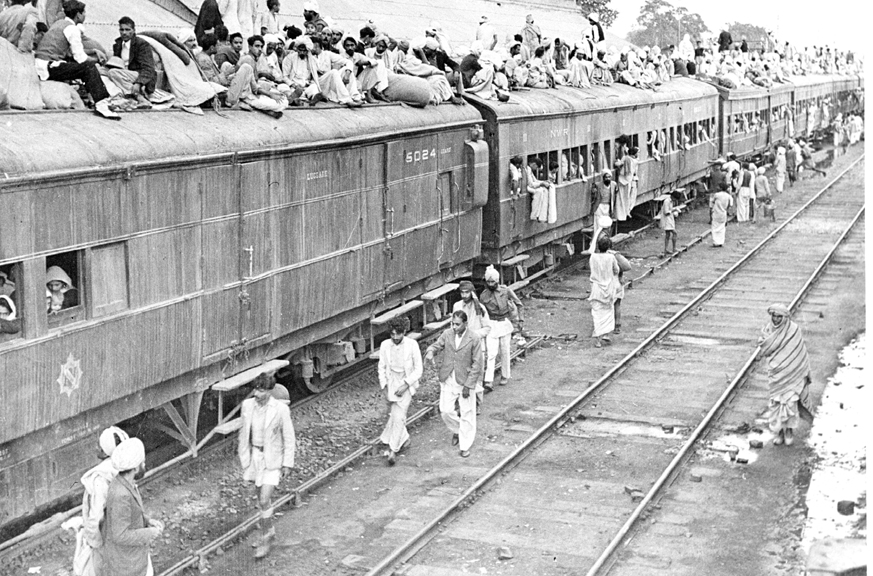
On 3 June 1947, Viscount Louis Mountbatten, the last Viceroy of British India, announced to the world what had long been circling the halls of New Delhi's Viceregal Lodge: British India would be partitioned. Two independent states—India and Pakistan—would come into being. The date was set for 15 August, ten weeks away.
Image context: this archival photograph, preserved by the Indian government's Photo Division, shows refugees thronging a special train at Ambala Station in Punjab during the summer and autumn of 1947. Ambala sat near what would become one of the busiest crossing corridors along the new boundary.
Somewhere inside that announcement was a problem that no one had solved: where, exactly, would the line run?
The man who had never been to India
Sir Cyril Radcliffe, a London barrister and King's Counsel, received his appointment as chairman of both the Punjab Boundary Commission and the Bengal Boundary Commission on 30 June 1947—the day he arrived in India for the first time in his life.[1] He was 47 years old, a distinguished legal mind with no prior experience of the subcontinent, no facility in Hindi, Urdu, Bengali, or Punjabi, and no detailed geographical knowledge of the territories he was asked to divide.
The choice of an outsider was deliberate. Indian and Pakistani representatives would each name two judges to sit on the commissions; a neutral chair was meant to guarantee impartiality. Radcliffe's unfamiliarity with the region was considered a feature, not a defect. He would weigh the evidence on its legal merits rather than carry old loyalties.
What the logic did not account for was the scale of what he was being asked to do.
A commission on paper
The Punjab Boundary Commission's formal remit, as set out in the June 3 plan, was to demarcate boundaries "on the basis of ascertaining the contiguous majority areas of Muslims and non-Muslims."[2] The Bengal commission operated under the same criteria. In principle, the method sounded tractable: plot the religious census data from 1941, identify which districts had Muslim majorities, draw a line separating them from districts with Hindu or Sikh majorities, and adjust for "other factors."
The phrase "other factors" would absorb months of argument into six weeks of hearings. Roads, railways, irrigation canals, rivers, administrative boundaries, historical patterns of settlement, temple towns, pilgrimage routes, princely states, rivers that formed natural lines but cut through single communities—all of it poured into submissions that both commissions heard through late July.[3]
Radcliffe read the evidence, heard advocates for the Indian National Congress, the Muslim League, and the Sikh community, and made his judgments. He consulted maps and census tables. He did not travel extensively through the districts he was drawing lines across; the schedule made that nearly impossible.[4]
The sealed award
By early August, Radcliffe had completed his reports. Both awards—the Punjab line and the Bengal line—were ready before the independence ceremonies. But Mountbatten made a decision that has been scrutinized ever since: the Radcliffe Award would be held back until 17 August 1947, two days after independence.[1]
The rationale, as Mountbatten and his administration framed it, was that announcing the boundary before independence would create disorder and undercut the celebrations. Critics, including historian Yasmin Khan in The Great Partition (Yale University Press, 2007), have argued that the delay left millions of people unable to make informed decisions about where they would live, and that the concealment of the line through the independence ceremonies—celebrated simultaneously in Karachi on 14 August and Delhi on 15 August—gave no one in Punjab or Bengal any clarity about which country their village, their farm, or their district now belonged to.[1]
Independence Day came first. The borders came later.
August 14–15: two midnights
On the night of 14–15 August, Jawaharlal Nehru addressed India's Constituent Assembly in Delhi: "At the stroke of the midnight hour, when the world sleeps, India will awake to life and freedom."[5] In Karachi, Mohammed Ali Jinnah, the Governor-General of the new Pakistan, had already presided over his own ceremony on the 14th.
Crowds celebrated across both countries. But in the Punjab, along the approximate corridors where the new border was expected to run, violence had already begun weeks earlier. The riots that had started in March 1947 in Rawalpindi, and spread through the spring and summer, did not wait for legal cartography.[6]
By mid-August, both the Muslim League and Congress had been warning their administrations about violence in Punjab for months. Military commanders, including the British officers still nominally in command of the Punjab Boundary Force—a body assembled specifically to police the border corridor—knew the situation was deteriorating faster than the political timeline acknowledged.[7]
August 17: the line revealed
On 17 August, the Radcliffe Award was published. The line that emerged through Punjab gave Lahore, overwhelmingly Muslim by population, to Pakistan. It gave Amritsar—home to the Golden Temple, the spiritual center of Sikhism—to India. The Gurdaspur district, whose allocation was contested because it provided road access to the Kashmir Valley, was divided, with most of it going to India.[3]
In Bengal, the line placed Dhaka and most of the eastern districts in East Pakistan. Calcutta stayed in India. The partition of Bengal, unlike Punjab's, did not produce a comparable immediate wave of violence in August 1947, though the demographic displacement intensified through subsequent years and reached its most acute phase in 1950 and again during the 1971 Bangladesh Liberation War.[8]
Radcliffe himself left India on the day his award was published and never returned. He later told his stepson that he had burned his papers from the commission, saying he did not want anything to do with India or Pakistan ever again—an account reported by biographers and cited by Khan and other historians.[9][1]
The movement of people
What followed was the largest forced mass migration in recorded history. By the end of 1948, somewhere between 10 and 14.5 million people had crossed the new border in both directions—Muslims moving toward Pakistan, Hindus and Sikhs moving toward India.[1][6] Estimates of the death toll range widely, from several hundred thousand to over a million, reflecting both the scale of violence and the difficulty of documentation in conditions of administrative collapse.[6][11]
The refugee trains—some overcrowded beyond any design limit, some arriving at their destinations with every passenger dead—became the defining image of the migration. Ambala, Lahore, Amritsar, Ferozepore: stations became processing points for hundreds of thousands of displaced people within weeks of the border's announcement.
The Punjab Boundary Force, initially fielded to protect civilians in the border zone, was formally stood down by 1 September 1947, unable to contain what was happening. It had been designed for a corridor roughly 16,000 square miles wide; the violence exceeded both its geographic remit and its manpower by the first week of operations.[7]
What the chronicle holds
The narrative of the Radcliffe Award is sometimes reduced to the figure of one man drawing a line in six weeks. The line was consequential, and Radcliffe's judgments mattered. But the chronicle contains a larger mechanism.
The speed of partition was a political choice, not a logistical constraint. The decision to accelerate the independence date from June 1948 (the original British government plan) to August 1947 was Mountbatten's, made in part to prevent ongoing communal violence from destabilizing an already volatile situation—and in part from a reading of Indian political dynamics and British imperial exhaustion.[2][1] Historian Stanley Wolpert, in Shameful Flight (Oxford University Press, 2006), argues that the acceleration compounded nearly every subsequent failure of the transfer of power.[10]
The sealed awards—ready before independence, withheld until after—meant that the population most affected by the decision had no information about which country they were in when they celebrated independence. The violence in Punjab did not wait for the borders to be announced; it had been running on its own timeline since March. But the gap between the ceremonies and the cartography created a specific category of uncertainty that structured the refugee movement's most acute phase.
Urvashi Butalia's The Other Side of Silence (Penguin, 1998), built on oral history interviews with survivors, documents what that uncertainty meant at the level of individual families: people who stayed because they did not know which way to move, people who moved in the wrong direction, families split across what became international frontiers within days.[11]
The Radcliffe Award has been challenged, defended, relitigated in academic literature, and mourned across four generations. The line it drew is still the most militarized land border on earth at certain points, and the political inheritance of partition—in Kashmir, in the relationship between India and Pakistan, in the demographic geography of both countries—remains active.
Radcliffe spent the rest of his life in England. He was awarded a peerage in 1949. He did not speak publicly about the commission in any sustained way. The papers, if he burned them, are gone. What remains is the line, the movement it triggered, and the chronicles of the people who crossed it.
Sources
- Khan, Yasmin. The Great Partition: The Making of India and Pakistan. Yale University Press, 2007 — Radcliffe appointment (ch. 5), commission remit (ch. 3), withheld award (ch. 7), Boundary Force (ch. 8), burning papers (ch. 9), displacement estimate pp. 2, 130–132.
- Indian Independence Act 1947, His Majesty's Stationery Office — formal commission remit and original June 1948 timetable.
- Lamb, Alastair. The Crisis in Kashmir 1947–1966. Routledge, 1966 — Punjab Boundary Commission hearing submissions; Gurdaspur district allocation and commission dissenting notes.
- Roberts, Andrew. Eminent Churchillians. Weidenfeld & Nicolson, 1994 — Christopher Beaumont's declassified 1989 memorandum on Radcliffe's working method quoted at pp. 82–135.
- Nehru, Jawaharlal. "Tryst with Destiny" speech, Constituent Assembly of India, 14–15 August 1947. Constituent Assembly Debates (Official Report), vol. 5, col. 1.
- Pandey, Gyanendra. Remembering Partition: Violence, Nationalism and History in India. Cambridge University Press, 2001 — communal violence March–September 1947; death toll range discussion pp. 1–5.
- Moon, Penderel. Divide and Quit: An Eyewitness Account of the Partition of British India. Chatto & Windus, 1961 — Punjab Boundary Force operations and Major Short G.H.B. report on the September 1947 stand-down.
- Chatterji, Joya. The Spoils of Partition: Bengal and India, 1947–1967. Cambridge University Press, 2007 — Bengal partition trajectory and subsequent displacement waves.
- Hodson, H.V. The Great Divide: Britain, India, Pakistan. Hutchinson, 1969 — account of Radcliffe burning his commission papers, reported by his stepson.
- Wolpert, Stanley. Shameful Flight: The Last Years of the British Empire in India. Oxford University Press, 2006 — argument that accelerating the independence date compounded the partition's administrative failures.
- Butalia, Urvashi. The Other Side of Silence: Voices from the Partition of India. Penguin India, 1998; Duke University Press, 2000 — oral histories documenting how border uncertainty shaped individual family displacement decisions.