The pigeons had to leave Paris before they could bring replies back. During the siege of 1870–71, birds travelled out in cages aboard balloons, crossed the surrounding German lines, and were taken to places where messages could be prepared for their return. Their useful destination was the loft they already knew inside the city.[1][2] A pigeon released in Paris would have had no reason to fly to the person waiting for an answer in provincial France.
That directional problem shaped the whole service. On 23 September 1870, the balloon Neptune left Paris carrying mail. An outbound balloon could rise over the encirclement, but its flight did not establish a dependable journey back. The postal authorities needed a second kind of carrier.[1] Balloons supplied the outward passage; homing pigeons supplied the inward one. The two journeys fitted together because their limitations were different.
A bird could find the city without finding an individual correspondent. The Musée de l'Armée preserves a particularly concrete account of that distinction: an inscription on a later painting records a pigeon returning to Édouard Cassiers's dovecote on 9 October, two days after leaving with Léon Gambetta's balloon party. Cassiers kept his loft at his apartment on Boulevard du Montparnasse.[2] The bird's arrival ended one transport stage. People still had to collect, read and distribute what it carried.
The return route was therefore an arrangement between places and workers as much as between animals and machines. It needed known lofts inside Paris, birds carried beyond the siege, handlers outside, and a receiving service inside. A cage on an outbound balloon was already part of the preparation for an inbound message.
The next constraint was the message's weight. A little paper could carry a short dispatch; a city waiting for official instructions and family news required much more. René Dagron brought a photographic technique previously used for tiny pictures viewed through magnifying lenses to this larger problem. The Swiss Camera Museum describes photographs mounted in jewellery and other small objects before the war.[3] Miniaturization was an existing craft that the siege gave an urgent postal purpose.
Even getting the photographer into position required the outward system. Dagron's own account dates his departure aboard Le Niepce to 12 November 1870. He travelled with collaborators and photographic equipment, survived a dangerous landing and an escape through occupied territory, and reached Tours on 21 November.[4] To help Paris receive news, he first had to establish his workshop elsewhere.
Dagron did not arrive in an empty field. In his account, the Tours photographer Blaise had already been reducing messages onto paper. Dagron argued that the paper's grain limited the fineness of the resulting text. His transparent film offered a different combination: a light carrier and an image that could be enlarged by transmitted light in Paris.[4] The distinction mattered at both ends of the journey. Smaller writing was useful only if someone could recover it accurately.
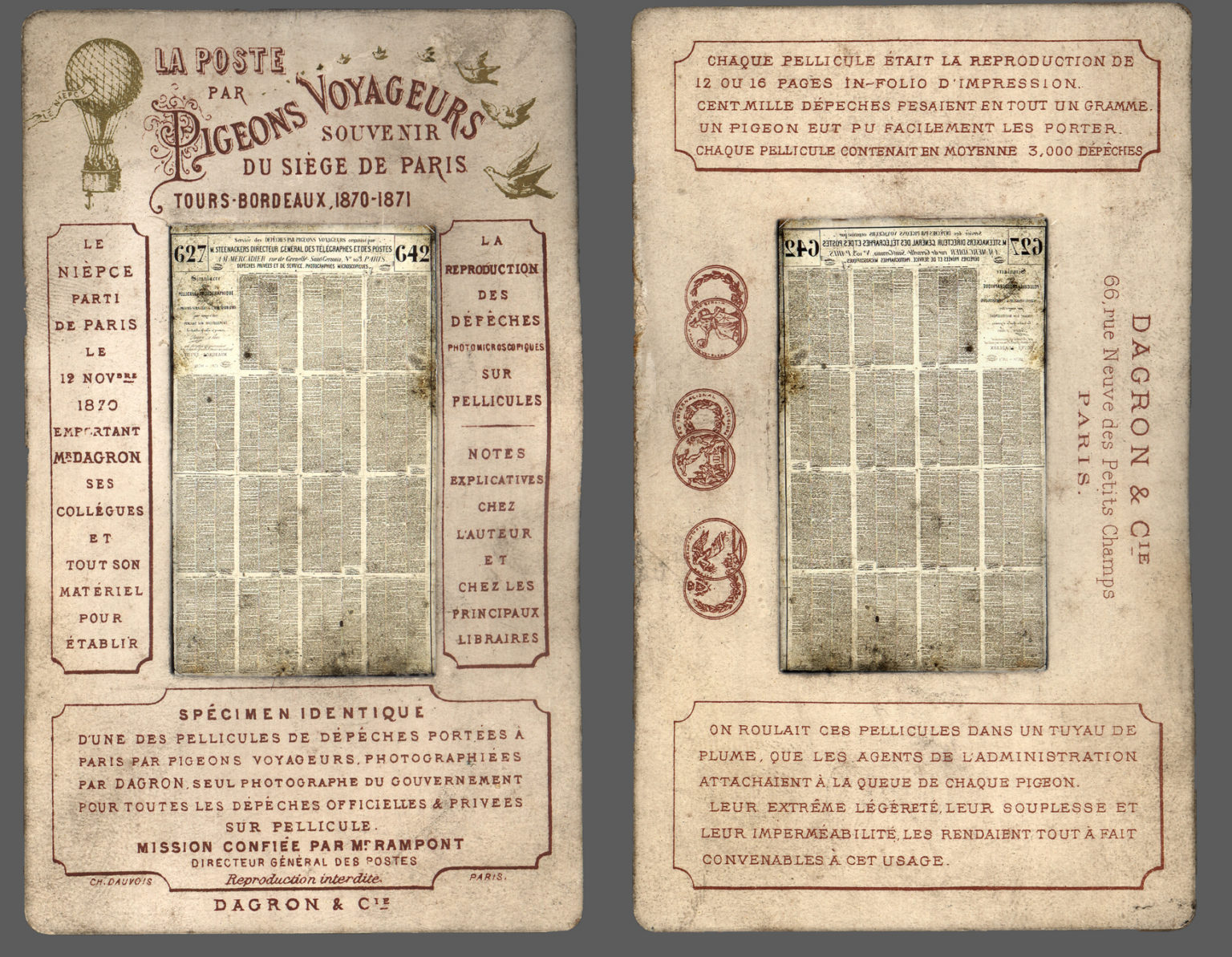
The Camera Museum explains the material step. The photographic image was made on collodion supported by glass; after processing, the light, flexible film could be removed from that support, rolled and placed inside a quill tube attached to the pigeon's tail.[3] The glass stayed behind. A fragile photographic process became a portable message because the part necessary for making the image did not all have to travel with it.
The surviving specimen card gives this transformation a physical scale. Its film insert measures about 3 by 5 centimetres and represents sixteen reduced pages, according to the museum.[3] The dense rectangle is scarcely an invitation to ordinary reading. It is something prepared for a receiver with the right equipment. Holding the message and being able to read it were separate achievements.
Gaston Tissandier's contemporary account follows the message through that receiving room. Officials opened the quill, unrolled the film in liquid, dried it and placed it between glass plates. Projection enlarged the characters onto a screen. Clerks then read and copied the dispatches for forwarding to offices around Paris.[5] The bird brought an image of correspondence. Human hands made it correspondence that could circulate again.
This work took time. Tissandier describes setting up the projection apparatus taking around four hours, followed by further hours of copying, and efforts to improve the equipment.[5] The ability to fit more writing onto a film could increase the work awaiting its arrival. A successful flight did not abolish the need for patient transcription; it delivered that work across an otherwise obstructed frontier.
Nor did a beautifully legible film guarantee a successful flight. Both Dagron and Tissandier describe the severe winter interfering with the pigeons' return.[4][5] Here photography offered another advantage: repeated copies could travel on different birds. Dagron reported that most films were sent about twenty times, with some dispatched thirty-five or thirty-eight times.[4] Repetition used the extra carrying capacity to give the same news more chances of reaching Paris.
Those copies also complicate impressive totals. Dagron distinguished roughly 115,000 dispatches in the material his team processed from more than 2.5 million when the repeated copies were included.[4] The larger figure describes the multiplication of their photographic work. It cannot be read as millions of different messages successfully delivered. Production, dispatch and receipt were three separate events.
Dagron's pamphlet deserves the same care as his arithmetic. He wrote as a participant defending his contribution, ending with a protest against others claiming credit. He also explained that the souvenir specimen accompanying his account reproduced his method while changing the names in the messages.[4] Such a specimen can show how the process worked without preserving an untouched batch of personal correspondence. Its evidential value depends on knowing what kind of object it is.
By the armistice of 28 January 1871, the service had linked two fundamentally different journeys across the siege.[1] Its achievement rested on their sequence: first get the birds out, then give them something light enough to bring home, then turn the arriving image into readable news. The small film is the striking survivor. Around it stood balloon crews, pigeon keepers, photographers and copying clerks, each making the next person's part possible.
Sources
- Musée de La Poste, “Du pigeon à l'Aéropostale / La Poste dans les airs,” educational dossier, pp. 1–2 — balloon departures, outward transport of pigeons, return messages and the siege's end.
- Musée de l'Armée, “Animals and war, episode 15: The pigeon,” 10 June 2017 — homing routes, Cassiers's loft and the inscription recording the October return.
- Swiss Camera Museum, “The first film” — collodion processing, prewar microphotography and the illustrated commemorative card with its film insert.
- Prudent René-Patrice Dagron, La poste par pigeons voyageurs: Souvenir du siège de Paris, 1870–71, “Rapport de M. Dagron” and postscript — participant account of the workshop, film process, repeated copies and souvenir specimen; transcription from the BnF digitization.
- Gaston Tissandier, En ballon! Pendant le siège de Paris, 1871, section on pigeon post — contemporary description of receiving, enlarging and copying dispatches, and winter disruption.