Around 6:30 a.m. on 4 November 1966, the Arno overtopped its embankments in front of Florence's National Central Library. Water and mud spread through the Santa Croce district. By the following morning the river had withdrawn into its channel, but parts of the city remained flooded and the streets were coated with mud and heating oil.[1]
For the library's books, that retreat began another emergency. A volume could be carried out of the building and still deteriorate. It could survive drying and remain unreadable. It could reach a restoration bench with its pages separated from the evidence needed to put them back together.
The rescue therefore had several destinations. Trucks, industrial drying facilities, a fort, railway premises and eventually workshops inside the library formed a route back toward the shelves. Following that route explains why the famous volunteers lifting books from the mud were the beginning of the story.
The emergency continued indoors
Florence's flooded streets were also homes and workplaces. The Uffizi's photographic history describes families trapped on upper floors while the current carried cars and debris below. Its own staff moved paintings upstairs even as the museum's restoration and photographic rooms flooded.[1] Saving collections took place within a city struggling to recover ordinary services and shelter.
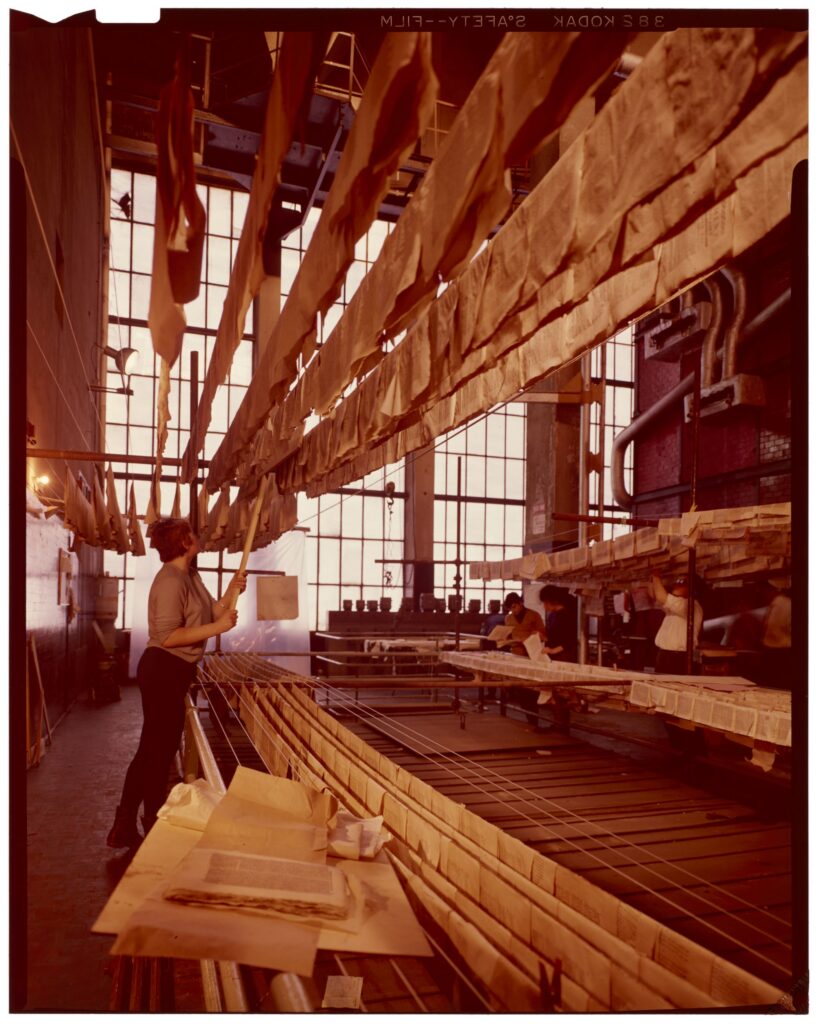
Photographer Balthazar Korab, then staying near Florence, documented both the inundation and the work that followed. His photographs include the volunteers remembered as the mud angels, as well as conservators washing pages and suspending them to dry.[2] Those different scenes resist an easy ending: the moment an object emerged from the mud did not establish whether it would survive.
American bookbinder Carolyn Horton arrived with an early team organised by the Committee to Rescue Italian Art, or CRIA. In her June 1967 account, she explained the danger after the water receded. Prolonged damp encouraged mould, while wet books could raise humidity around books that had escaped immersion. Working carefully through a collection one volume at a time would leave the rest waiting in those conditions.[3]
Horton's team largely assisted smaller libraries; Italian and German specialists, followed by British colleagues, concentrated on the National Library and State Archives. That division matters. The international response involved multiple institutions, with different buildings, supplies and damage, rather than one uniform operation directed from a single bench.[3]
Out of the building, into another danger
Moving books quickly created its own risks. Peter Waters's later salvage manual, reproduced by the US National Archives, recalls that waterlogged volumes were piled high outside the National Library while awaiting transport. Their accumulated weight caused further physical damage and increased subsequent restoration costs.[4]
This is an uncomfortable detail within a celebrated rescue. It does not diminish the volunteers' labour. It shows how an urgent success could transfer the problem somewhere else: clearing a flooded room required somewhere suitable to receive what came out. A growing pile outside could become another source of harm.
Library director Emanuele Casamassima arranged alternative working spaces. Christopher Clarkson's professional account identifies Forte di Belvedere as a place for sorting and selecting books, and the Florence Railway Power Station as a place for washing and drying them. Anthony Cains established improvised washbasins and drying lines there. Clarkson joined the English rescue team in November 1966 and took charge of volunteers at the power station.[5]
These locations supplied different things the damaged library could not immediately provide. The fort offered space to organise material; the railway premises accommodated wet treatment. The route was becoming a sequence of tasks, each with its own practical requirements.
Drying bought time, sometimes at a cost
Emergency drying extended far beyond Florence. In his later account of the National Library's system, Cains lists tobacco, brick and wood drying facilities among the destinations for wet books. Industrial capacity allowed material to move in quantities that ordinary conservation workshops could never have handled.[6]
But a dry book was not necessarily an unharmed book. Cains compared carefully processed material from Bologna with badly fragmented books from another centre. He also recalled that English bookbinders stopped the disbinding of wet volumes at the railway power station because the practice was damaging them.[6] Speed and available equipment had to be judged against what they did to fragile paper and bindings.
Horton observed another difficulty in smaller libraries. Volunteers sometimes kept books, heaters and discarded wet interleaving paper together in closed rooms. Her team encouraged them to remove the wet paper and improve ventilation. The colder weather helped restrain the mould growth the conservators feared.[3] Drying depended on the room around the book as well as the work performed on its pages.
The surviving accounts thus describe a changing response. Techniques were examined, damaging practices interrupted and work reorganised as specialists learned what the emergency measures had achieved. Recovery required the ability to revise a method while thousands of other objects still awaited attention.
A record travelled with each book
By Easter 1967, Clarkson records, temporary workshops had been established on the National Library's main entrance floor.[5] Later that year, American restorer Richard Young joined a programme employing about a hundred people, mostly Florentines. His report, published in April 1968, estimated that roughly a million library items had been inundated.[7]
Young described a disciplined sequence. Workers photographed a damaged book before taking it apart, counted and ordered its pages, and attached a restoration card. Cleaning and disassembly were followed by washing, drying, checking the sequence of pages, mending and rebinding.[7]
The photograph and card made separation manageable. Once a binding had been undone, the object no longer held all its information in its original physical arrangement. Records allowed different workers to carry out successive operations while retaining a reference for what belonged together. Organisation was part of the conservation treatment.
The books also offered evidence about their own construction. Clarkson noticed that many flexible vellum bindings had survived intact while other structures suffered badly. He began developing binding methods informed by late medieval examples and training selected volunteers and staff.[5] The flood had exposed differences in resilience that could be studied while decisions about repair were being made.
The work after the photographs
Continuing that work required money, equipment and paid expertise. Harvard's CRIA archive describes an organisation that expanded its remit from art to books and manuscripts, shipped supplies, supported specialist travel and helped establish restoration centres. Its New York office closed in 1971; the Florence administrative office followed in spring 1973.[8] Those dates measure a commitment extending years beyond the first volunteer arrivals.
The experience travelled too. In 1971, the Library of Congress recruited Waters to lead its Conservation Division. Its institutional history connects his Florence work to the salvage procedures he published in 1975. It also records preservation planning before the flood: a national conference in 1965 preceded the Library's consolidation of preservation activities in 1967.[9] Florence accelerated and reshaped an existing field; it did not create conservation from nothing.
Korab's hanging pages offer a quieter image of the rescue than people wading through the streets. Each sheet has reached a controlled stage of work, yet still awaits reunion with the rest of its book. The distance between those two scenes is the achievement: an improvised emergency response developed into a sustained process capable of caring for individual objects in an immense damaged collection.
Sources
- Chiara Ulivi, “The 1966 flood's damages to the art heritage of Florence,” Uffizi Galleries — flood chronology, conditions in the city and the museum's photographic archive.
- Gillian Mahoney, “Balthazar Korab and the Florence Flood of 1966,” Library of Congress, 4 November 2026 — archival photographs of the flood, volunteers and book treatment; source of the photograph reproduced here.
- Carolyn Horton, “Saving the Libraries of Florence,” Wilson Library Bulletin, June 1967, pp. 1035–1043, reprinted in the Guild of Book Workers Journal — firsthand account of smaller-library salvage, humidity and international assignments; PDF.
- Peter Waters, “Salvage of Water Damaged Library Materials,” part 5, reproduced by the US National Archives — retrospective account of damage caused by stacking saturated books outside the National Library.
- Christopher Clarkson, professional profile, “Florence” — arrival, temporary work sites, Easter 1967 workshops and observations about binding structures.
- Anthony Cains, “The ‘System’ of the Biblioteca Nazionale in Florence: the International Contribution to its Philosophy and Development during the Period 1966–1971,” in Dal 1966 al 1986, proceedings published in 1991, especially printed pp. 125–127 — participant's retrospective on industrial drying and damaging practices; Italian Ministry of Culture PDF.
- Richard Young, “Experiences at the Biblioteca Nazionale in Florence,” Guild of Book Workers Journal, vol. 6, no. 3, pp. 21–24, reprinting his 25 April 1968 Library of Congress Information Bulletin account — scale, staffing and treatment sequence observed in 1967; PDF.
- Harvard University, Villa I Tatti, “CRIA — Committee to Rescue Italian Art” — archival exhibition documenting aid, restoration centres and the committee's operating years.
- Library of Congress, “History of the Preservation Directorate” — institutional chronology, Waters's appointment and the Florence experience's subsequent influence.