
In 1937, the Mississippi watershed could be made to look like a single national problem only by joining things that Americans usually saw separately: a logged hillside in Minnesota, a cotton field in the Delta, a steel mill on the Ohio, an eroded farm, a broken levee, a relief camp, and a hydroelectric dam. Pare Lorentz's The River performs that act of joining. It is less a neutral tour of the Mississippi than a 32-minute argument that land, water, labor, poverty, and public power belong to one causal system.[2][4]
The argument arrived at a precise political moment. Franklin D. Roosevelt's administration had created the Tennessee Valley Authority in May 1933, giving a federal corporation responsibilities that crossed the usual boundaries between navigation, flood control, power, agriculture, and regional development.[6] By June 1936, Lorentz had already made The Plow That Broke the Plains for the Resettlement Administration and was ready to leave government filmmaking. According to the Library of Congress essay on The River, a wall map of the Mississippi and its tributaries changed his mind; Roosevelt then supplied $50,000 for a second film.[4]
Reality altered the production plan. Field shooting had largely ended by mid-January 1937 when destructive Ohio River flooding began. Lorentz sent a crew toward Memphis on January 21, then followed the flood north toward Cairo, Illinois. The filmmakers worked in emergency conditions and used an airplane for some of the aerial views that make inundation read as geography rather than as one ruined street.[4] The River premiered in New Orleans on October 29, 1937, later circulated through Paramount, aired by the BBC in March 1938, and won first prize for documentary at the 1938 Venice festival.[4][5]
The surviving film is also an institutional object. The U.S. National Archives identifies it as NAID 13593, local identifier 96.1, in Record Group 96, the Records of the Farmers Home Administration, and hosts the official YouTube copy embedded below.[1][2] The Library of Congress credits Lorentz as writer-director, Floyd Crosby, Willard Van Dyke, and Stacy Woodard for photography, Lloyd Nosler and Leo Zochling for editing, Virgil Thomson for music, and Thomas Chalmers for narration.[3] Those credits matter because the film's thesis is carried as much by rhythm, cutting, and sound as by any spoken claim.
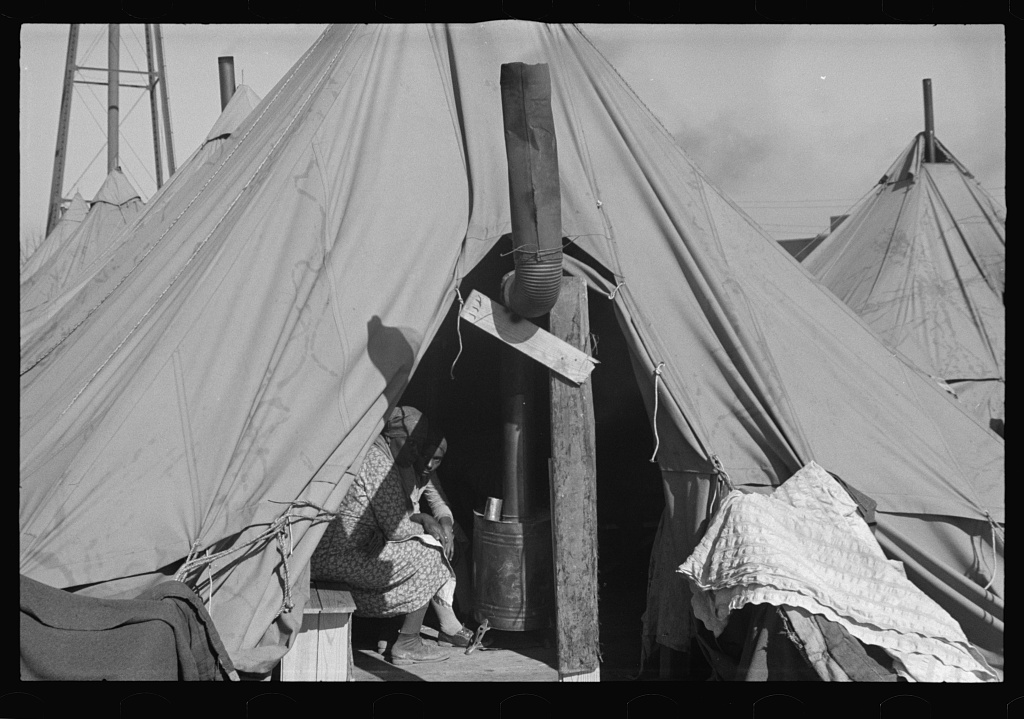
Image context: Edwin Locke photographed Black flood refugees at a Resettlement Administration camp in Forrest City, Arkansas, in February 1937.[7] The photograph is not a frame from the film. It is an independent archival image from the federal documentary apparatus surrounding the same flood crisis, and its faces provide a useful counterweight to the film's preference for crowds, landscapes, and systems.
The Archival Film
The embed is the U.S. National Archives upload of The River.[1] The archive describes the film as a Farm Security Administration/Resettlement Administration production released in 1937; the Library of Congress catalogs the FSA-Paramount print under 1938 while also recording the October 1937 copyright and premiere-era history.[2][3][4] That small date difference reflects the film's passage from government production and first release into wider theatrical distribution, not uncertainty about which work is being shown.
A Continent Built as a List
The opening does not begin with a hero or a disaster. It begins with accumulation. Chalmers names tributaries while the film moves among water, forest, sky, and current.[1] The roll call is geographic, but its rhythm makes a political point: water arriving at the lower Mississippi has already crossed boundaries that local government cannot contain. A few symbolic river shots stand for a basin too large to photograph literally, an approach the Library of Congress essay identifies as central to the film's visual method.[4]
Lorentz then applies the same list-making to development. Levees, cotton bales, steamboats, railroads, timber, coal, furnaces, mills, cities, and cultivated slopes arrive as parts of one expansionary sequence.[1] The repeated collective pronoun is doing historical work. It turns private extraction and regional industries into a national autobiography. The film can therefore pivot from achievement to the compact question “at what a cost?” without changing subjects. Prosperity and damage are two phases of the same montage, not rival stories.[1][4]
This is the film's strongest conceptual move. Flood is not treated as water that suddenly became malicious. It is presented as the downstream expression of choices made far from the levee: forests cut, slopes exposed, soil mined by repeated cash cropping, settlement expanded, and the river confined.[1] The causal chain is broad and sometimes too smooth, but it is recognizably ecological. A watershed becomes a way of seeing responsibility travel.
When Montage Becomes a Flood
Around the 14-minute mark, industrial momentum gives way to stripped and gullied land. Soon afterward, isolated drops and gathering clouds begin the film's flood crescendo.[1] By roughly 16 minutes, Thomson's percussion, Chalmers's accelerating place names, patrol calls, emergency labor, broken water, and aerial footage have collapsed the distance between rainfall and catastrophe. The Library of Congress essay notes how the sequence builds from single drops into visual and sonic chaos.[4] The effect is not a record of one camera standing before one event. It is an edited model of escalation.
Watch how scale changes inside that passage. Wide views make the flood look continental; boats and rooftops make rescue look improvised; workers at levees turn public response into physical labor; camps and queues reveal the social afterlife of water after the spectacular current has passed.[1] The film does not let the crest serve as an ending. It keeps moving from emergency into erosion, tenancy, poor housing, illness, and hunger. Flood control becomes inseparable from the conditions under which people return to the land.
Yet the collective scale has a cost of its own. Many people appear, but the authoritative voice remains the narrator's. Black tenant farmers and flood refugees are used as evidence of structural poverty without being given comparable room to interpret their own circumstances.[1] That is an inference from the film's form, not a claim that the images are false. Locke's Forrest City photograph helps mark the boundary: the federal camera could preserve individual presence even when Lorentz's montage needed “the people” to function as one element in a basin-wide diagnosis.[7]
The Solution, and What It Leaves Outside the Frame
In its final quarter, The River turns from diagnosis to the Tennessee Valley Authority. Maps join tributaries into a planning region; dam construction, reforestation, soil conservation, resettlement, and electric transmission appear as coordinated answers.[1] The sequence is openly persuasive. A problem built by interdependence demands an institution capable of acting across the same interdependence. The film's achievement is to make integrated planning visible before most viewers would ever read a watershed report or a TVA statute.
But the solution arrives more cleanly on screen than it did on land. The National Archives' documents on Mattie Randolph record a family's resistance to relocation for Norris Dam and explain that TVA's flood-control and power program used eminent domain, inundating farmland and forcing landowners to move.[6] That history does not cancel the benefits of electrification, navigation, erosion control, or flood management. It changes the viewing question. The closing images should be read as a government presenting its preferred balance of costs and gains, not as the watershed itself delivering an uncontested verdict.
This tension is why the film remains valuable. It sees something profound: upstream land use, downstream flooding, agricultural poverty, and infrastructure cannot be governed as isolated files. At the same time, its magnificent compression can hide the people for whom “putting the valley back together” meant losing a farm, accepting a resettlement plan, or appearing on screen as a symbol rather than a speaker.[1][6][7] The wider archive does not refute the film. It supplies the voices and frictions that a persuasive half hour leaves out.
The Afterlife of a Government Argument
The River became more than a successful New Deal short. Its reception helped lead to the United States Film Service in August 1938, with Lorentz as director, though congressional politics, industry opposition, and war limited that institution's life.[4][5] The film entered the National Film Registry in 1990.[3][4] Its formal legacy is easy to see: documentary evidence arranged not as a dossier but as a score, with recurring phrases and images making a policy system feel emotionally inevitable.
The responsible way to watch it now is with two archives open at once. One preserves Lorentz's extraordinary synthesis: tributary, axe, plow, furnace, flood, map, dam, and power line joined into a national environmental history.[1] The other preserves the people and disputes compressed by that synthesis: refugees held in a still photograph, a landowner contesting relocation, and records that distinguish public benefit from universal consent.[6][7] Together they reveal both the promise and the danger of the government documentary. It can teach a country to see a system. It can also make one proposed solution look as natural as the river flowing toward it.
Sources
- U.S. National Archives, The River — official YouTube upload of Pare Lorentz's government documentary.
- U.S. National Archives, “The River, 1937” — archival highlight page with production agency, release year, NAID 13593, local identifier 96.1, and Record Group provenance.
- Library of Congress, “The river” — National Film Registry catalog record with credits, physical holdings, subjects, runtime, and 1937 copyright note.
- Robert J. Snyder, “The River,” Library of Congress National Film Preservation Board essay — production history, flood filming, musical construction, premiere, reception, and institutional afterlife.
- Franklin D. Roosevelt Presidential Library and Museum, “Biography of Pare Lorentz” — Lorentz's government-film ambitions, documentary method, New Orleans premiere, distribution, and Venice award.
- U.S. National Archives, “The TVA and the Relocation of Mattie Randolph” — background and primary-document links on eminent domain, inundated farmland, and resistance to Norris Dam relocation.
- Library of Congress, “Negro refugees from the flood of 1937 in camp at Forrest City, Arkansas” — Edwin Locke photograph and catalog record for the archival image used in this article.