Shortly after half past six on the rainy evening of 4 October 1930, R101 slipped away from its mast at Cardington. Its destination board might have read like the promise of a mature transport system: Ismailia, then Karachi. Its actual condition told a different story. The airship had been lengthened only days earlier, had completed one shortened post-modification trial, and was beginning its first journey outside Britain.[3][5]
There were 54 people aboard, but only six were passengers. The other 48 were the crew and technical establishment needed to operate, observe, and represent a machine still proving itself. One passenger was Christopher Thomson, the air minister and political sponsor of Britain's Imperial Airship Scheme; another was Sir Sefton Brancker, the director of civil aviation. R101 was therefore carrying its operators, its patrons, and much of the expertise that would have interpreted the flight afterward.[2]
Before dawn, the airship was on the ground outside Beauvais, France. The impact was slow enough to be survivable. The fire that followed was not. Forty-eight people died, all six passengers among them, and six crew members escaped.[2][5]
R101 is often compressed into a morality play about technological vanity or a politician ordering a dangerous machine into a storm. The surviving record is more difficult and more useful. It shows a development program in which testing, demonstration, diplomacy, and political timing had become the same flight. That compression did not by itself identify the component that failed above Beauvais. It did make a still-experimental aircraft carry consequences that no single trial should have had.
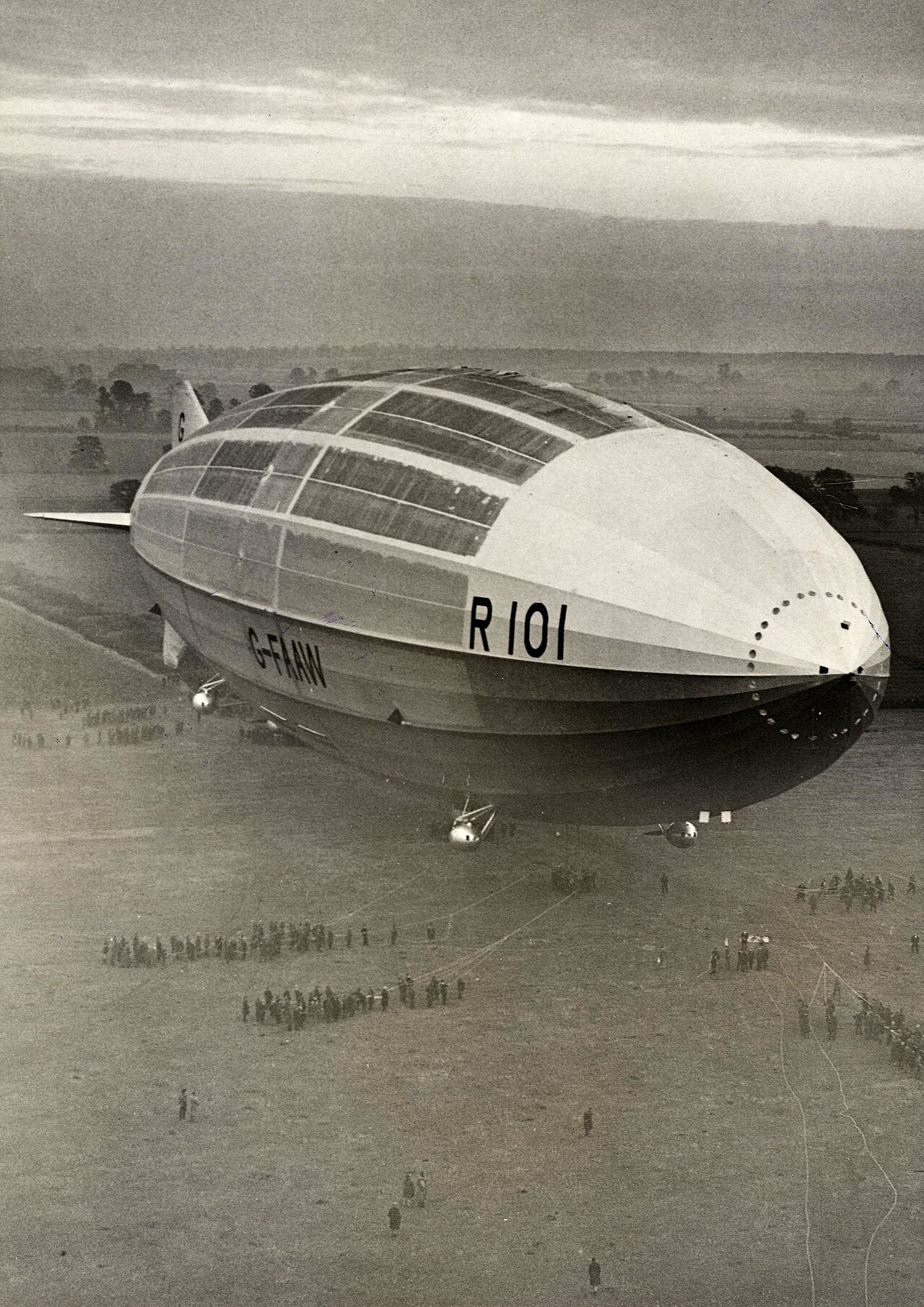
Image context: the cover is a real United Kingdom government photograph, not an illustration or generated reconstruction. It dates from R101's first-flight period in October 1929. The airship fills almost the entire vertical frame while people remain visible as small figures below, preserving the physical imbalance between the machine's immense scale and the human system responsible for testing it.[7]
1924: two prototypes for one imperial promise
The Imperial Airship Scheme began in 1924, when long-distance passenger aviation had no obvious winner. Fixed-wing aircraft could carry relatively few people over limited distances, while rigid airships offered room, range, and the possibility of overnight travel. The British government commissioned two prototypes: the privately designed R100 and the state-built R101. Canada would test one imperial route; Egypt and India would test the other.[1][5]
This was not a contest between a sensible aeroplane future and an obviously absurd airship past. G. B. Gratton's review of the program notes that, when it began, airships had accumulated far more operating experience than aeroplanes and had carried more people on successful Atlantic crossings. The scheme was an ambitious bet, but it was a bet made while both forms of long-distance flight were immature.[5]
R101 was also more than a large version of a proven design. It combined a steel framework, diesel engines, experimental gasbag retention, water-recovery equipment, and passenger rooms inside the hull. The public rooms suggested an ocean liner in the air; the hidden systems made it a flying laboratory. Its first flight, on 14 October 1929, came from the state works at Cardington.[1][5]
The central problem soon became lift. The airship could fly, but it could not carry the fuel, people, and margin demanded by regular service to India. Passenger capacity was reduced. Equipment was removed. The gasbags were allowed to expand farther inside the framework, where chafing against projections created new leaks. June 1930 flights exposed continuing trouble: the ship needed substantial ballast release, and after one flight two tons of fuel had to be jettisoned before mooring.[3]
The eventual answer was structural. Engineers inserted another central bay and gasbag, increasing R101's total length to 777 feet. The modification improved disposable lift, but it also created a new configuration. An airship that looked complete from the ground once again required a disciplined sequence of test, inspection, correction, and retest.[3][5]
1 October: a trial became permission to depart
R101 emerged from the shed on 1 October 1930. The plan called for a 24-hour endurance flight, significant running at high speed, and then a return to the hangar for structural inspection. Gratton reconstructs what happened instead: the flight lasted 16 hours and 51 minutes off the mast, the planned inspection did not follow, and preparation for India began immediately. In its lengthened form, the airship had not been proved in severe weather or at high speed.[5]
That does not mean the trial found an aircraft incapable of flight. It means that a successful flight answered a narrower question than the schedule asked of it. The machine had stayed aloft; it had not completed the test-and-inspection cycle designed to reveal what prolonged flight had done to the modified structure. The distinction disappeared when the result was treated as authorization for a roughly 74-hour demonstration journey.[5]
Political urgency was real, but the paperwork resists a cartoon of direct coercion. Thomson wanted to travel to India and return during the Imperial Conference in London. Yet on 2 October he also wrote that his impatience must not influence the officers' considered judgment. The Airship Heritage Trust preserves that message alongside evidence of schedule pressure; Gratton argues that concerns moving up the organization were repeatedly softened before reaching the minister.[3][5]
Both facts matter. A leader can formally leave a decision to experts while an institution still understands the desired answer. The failure was not simply that one man issued a reckless command. It was that no independent gate forced the program to finish its own test plan before prestige, passengers, and an intercontinental route were added to the vehicle.
4 October: rain, ballast, and reports of routine
The weather conference on the morning of 4 October anticipated cloud and moderate winds over northern France. By departure that evening, fine rain and darkness surrounded the mast. The fully fueled airship needed ballast dropped before it could climb. It circled Bedford, then headed toward London at about 1,500 feet. Around 8 p.m., it passed over the capital and turned toward Paris.[3]
The messages sent from R101 are important because they do not read like a crew announcing catastrophe. The ship reported rain, a low cloud base, a strong southwesterly wind, and later a harder Channel crossing. It also reported engines at cruising speed and the airship behaving well. Gratton's review records that one of the five engines stopped and was restarted during the journey, but the crew showed no sign of treating temporary four-engine operation as an emergency.[3][5]
Near midnight, R101 crossed the French coast. At 00:18 on 5 October, a wireless report put the ship southwest of Abbeville at 1,500 feet, in intermittent rain, with its essential services functioning. The account of dinner and passengers going to bed was public-relations prose, but the watch changed normally afterward. The 1931 inquiry treated that ordinary change as evidence that the captain knew of no serious trouble at 2 a.m.[3][4]
The final directional signal to Cardington went at 1:28 a.m. A last acknowledgement from R101 followed at 1:52. Then the documentary voice of the airship stops. What happened next has to be reconstructed from six survivors, witnesses on the ground, the damaged framework, calculations, and the assumptions investigators used to join them.[3]
5 October: a gentle impact became a fatal fire
Soon after 2 a.m., near the village of Allonne, R101 entered a shallow dive, recovered, and descended again. The crew released ballast, reduced power, and tried to land. Modern reconstructions place ground contact at about 14 miles per hour. The airship's nose struck the hillside and the structure moved forward only a short distance before settling.[3][5]
The low speed changes the meaning of the word crash. Gratton concludes that the initial impact appears to have been survived by everyone aboard. The lethal event was the hydrogen fire immediately afterward. Forty-six people died at the site and two later in hospital. Some of the six survivors were protected by their position in the airship or by water released from a ruptured ballast tank.[5]
The ignition source is not securely known. Suggested mechanisms include flares igniting or an engine car being driven into a gasbag. The larger point does not depend on choosing between them: a relatively soft forced landing became a mass-casualty disaster because the impact opened a path from structure and machinery to hydrogen.[5]
That distinction also explains the catastrophe's institutional severity. The fire did not only take passengers. It killed senior officials, designers, and operators who held much of Britain's practical airship knowledge. The investigation could examine records and wreckage, but the people best able to explain informal decisions inside the program were largely gone.
March 1931: one inquiry, two accounts of the final dive
The official inquiry published its report in March 1931.[4] It reconstructed two descents. In the inquiry's account, strong wind tore the outer cover, damaged forward gasbags, and made the nose lose lift. The crew arrested the first dive with the elevators. The second descent was less securely explained; investigators connected it to the actions taken for a soft landing, including ballast release and engine reduction.[6]
That account fit much of the evidence, but not all of the calculated motion. National Physical Laboratory staff noted that loss of gas alone did not reproduce the observed angle at which the airship hit the ground. They believed an additional assumption was needed. The inquiry nevertheless accepted its plotted path as the closest available match.[6]
Bryan Lawton's 2018 reanalysis supplies a different second mechanism. Using the inquiry's wind-tunnel data and equations in a modern computation, he argues that the forward gasbag failure began the first dive, but that an elevator cable then broke while the crew was recovering. The inquiry knew the cable was broken but placed the fracture in the post-impact fire. Lawton instead reads the cable arrangement and wreck deformation as evidence that it failed before impact, removing the control response needed to stop the second dive.[6]
The two interpretations should not be blurred into a false certainty. The official model treats the cable as fire damage and explains the second descent through the landing sequence; Lawton treats the cable as a pre-impact control failure that makes the observed descent angle easier to reproduce. Evidence that securely dated the fracture—an instrumented control trace, an unambiguous metallurgical record, or intact wreck geometry excluding one sequence—would change the balance. R101 carried no modern flight recorder, much of the physical evidence burned, and the wreck was later dismantled. The initiating chain therefore remains an argument, not a solved animation.
The scheme ended where the demonstration began
The government abandoned Britain's large-airship program after R101. R100, which had completed its Canadian proving flight, never returned to service and was broken up. The outcome can make every earlier decision look fated, but hindsight is too blunt an instrument. The initial case for airships had been defensible in 1924. What failed by October 1930 was the boundary between a prototype and a transport system.[1][5]
R101 was asked to perform four jobs at once. It had to complete development testing, demonstrate an imperial route, carry political authority, and validate the next stage of the program. A test can produce uncertainty and still be useful; a diplomatic demonstration is expected to produce confidence. Once both purposes occupied the same flight, delay looked like failure and a partial test looked like permission.
The last three days make the lesson concrete. On 1–2 October, a modified aircraft completed less testing than planned and skipped the inspection meant to interpret that test. On 4 October, it departed in deteriorating weather with passengers and the program's leadership aboard. On 5 October, its gentle impact and violent fire erased the distinction between proving a machine and operating one.[3][5]
That sequence does not settle whether fabric, gasbags, control cable, crew response, or some combination produced the fatal descent. It explains why uncertainty in any of them had become intolerable. R101 left Cardington as a prototype carrying an empire's timetable. When it failed, Britain did not merely lose an aircraft; it lost the institution that had arranged its experiment as a verdict.
Sources
- Airship Heritage Trust, "Imperial Airship Service" — history of the 1924 scheme, the parallel R100 and R101 projects, planned imperial routes, and the program's termination.
- Airship Heritage Trust, "R.101 Passenger and Crew List" — preserved roster of the six passengers and 48 crew aboard on 4–5 October 1930, including their roles and outcomes.
- Airship Heritage Trust, "R.101" — detailed technical and flight history with preserved logs, weather messages, test records, final signals, survivor accounts, and links to primary documents.
- Airship Heritage Trust, "R.101 Public Inquiry Document" — landing page for the full March 1931 inquiry report.
- G. B. Gratton, "Flight Testing the Titanic: Re-visiting the Loss of His Majesty's Airship R.101," Journal of Aeronautical History, Paper 2015/05 — a flight-test analysis of the program, modification, curtailed trial, final flight, impact, fire, and organizational risk.
- Bryan Lawton, "Control, Response and Crash of HMA R.101," Journal of Aeronautical History, Paper 2018/05 — computational reanalysis of the inquiry's aerodynamic data and the disputed timing of the broken elevator cable.
- Wikimedia Commons, "File:R101.jpg" — source record and high-resolution scan for the United Kingdom government photograph used as the article image.