Oppau in 1921 and Texas City in 1947 are separated by an ocean, a generation, and two very different industrial settings. One began inside a BASF fertilizer silo in Germany. The other began with smoke in the hold of the French ship Grandcamp at a Texas Gulf port. Yet the two disasters rhyme closely enough to be read together: both turned nitrogen fertilizer into a public lesson about what routine can hide.
The useful comparison is not simply "fertilizer explodes." That is too crude. The sharper point is that both places had reasons to think they understood the material in front of them. Oppau had years of blasting practice behind it. Texas City had a common port fire before it had a catastrophe. In both cases, the danger was not visible as one isolated mistake. It lived in changes, adjacencies, assumptions, and emergency habits that made sense locally until they interacted at full scale.
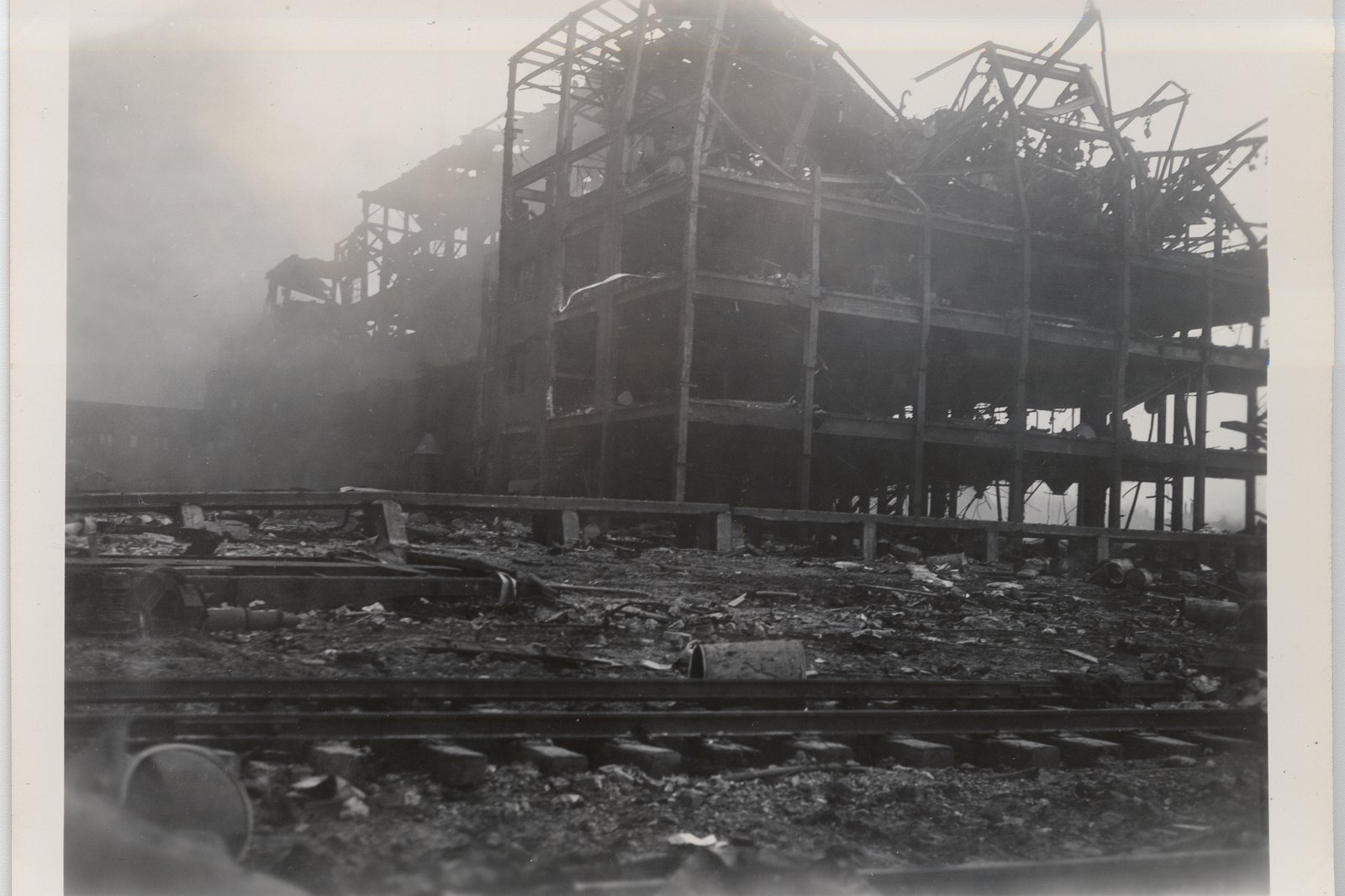
Image context: the cover uses a real 1947 disaster-scene photograph from Texas City's slip number one. It is not a technical diagram of chemistry; it is a ground-level record of what happened when a material treated as manageable crossed the boundary into port and city destruction.[8]
Two Familiar Materials, Two Bad Contexts
At Oppau, the material was ammonium sulfate nitrate, a fertilizer stored in silo Op 110. BASF's centenary account says roughly 4,500 metric tons were in the silo on September 21, 1921, when blasting work meant to loosen compacted fertilizer caused a catastrophic explosion at 7:32 a.m.[1] The practice was not a one-off improvisation. The fertilizer tended to harden during storage, and BASF says more than 20,000 loosening blasts had already been conducted without incident.[1]
That detail is the historical trap. A method can feel safe because it has worked many times, while the conditions that made it safe are quietly changing. BASF notes that the Oppau salt was a 50/50 mixture of ammonium nitrate and ammonium sulfate, and that ammonium sulfate was believed to neutralize the explosive hazard of ammonium nitrate at that ratio.[1] A 1921 Nature report captured the same contemporary confidence: the company argued that the mixed salt had been shown to be non-explosive and that explosives had long been used to break up hardened blocks without accident.[2]
Later technical reassessment makes the weakness clearer. Ulrich Horcher's 2016 review argues that the explosiveness of the mixed salt depended not only on the chemical ratio, but also on physical parameters such as particle size, density, water content, and crystal-structure homogeneity.[3] The crucial change was not a new label on the product. It was a process change: spray drying altered the physical character of the material and allowed a fine fraction richer in ammonium nitrate to accumulate near the silo edge.[3] The old practice met a new material distribution.
Texas City began differently. There was no silo-blasting routine. There was a ship fire. The city exhibit on the Grandcamp says local longshoremen had loaded about 2,300 tons of ammonium nitrate into holds 2 and 4 by April 16, 1947; shortly after workers entered the holds around 8 a.m., they smelled smoke and found a small fire below the surface.[4] Firefighters responded. The ship's captain tried to use steam to smother the fire without wetting the cargo.[4] In hindsight, that response worsened the problem, but in the moment it belonged to a practical world of cargo preservation, firefighting improvisation, and incomplete understanding.
The first blast came at 9:12 a.m. The City of Texas City account says the ammonium nitrate on the Grandcamp detonated, rupturing the ship and throwing cargo and fragments thousands of feet into the air.[5] The blast shattered windows far beyond the port, destroyed nearby industrial facilities, and killed many workers, firefighters, bystanders, and residents.[5] Then the disaster acquired a second clock: the nearby High Flyer contained about 1,000 tons of ammonium nitrate and 2,000 tons of sulfur. It caught fire and exploded at 1:10 a.m. on April 17, about fifteen hours after the Grandcamp blast.[6]
The Shared Pattern Is Management Of Change
Oppau's modern process-safety lesson is unusually direct. Horcher calls the accident a strong example of the need for Management of Change procedures.[3] The phrase is modern, but the historical mechanism is older: when a production process changes, an organization has to revalidate what it thinks it knows. Oppau had tested and practiced one operating world. By early 1921, the spray process had changed the physical form of the fertilizer. The old confidence came forward into a changed setting.[1][3]
Texas City shows a related problem at the boundary between cargo handling and emergency response. The material was not merely "on the ship." It sat beside other cargoes, fuel, heat, dock infrastructure, firefighters, spectators, and another dangerous ship. The City of Texas City's fire account says the Grandcamp also carried small-arms ammunition in a nearby hold, and that crew members feared a possible explosion even before the ammonium nitrate detonated.[4] The first explosion then pushed the High Flyer toward danger, started new fires, and made the second ammonium nitrate cargo part of the same disaster system.[6]
In other words, both catastrophes punished narrow definitions of risk. Oppau's danger could not be read from a simple chemical name alone; it lived in moisture, density, drying, particle distribution, storage, and the shock of loosening blasts.[3] Texas City's danger could not be read from one burning hold alone; it lived in cargo adjacency, firefighting tactics, pier layout, bystander behavior, refinery proximity, and the second ship's cargo.[4][5][6]
That is why the comparison matters historically. Industrial disasters often look, after the fact, like obvious warnings that someone foolishly ignored. The record is less comforting. Oppau's operators had a body of successful experience. Texas City's responders faced smoke before they faced a known mass-detonation event. The disasters became legible only when separate assumptions collided: safe mixture, safe blasting, ordinary fire, salvageable cargo, controllable dock scene.
The Public Learned Through Damage Radius
The scale of both disasters converted technical uncertainty into civic fact. BASF says Oppau's pressure wave burst windows in Heidelberg, Worms, Darmstadt, and even parts of Frankfurt more than 80 kilometers away; seismological instruments in Munich, about 300 kilometers from Oppau, registered the shock.[1] The explosion left a crater 96 meters wide, 165 meters long, and 18.5 meters deep, and damaged around 2,000 buildings, with 1,036 completely destroyed.[1]
Texas City's blast radius was no less instructive. The city exhibit says the Grandcamp explosion caused a 15-foot tidal wave, shattered windows in Houston about 40 miles away, and flattened much of the zone closest to the ship.[5] The federal Bureau of Mines investigation, preserved by the University of North Texas, treated the catastrophe as a two-ship ammonium nitrate disaster: the Grandcamp and High Flyer explosions had to be studied together through observations, collected data, testing, photographs, and technical reconstruction.[7]
These numbers matter because they show how industrial knowledge moved from plant and port specialists into public memory. Before the explosion, the relevant questions could seem technical: how a fertilizer had been dried, whether a mixed salt would detonate, whether steam should be used in a hold, how far apart dangerous cargoes should sit. Afterward, those questions became urban. Homes, hospitals, roads, rail lines, warehouses, fire departments, and family identification systems all entered the evidence.
Oppau also shows the institutional desire to preserve a boundary around the disaster. In the 1921 Nature account, BASF emphasized that the high-pressure ammonia process itself had nothing to do with the explosion and that parts of the factory were comparatively uninjured.[2] That distinction was technically important, but it also reveals a larger historical anxiety. The disaster threatened confidence not only in one silo, but in a whole modern chemical order built around nitrogen fixation, fertilizer production, and industrial scale.
Texas City carried a similar anxiety into the postwar Gulf Coast. The Grandcamp was a wartime Liberty ship renamed after Grandcamp-les-Bains and transferred to France after World War II, then loaded in Texas with ammonium nitrate for export.[4] A cargo meant for agricultural recovery and postwar circulation became the source of what the city now describes as the deadliest industrial accident in U.S. history.[5] The same material could signify abundance, reconstruction, and blast hazard, depending on context.
The Difference Is Where The Lesson Settled
Oppau's lesson settled strongly inside process history. The key later insight was not that ammonium nitrate was always explosive in the abstract. It was that the supposedly safer mixed salt could become dangerous when physical conditions changed. BASF says production of ammonium sulfate nitrate stopped after the disaster and did not resume until 1940, with a modified process.[1] Horcher's later review turns that into a process-safety lesson: do not let repeated success substitute for re-testing after process change.[3]
Texas City's lesson settled more visibly across emergency management, port safety, and cargo segregation. The second explosion shows why. After the Grandcamp blast, people knew the High Flyer was dangerous. The city account says efforts were made to detach its anchor and tow it away, but the ship could not be moved enough; when it exploded, most people had been removed from the area, which limited casualties from the second blast.[6] That sequence made warning and evacuation part of the historical record in a way they had not been before the first explosion.
There is also a memorial difference. Oppau's centenary memory, told by BASF in collaboration with Ludwigshafen, has to hold corporate history, victim memory, technical uncertainty, and reconstruction together.[1] Texas City's memory is municipal and emergency-service focused: the city exhibit emphasizes the firefighters, dockworkers, industrial workers, bystanders, medical response, and the later memorial culture around the disaster.[5][6] Both are forms of public accounting, but they answer different questions. Oppau asks how a chemical works system misread process change. Texas City asks how a port city, a ship, and an emergency scene became one blast system.
Why The Comparison Still Holds
The common thread is false familiarity. Oppau's fertilizer was familiar because it had been manufactured, stored, hardened, and blasted before. Texas City's ammonium nitrate was familiar because it was cargo, fertilizer, and part of postwar commerce. Familiarity narrowed attention. It made the material seem ordinary until heat, shock, confinement, composition, and adjacency changed what ordinary meant.
That is the comparative history worth keeping. The two disasters do not teach the same narrow lesson, but they teach the same historical discipline: industrial safety has to look for risk at the boundary between material and system. At Oppau, that boundary ran through a changed drying process and a silo full of uneven physical fractions. At Texas City, it ran through a burning hold, a crowded dock, nearby refineries, a disabled emergency service, and another ship with another load of ammonium nitrate.
The most dangerous phrase in both stories is not "ammonium nitrate." It is "we have done this before." History does not make that phrase useless. It makes it conditional. If the material, process, storage, cargo mix, response plan, or surrounding city has changed, then experience can become a stale map. Oppau and Texas City made that lesson visible in craters, wreckage, and memorial rolls.
Sources
- BASF Corporate History, "The Oppau Explosion of 1921 - Remembering a Disaster" - centenary account of timing, silo contents, process context, damage, aid, inquiry, and reconstruction.
- Nature, "The Oppau Explosion" (27 October 1921) - contemporary technical report on BASF's post-disaster explanation and assumptions about ammonium sulfate nitrate.
- Ulrich Horcher, "Oppau 1921: Old Facts Revisited," Chemical Engineering Transactions 48 (2016) - technical reassessment of composition, drying process, physical parameters, fine fractions, and Management of Change implications.
- City of Texas City, "Fire on the Grandcamp" - local historical exhibit page on the April 16, 1947 fire, cargo, firefighting response, and ammonium nitrate reaction sequence.
- City of Texas City, "First Explosion" - local historical exhibit page on the 9:12 a.m. Grandcamp detonation, blast effects, bystanders, emergency services, and regional response.
- City of Texas City, "Second Explosion" - local historical exhibit page on the High Flyer cargo, towing attempt, 1:10 a.m. April 17 explosion, and evacuation context.
- University of North Texas Digital Library, G. M. Kintz, G. W. Jones, and Charles B. Carpenter, "Explosions of Ammonium Nitrate Fertilizer on Board the S. S. Grandcamp and S. S. High Flyer at Texas City, Texas, April 16, 17, 1947" - archived 1948 Bureau of Mines investigation page.
- University of Houston Libraries Digital Collections, "Five story building beside slip #1" - 1947 Texas City Disaster photograph used as the article image.