The popular version of the 1919 eclipse story is clean enough to be suspicious: Arthur Eddington photographs a total solar eclipse, the stars shift exactly as Albert Einstein predicted, and Newton's universe gives way in a single dramatic exposure. The real history is stronger because it is messier. Eddington, Frank Watson Dyson, Charles Davidson, and their colleagues did not need one perfect picture. They needed a difficult comparison precise enough to distinguish three possibilities: no bending of light, a Newtonian-style half deflection of about 0.87 arcsecond at the Sun's limb, or Einstein's general-relativity value of about 1.75 arcseconds.[1]
That distinction makes the episode more historically interesting than the myth. The eclipse of May 29, 1919 gave astronomers a temporary screen: with the Sun covered, stars near the solar disk could be photographed and compared with their normal positions in the night sky.[1][2] Two expeditions divided the risk, one at Sobral in Brazil and one at Principe off West Africa. The data were uneven. Weather interfered. Instruments behaved differently. Some images were much more useful than others. Yet the combined result was good enough for Dyson, Eddington, and Davidson to argue in 1920 that the observed light deflection fit Einstein better than the alternatives.[1][2]
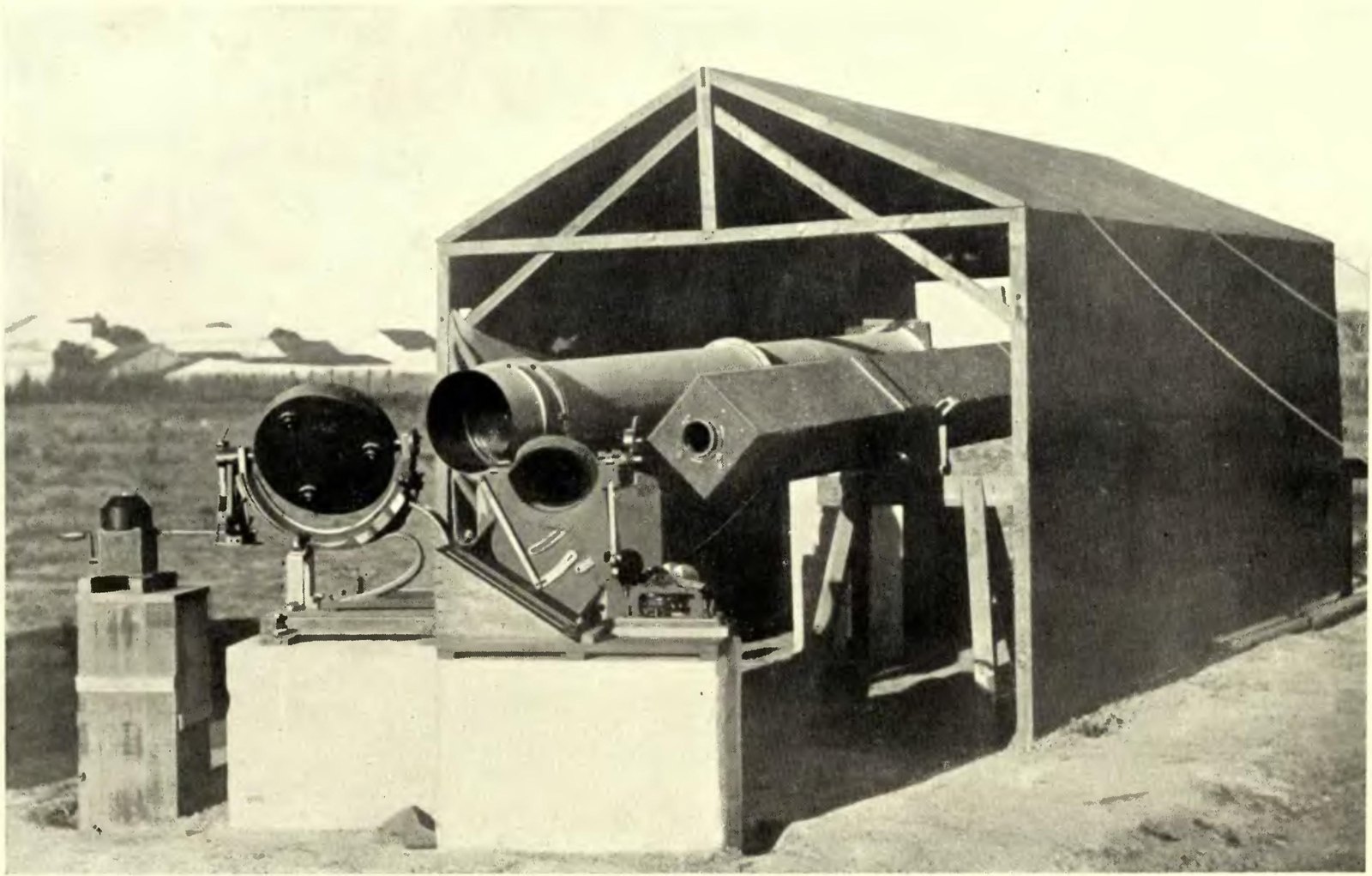
The image attached to this article keeps the event honest. It is an archival photograph of the Sobral expedition's eclipse instruments: portable apparatus, open air, improvised field conditions, and the physical awkwardness behind a measurement that later became a public symbol.[5] The myth says history changed because one photograph was perfect. The evidence says history changed because fragile observations became part of a disciplined comparison.
Myth: the eclipse produced a simple before-and-after proof
The first myth is that the eclipse "proved Einstein" in the modern sense of a decisive, high-precision laboratory result. That is too tidy. The original paper framed the test as a choice among live alternatives, not as a ceremony staged after the answer was already obvious. It explicitly named the three outcomes: no gravitational effect on light, a Newtonian value half as large as Einstein's, or Einstein's full relativistic deflection.[1]
The measurement problem was severe. The apparent shift was less than two arcseconds even for stars close to the Sun.[2] That is a tiny angular displacement, and the observers had to recover it from eclipse plates, comparison plates, scale corrections, and instrument behavior. ESA's retrospective summary is useful because it does not overstate the neatness of the result: the 1919 measurements were roughly right, but Principe and Brazil did not produce identical-looking certainty.[2]
So the historical achievement was not that Eddington returned with a magic plate. It was that the expeditions converted a philosophical and mathematical dispute about gravity into a measurable astronomical test. The eclipse mattered because it made Einstein's prediction vulnerable to observation.
Evidence: the test worked by comparison, not spectacle
Totality supplied the observational window, but the real work happened in comparison. During ordinary daylight, the Sun overwhelms stars near it. During an eclipse, those stars can appear close to the covered solar disk. If gravity bends light, their apparent positions shift outward from the Sun. The observers then compare eclipse plates with reference plates of the same star field taken when the Sun is elsewhere.[1][2]
That is why the Hyades star field mattered. ESA notes that the Sun happened to stand before a useful cluster of stars during the 1919 eclipse, giving the expeditions a better field to measure than many eclipses would have offered.[2] The opportunity was astronomical, not merely dramatic. The Moon did not "show" relativity by itself. It made a temporary measurement geometry available.
The two-site design also matters. Sobral and Principe were not redundant in the casual sense. They were a risk strategy. If one site clouded out, failed mechanically, or produced ambiguous plates, the other might still supply evidence.[2] That is exactly the kind of practical planning that the myth erases. The result survived because the experiment had been organized as a comparison across places, instruments, and reference frames, not as one heroic snapshot.
Myth: Eddington simply accepted the data he wanted
A second myth, popular in some later retellings, flips the old triumphal story into a charge of simple bias: Eddington wanted Einstein to be right, so he discarded inconvenient results. The evidence supports a more careful boundary. Eddington was certainly not neutral in the empty sense; he was one of the few British scientists who understood general relativity early and took it seriously.[2] But the data problems were also real, and the original publication did not hide that the observations had to be sorted, corrected, and judged.[1]
The important question is whether judgment automatically means fraud or special pleading. It does not. Observational astronomy often depends on rejecting plates or instruments when focus, scale, temperature, weather, or mechanical behavior make them unreliable. The 1919 eclipse plates were no exception. ESA's summary keeps the right proportion: the measurements confirmed the deflection "roughly" by the right amount, while later eclipse observations still left critics worrying about sizable error margins.[2]
Eddington's own immediate response to a proposed atmospheric-refraction objection in Nature also shows that the result was being debated in technical terms almost at once.[3] That matters historically. The announcement did not end scrutiny; it started a new public and scientific argument over how much confidence the plates could carry.
Evidence: the public result was stronger than the precision
The London announcement in November 1919 made Einstein famous because it translated a narrow observational test into a cultural event.[2][4] A German-born theorist's wartime-era theory had been tested by British astronomers just after World War I. Newton, British scientific inheritance, and a new relativistic universe all sat in the same newspaper-ready story. That public meaning exceeded the technical precision of the plates.
But "exceeded" does not mean "invented." Clifford Will's retrospective correctly treats the 1919 measurement as the first external verification of general relativity and as the beginning of a longer legacy of testing light deflection.[4] The key is scale. As a 1919 measurement, the result was limited. As a historical turning point, it was immense. It turned general relativity from a difficult theory known by specialists into a public claim about the structure of nature.
This is why the old headline version still survives. History often remembers the moment when an argument becomes visible, not the full error budget behind it. The eclipse gave Einstein's mathematics an image, a date, a meeting, and a newspaper story. That does not make the measurement fake. It means the public proof was partly scientific evidence and partly media conversion.
What later confirmation changed
Later tests changed the confidence level, not the basic importance of 1919. ESA notes that eclipse observations remained imperfect for decades and that radio astronomy and the Hipparcos satellite eventually gave much stronger confirmation of Einstein's prediction.[2] Hipparcos, operating from 1989 to 1993, measured stellar positions accurately enough that the Sun's light-bending effect no longer required waiting for an eclipse, and ESA reports confirmation to within one part in a thousand.[2]
That later precision should make the Eddington story more credible, not less. If the 1919 result had been the last word, the myth would be dangerous. Because it became the first famous word in a much longer chain of tests, it can be read in the right proportion. The eclipse plates were not modern definitive proof. They were an early, difficult, historically consequential measurement that pointed in the right direction and forced the theory into public view.[2][4]
The better version of the story
The strongest history sits between triumph and debunking. Eddington's eclipse did not overthrow Newton with one immaculate photograph. Nor was it merely a propaganda exercise dressed as astronomy. It was a fragile field experiment, designed around a rare sky geometry, built to discriminate among rival predictions, and judged under conditions where every plate had to be treated as both evidence and problem.[1][2]
That is why the 1919 eclipse still matters. It shows how scientific revolutions often become public before they become perfectly measured. Einstein's theory gained fame because the observations were persuasive enough to make a new gravitational picture credible. Later instruments made the evidence stronger. But the hinge moment remains that wet, difficult, photographic day in May 1919, when the best available plates made light itself look historical.
Sources
- F. W. Dyson, A. S. Eddington, and C. Davidson, "A Determination of the Deflection of Light by the Sun's Gravitational Field, from Observations Made at the Total Eclipse of May 29, 1919," Philosophical Transactions of the Royal Society A 220 (1920), Zenodo record and PDF.
- ESA Science & Technology, "Relativity and the 1919 eclipse" - historical summary of the expeditions, measurement difficulty, public announcement, and later Hipparcos confirmation.
- A. S. Eddington, "The Deflection of Light during a Solar Eclipse," Nature 104 (1919) - contemporary response to a proposed systematic-error objection.
- Clifford M. Will, "The 1919 measurement of the deflection of light," arXiv:1409.7812 - retrospective on the measurement's history and later testing legacy.
- Wikimedia Commons, "Eclipse instruments at Sobral" - archival photograph of the instruments used by the British expedition observing the May 29, 1919 total solar eclipse from Sobral, Brazil.