
The Golden Gate Bridge did not become public first as a highway. It became public as a walk. On May 27, 1937, the new span opened from dawn to dusk for Pedestrian Day, a one-day civic experiment before automobile traffic began the next day.[2][3] That sequence matters. San Francisco and Marin were not only being connected by a toll road. For one day, the bridge was handed to bodies before it was handed to vehicles: walkers, runners, roller skaters, unicyclists, musicians, people pushing baby carriages, and people determined to set some private "first" on a structure built for regional movement.[2][5]
The short archival film embedded below is rough, but that roughness is part of its value.[1] It does not offer a polished engineering explanation, a drone's perfect geometry, or the familiar postcard bridge hovering in fog. It shows the bridge at the moment when completion had to be socially absorbed. The camera watches people move across a new public surface that was still strange enough to deserve ritual. They are not merely using infrastructure. They are helping certify it as shared space.
The deeper historical point is that the bridge's first public day translated an intimidating Depression-era megaproject into local proof. The Federal Highway Administration's fact sheet describes the financial and technical scale: a $35 million bond-backed project, construction from 1933 to 1937, a 4,200-foot main span that was then the world's longest suspension bridge span, 746-foot towers, and a safety regime that still could not prevent eleven worker deaths.[4] Those facts establish the bridge as an engineering and finance achievement. Pedestrian Day shows what had to happen after engineering succeeded. A population needed to cross it, look over the rail, feel the wind, and turn a newly finished machine into a place.
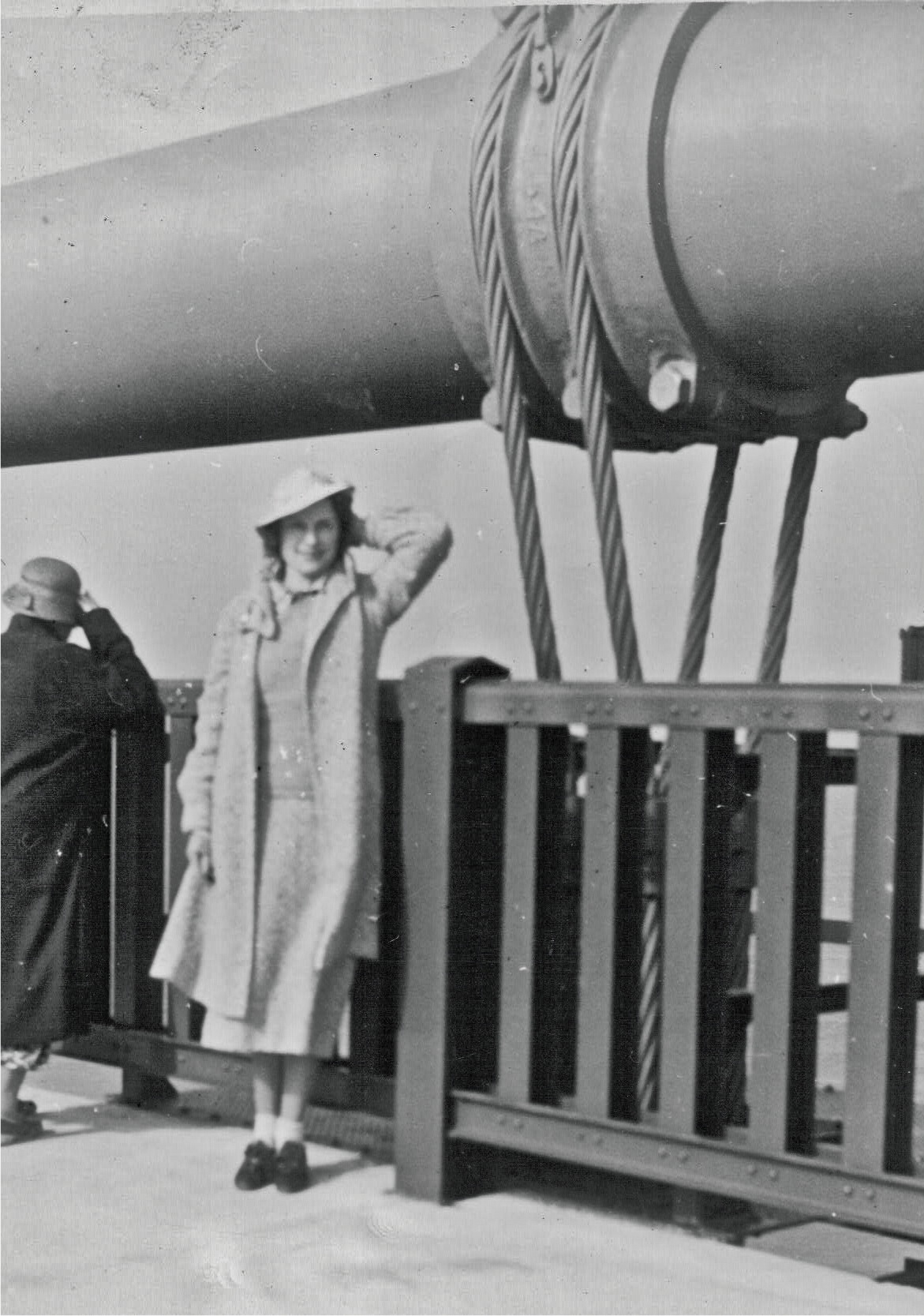
Image context: the lead photograph is deliberately intimate rather than panoramic. Annell Euler stands by the railing during the 1937 opening period, close enough that the wrapped cables and barrier details become tactile.[6] The article is about that scale of encounter. The bridge became famous as a skyline object, but on Pedestrian Day its meaning was produced through ordinary people meeting its edges, handrails, roadway, toll gates, and height.
Historical Context: An Impossible Bridge Becomes A Scheduled Day
The bridge had accumulated doubt for decades before anyone could walk it. The Golden Gate Bridge and Highway District timeline places the financing and administrative turn in the late 1920s and early 1930s: the District was incorporated in 1928, Joseph Strauss was appointed chief engineer in 1929, the War Department issued a final permit in 1930, voters approved the $35 million bond issue in 1930, and construction officially began on January 5, 1933.[3] That sequence matters because the bridge was not built by technical confidence alone. It required a public authority, county-backed finance, military permission, engineering design, and political tolerance for risk.
The construction record also complicates the celebratory film. The official timeline notes repeated construction hazards: access-trestle damage in storms and fog, tower and cable milestones, the installation of a safety net under the suspended structure in 1936, and the fatal scaffold accident on February 17, 1937, when ten men died after timber fell through the net.[3] FHWA's summary likewise emphasizes both the unusual safety measures and the eleven deaths.[4] Pedestrian Day therefore came only a few months after the project's worst loss. The festive crossing did not erase that cost. It sat on top of it.
That tension gives the opening its force. By late May, the bridge had to stand for more than successful steelwork. It had to persuade people that the dangerous work had produced a reliable civic object. The official Opening Fiesta account describes a week-long celebration from May 27 to June 2, 1937, with pageants, fireworks, parades, formal programs, proclamations, toll rules, and traffic rules.[2] This was not simply a ribbon cutting. It was a choreography of acceptance.
The Archival Footage
The embedded video is the public YouTube upload titled "Golden Gate.mpg", which preserves period moving images of the 1937 opening festivities and Pedestrian Day. The Golden Gate Bridge Highway and Transportation District's key-dates page points readers to a YouTube Pedestrian Day film, and its Opening Fiesta page separately frames the surviving film as "poor quality but fun" footage of Pedestrian Day and Opening Day.[1][2][3] That provenance is imperfect in the way many local moving-image archives are imperfect: a public transfer, sparse metadata, and a title that is more file label than curatorial description. For an archival spotlight, the value is still clear. The footage gives us bodies in motion on the newly opened bridge before routine traffic normalized it.
What The Film Shows That The Finished Bridge Hides
The first thing to notice is the absence of ordinary traffic logic.[1] A bridge built to shorten regional movement appears, temporarily, as a promenade. That reversal is historically revealing. The next day, May 28, President Franklin D. Roosevelt pressed a telegraph key from the White House to announce the span open to the world, and automobile traffic began at noon.[2][3][5] But on May 27, the roadway belonged to people moving at walking speed. The bridge's function was suspended so its meaning could be rehearsed.
The official Fiesta account makes the day sound almost carnival-like: an estimated 18,000 people waiting by 6:00 a.m., roughly 15,000 visitors per hour passing through turnstiles, 25-cent pedestrian tolls, hot dog stands, and a list of firsts that included roller skaters, mail carriers, a rope carried by Boy Scouts, and a lost child who was found.[2] PBS's account gives the same social texture from another angle, with people walking backward, carrying objects, tap-dancing, playing music, and treating the crossing as a stage for small performances.[5] That is the key to reading the footage. The bridge is not yet background. It is the event.
This changes how the engineering achievement should be understood. The common postcard view emphasizes span, towers, color, and setting. Pedestrian Day emphasizes scale against the body. A 4,200-foot main span is an abstraction until people begin to cross it.[4] Height becomes real through leaning, pausing, crowding, and looking outward. Wind becomes part of the ceremony. Distance becomes a queue. The film catches that transformation better than a still technical drawing could.
The second thing the footage preserves is confidence as a public act.[1] Engineers had already calculated loads, cables, foundations, and deck behavior. Officials had already accepted the project. But mass infrastructure still asks for another kind of acceptance: the willingness of ordinary people to step onto it. That willingness can look casual after the fact. In 1937 it had to be made visible. A crowd on the bridge was not only a crowd. It was a demonstration that the new crossing could hold civic imagination as well as physical load.
The third thing to notice is sequencing. Pedestrian Day came before vehicular opening, but it also belonged to a longer program of pageants, speeches, fireworks, fleet movements, aviation display, and ceremony.[2] The bridge was being introduced through multiple registers at once: local fun, regional pride, national announcement, military spectacle, and transportation modernization. The film's charm lies in the fact that it does not keep those registers separate. A person clowning across the roadway and a civic authority dedicating the bridge are part of the same historical process. Both are forms of adoption.
Legacy: The First Crossing Was Not A Footnote
Pedestrian Day looks quaint only if the later bridge is treated as inevitable. It was not inevitable to the people who financed it with local collateral, worked above dangerous water, watched the fatal scaffold accident enter the construction record, or paid to cross on the first morning.[2][3][4] The day mattered because it converted risk into use. Once people had walked the roadway, the bridge was no longer only Strauss's project, the District's project, or a bondholder's project. It became something the region had physically claimed.
That is why the 1987 fiftieth-anniversary Bridgewalk drew such strong memory. PBS notes that roughly 300,000 people stepped onto the roadway for the anniversary event, consciously echoing Pedestrian Day 1937.[5] FHWA's fact sheet adds the engineering afterlife: officials expected far fewer people, and the crowd caused visible roadway deflection, though the bridge remained within design movement allowances.[4] The anniversary is not the subject here, but it proves that the original pedestrian opening had become the bridge's civic template. When the region wanted to remember the bridge, it did not remember by staging a traffic jam. It remembered by walking.
The archival film matters now because it keeps that first public meaning alive.[1] Before the Golden Gate Bridge became a commute corridor, a tourist image, a maintenance obligation, and a global symbol, it was a temporary civic room suspended across a strait. People entered it with hats, stunts, instruments, toll coins, nerves, and curiosity. The film lets us see the bridge in that brief interval before routine swallowed wonder: completed, not yet ordinary; engineered, not yet absorbed; public because people were walking it into history.[1][2][5]
Sources
- Albert Wagner, "Golden Gate.mpg" - YouTube video preserving period footage of Golden Gate Bridge opening festivities and Pedestrian Day.
- Golden Gate Bridge Highway and Transportation District, "Opening Fiesta Week, May 27 to June 2, 1937" - official account of Pedestrian Day, Opening Day, ceremonies, tolls, crowds, and festivities.
- Golden Gate Bridge Highway and Transportation District, "Key Dates - Moments & Events" - official timeline for financing, permitting, construction, safety net, fatalities, Pedestrian Day, and vehicular opening.
- Federal Highway Administration, "Golden Gate Bridge 1937" - fact sheet on bond finance, construction dates, main-span length, towers, cables, safety measures, worker deaths, and later bridge behavior.
- PBS American Experience, "The Golden Gate Bridge's Opening Day and its 50th Anniversary" - narrative context on Pedestrian Day behavior, the vehicle opening, and the 1987 anniversary walk.
- Wikimedia Commons, "File:GoldenGateBridge openingday.jpg" - source page for the 1937 opening-period photograph used as the article image.